Your product content doesn’t stay the way you uploaded it. You hit publish. Everything looks right. But the moment your data hits a retailer’s system, it’s out of your hands. Their formatting rules kick in. Character limits cut your titles short. Attribute structures don’t match yours. Bullet points get rearranged. Key details get dropped entirely. It is because that’s just how their system works.
These are small issues on paper, but real damage at scale. Without proper e-commerce product data management, you don’t fully control what goes live. And there’s no way to manually verify thousands of product pages across multiple retailers without missing something. That’s the reality of selling at scale. And it only gets harder as your catalog grows.
In this article, you’ll see exactly why product content breaks down as you scale, what’s actually driving it, and how leading teams monitor product content accuracy across thousands of SKUs without manual audits, patchy reports, or building anything in-house.

What Product Content Accuracy Means for Your Business
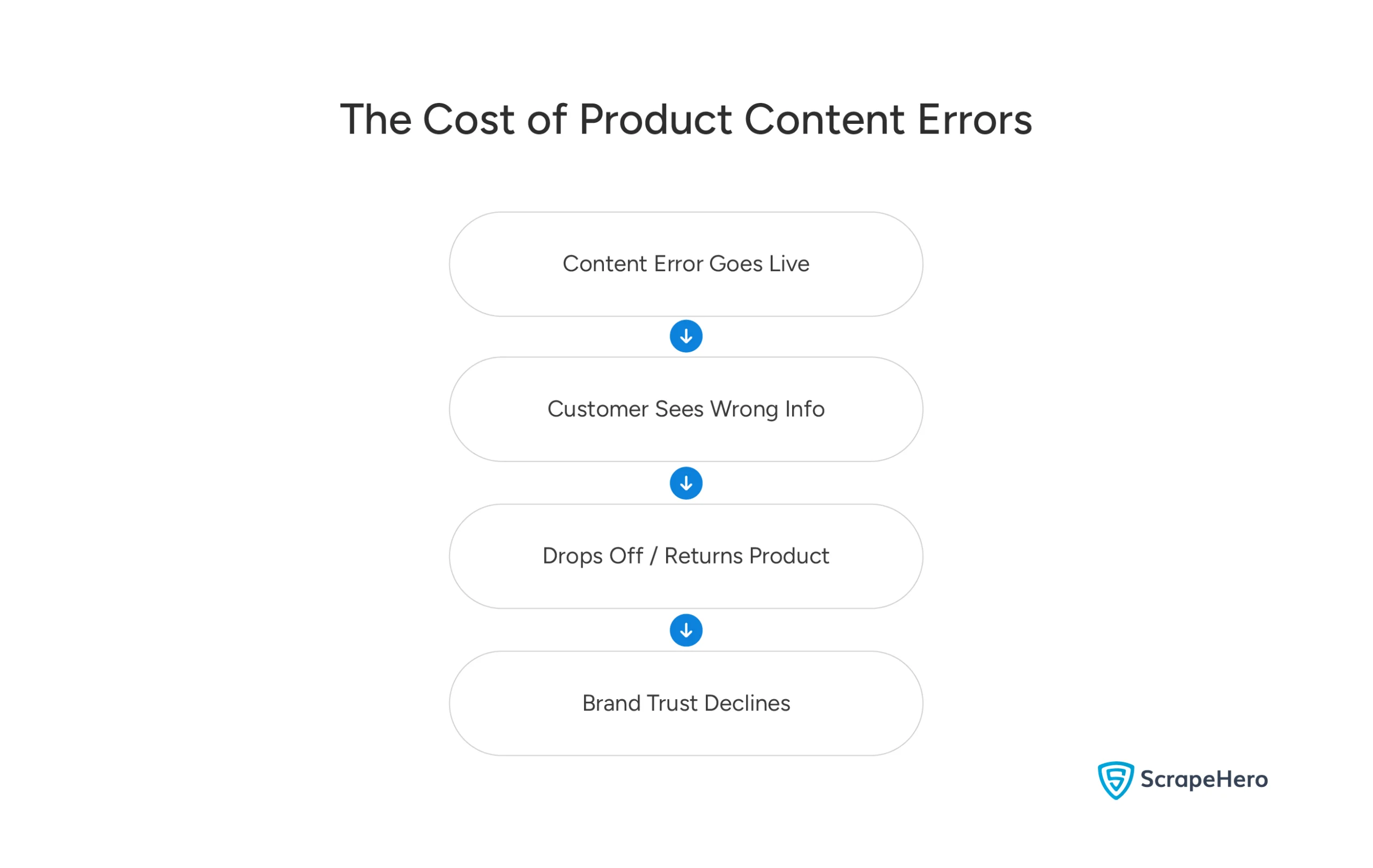
Product content errors don’t stay contained. They hit your conversion rate, drive up returns, slow your team down, and quietly erode the trust customers have in your brand.
For any brand serious about e-commerce product data management, the real risk lives in what’s rendering live across every retailer you sell on.
Here’s how it affects your business:
- Speed
- Conversions
- Returns
- Brand Trust
Speed
Content errors don’t announce themselves. You find out after a customer complains, after returns spike, or after a review goes live, which means a huge gap between when an error goes live and when your team fixes it.
Conversions
A customer deciding whether to buy is looking for reasons to confirm or abandon. An image that doesn’t match the selected variant is a reason to leave. A missing dimension is a reason to leave. Such small mistakes, across thousands of SKUs, add up fast.
Returns
Most returns stem from a gap between what the listing said and what arrived. Wrong dimensions, missing material info, and an image that didn’t match the actual product as customers ordered based on what they saw, not what they got.
Brand trust
Trust is built by consistency. When a customer sees the same accurate information, correct images, right specs, and matching variants across Amazon, Walmart, and your D2C site, your brand starts to feel reliable. When listings contradict each other across retailers, it doesn’t. That inconsistency is quiet, but it accumulates in how customers decide whether to buy from you again.
Every content error that slips through costs you somewhere a lost sale, a returned order, a customer who doesn’t come back. Fixing that starts with one thing: visibility into what’s actually live.
Why Traditional Approaches Break Down
Content accuracy is manageable when your catalog is small. It stops being manageable the moment you scale, and most brands don’t notice the shift until the damage is already visible.
Why scale breaks everything
- You’re managing thousands of products across Amazon, Walmart, D2C, and quick commerce platforms simultaneously
- Each retailer has its own content structure, update cycles, and listing rules
- Your product data isn’t static; pricing, inventory, promotions, and content edits are all shifting at once
- There’s no unified way to track differences across retailers or catch something the moment it breaks
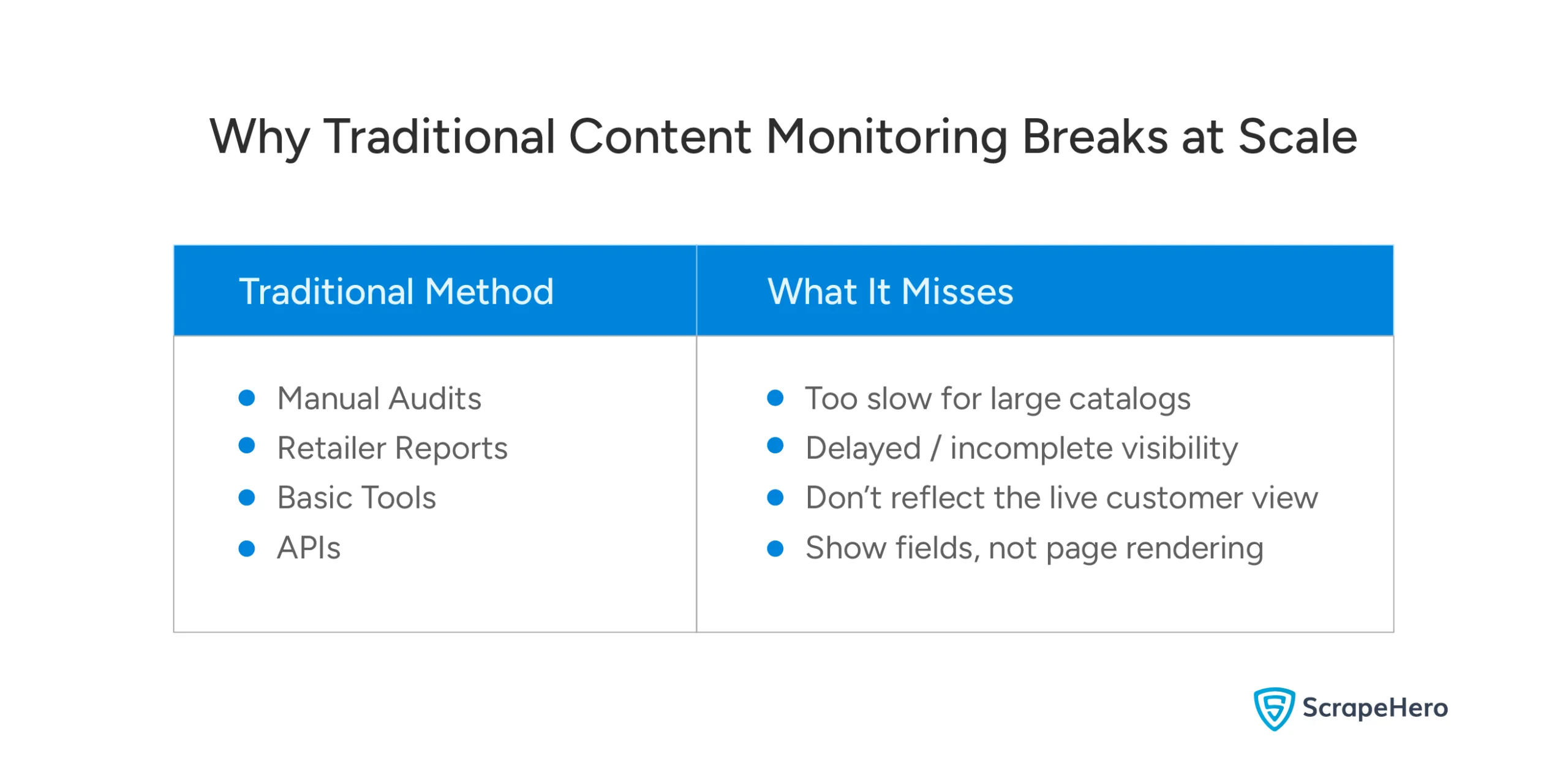
The tools and processes your team is using weren’t built for the scale you’re operating at.
- Manual audits
- Retailer reports
- Basic e-commerce tools
Manual audits
Pick a set of high-priority SKUs, review them periodically, and flag what looks wrong. It works when your catalog is small. But the moment you’re managing hundreds or thousands of products across multiple retailers, it falls apart.
Retailer reports
They feel like a safety net. They’re not. They’re delayed, limited to certain fields, and built around the retailer’s priorities. By the time an issue surfaces in a report, it’s already affected performance. You’re not getting visibility. You’re getting a recap of damage that’s already done.
Basic e-commerce tools
They’ll flag a missing attribute or catch an inconsistency in structured data. But they don’t see what your customer sees. They can’t tell you:
- How a listing renders on a mobile device
- How an image displays for a specific variant
- How a third-party seller has rewritten your product description
Every approach you’re using right now was designed for a smaller, simpler operation than the one you’re running today. You’re not working with complete information. You’re making calls based on partial data. That gap is where most content accuracy problems live, invisible, undetected, and compounding every single day.
What most teams are missing is a proper e-commerce content audit process that runs continuously, not just when someone remembers to check.
What You Actually Need (But Most Teams Don’t Have)
Solving content accuracy at scale starts with one thing: visibility. Not internal visibility. Not what your system says is live. A clear view of what your customers are actually seeing on live product pages right now. Without that, every decision you’re making is a guess.
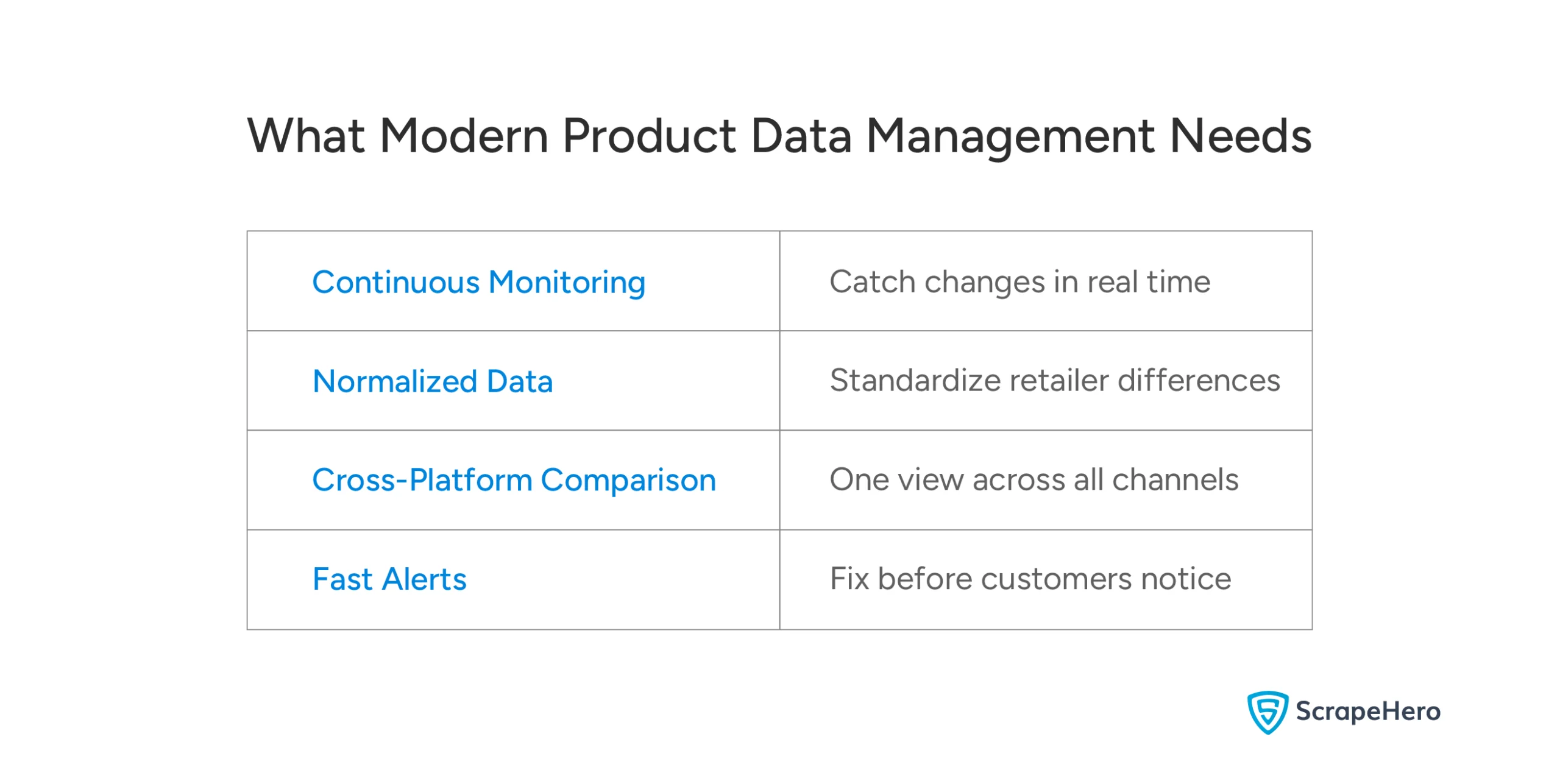
Most teams check listings weekly or monthly and assume things stay stable in between. They don’t. What you actually need is four things:
- Continuous monitoring: Tracking that catches changes as they happen, before they affect buying decisions.
- Normalized data: Every retailer structures content differently. Raw comparisons across platforms don’t work. The data has to be standardized first, or you’re missing what actually matters.
- Cross-platform comparison: One consistent view across every retailer, every SKU, every attribute. Not five different dashboards you’re toggling between.
- Speed: Catching an issue is useless if your customer gets there first. You need alerts that flag discrepancies early enough for your team to act.
Most brands already know they need this. They just keep hoping their current setup will eventually be enough. It won’t. Without these four things, content accuracy stays reactive. You’re always cleaning up. But with the right setup, it becomes something you actually control.
This is also where product information management (PIM) systems start to show their limits. A PIM keeps your internal data clean and approved, but it has no visibility into what’s actually rendering on live retailer pages. That gap is exactly where content accuracy breaks down.
Why Web Scraping Becomes Non-Negotiable
Most teams try APIs first. It makes sense as they’re clean, structured, and easy to work with. But APIs don’t show you what your customer sees. They return fields. They don’t capture how content is actually rendered on the page. Truncated titles, missing images, dropped attributes none of that shows up in an API response. You’re getting data, not reality.
Retailer dashboards aren’t the answer either. They’re not built for live monitoring. They show you what the platform decides to show you, on their timeline, with their limitations.
These are the core limitations most teams don’t see until it’s too late. E-commerce product data management extends all the way to what’s actually live on the shelf.
To see what your customers see, you need to pull from the source, the live product page. That’s what web scraping does. It pulls data directly from retailer websites, at scale, continuously:
- Titles, descriptions, images, and attributes exactly as they appear to a customer
- Pricing and availability as it stands right now, not what was reported
- The actual rendered page, not a sanitized API response
Observed data shows what’s on the page; reported data shows what the system recorded. That’s the gap you’re currently flying blind across.
However, building a web scraping infrastructure in-house is harder than it looks. Here’s what the real work looks like:
- Retail websites change constantly. A small layout update can break your scraper overnight, with no warning
- Product pages aren’t designed for clean extraction. Titles, attributes, images, and pricing are scattered in unstructured formats
- You need normalization, because one retailer lists weight in pounds and another in kilograms
- You need validation logic, because not every difference is actually an error
- All of this has to run continuously, across thousands of pages, without breaking
Here’s what nobody tells you when you decide to build this in-house: maintaining scrapers becomes a full-time job that has nothing to do with fixing your actual content problems.
Most teams hit this wall fast. The infrastructure takes over. Engineers spend more time keeping the system alive than using the data it produces. As a result, the content accuracy problem stays exactly where it was.
A proper product page audit that ecommerce teams actually need isn’t a one-time check. It’s a continuously running system that pulls live data, normalizes it, and surfaces discrepancies automatically. That’s what in-house builds rarely become.
The Smarter Approach: Managed Web Scraping for Content Accuracy
The decision is whether you build it in-house or hand it off so your team can focus on what actually matters.
What happens when you build in-house
- Six months in, your engineers aren’t improving ecommerce product data accuracy; they’re fixing scrapers
- Retail sites change, pipelines break, and smart, expensive people end up doing infrastructure maintenance
- The hidden costs never show up in the original plan
What a managed approach looks like instead
- Experts handle extraction, cleaning, maintenance, and delivery
- Your team receives structured, ready-to-use data, not raw HTML that needs three more steps
- Missing attributes get flagged automatically
- Mismatches across platforms get surfaced before your customers find them
- Your team stops chasing errors and starts fixing them
Content accuracy stops being something you react to. It becomes something you control. For a business managing thousands of SKUs across multiple retailers, that shift is worth more than any scraper your engineers could build.
How ScrapeHero Ensures Product Data Accuracy
ScrapeHero handles the entire web scraping lifecycle, including extraction, cleaning, structuring, and maintaining data pipelines. Broken scrapers, shifting page layouts, inconsistent outputs, that’s not your team’s problem anymore.
What you get:
- Clean, structured product page data reflecting exactly what’s live across every retailer
- Automatic flagging of missing attributes, mismatched content, incorrect images, and pricing inconsistencies
- Data that plugs directly into your existing dashboards, internal tools, or operational systems
- No internal engineering effort to build or maintain
- No scrapers quietly breaking overnight
- No blind spots across your product catalog
Most brands spend years trying to patch together this kind of visibility. The ones who get there fastest stop building and start with infrastructure that’s already running.
Wrapping Up: How to Track Product Data Accuracy
You can have the best systems, the strongest processes, and the most dedicated team in the room. But if you can’t see what’s on your retailer pages right now, product content errors will keep slipping through. They show up in your conversion rate, your return rate, and eventually, in how customers talk about your brand.
What won’t save you at scale?
- Manual checks
- Retailer reports
- Disconnected tools that only see part of the picture
What works?
- Accurate product page data pulled directly from live retailer pages
- Automatic comparison against what should be there
- The ability to act before a customer finds the problem first
That’s exactly what ScrapeHero’s web scraping service does. Our fully managed e-commerce product data management means you get continuous visibility across every SKU and every retailer.
Running a proper e-commerce content audit shouldn’t require a team of engineers or a week of manual checks. It should be automatic, continuous, and already done by the time your morning starts.
Every day without proper product data management is another day of errors your team isn’t catching. See how ScrapeHero fixes that.
FAQs
Product data management is the process of organizing, maintaining, and controlling all data related to your products, including specifications, images, attributes, and descriptions across every channel you sell on. It ensures the right product information reaches the right place accurately and consistently.
PDM (Product Data Management) focuses on managing product information and content across sales channels like titles, attributes, images, and descriptions. PLM (Product Lifecycle Management) goes broader, covering the entire lifespan of a product from design and engineering through manufacturing and end of life.
The 4 pillars of data management are accuracy, consistency, accessibility, and governance. Together, they ensure your product data is correct, uniform across platforms, easy to retrieve, and controlled by clear ownership so content errors don’t slip through and scale into real business damage.
Product content accuracy is how closely your live product listings match the approved information in your internal systems across every retailer and platform you sell on. When titles, images, attributes, and descriptions reflect exactly what your customers should see, that’s accurate product content.