Most e-commerce brands are sitting on data they’re not using.
Pricing trends, availability gaps, and content errors across platforms. All of it is trackable, and all of it affects revenue. Most brands are either checking it too late or not at all, and that’s lost revenue, day after day.
Without a proper digital shelf monitoring strategy, you’re flying blind while your competitors aren’t. The brands winning right now know what’s happening on their shelf before it becomes a problem. They catch a pricing gap before a competitor does. They fix a content error before it tanks a conversion. They see an availability issue before a customer bounces.
That kind of visibility doesn’t require a massive team. It requires tracking the right metrics in real time. In this article, we break down the exact metrics you should track and how to start closing those gaps to protect your revenue.
Key Metrics to Track for Digital Shelf Monitoring
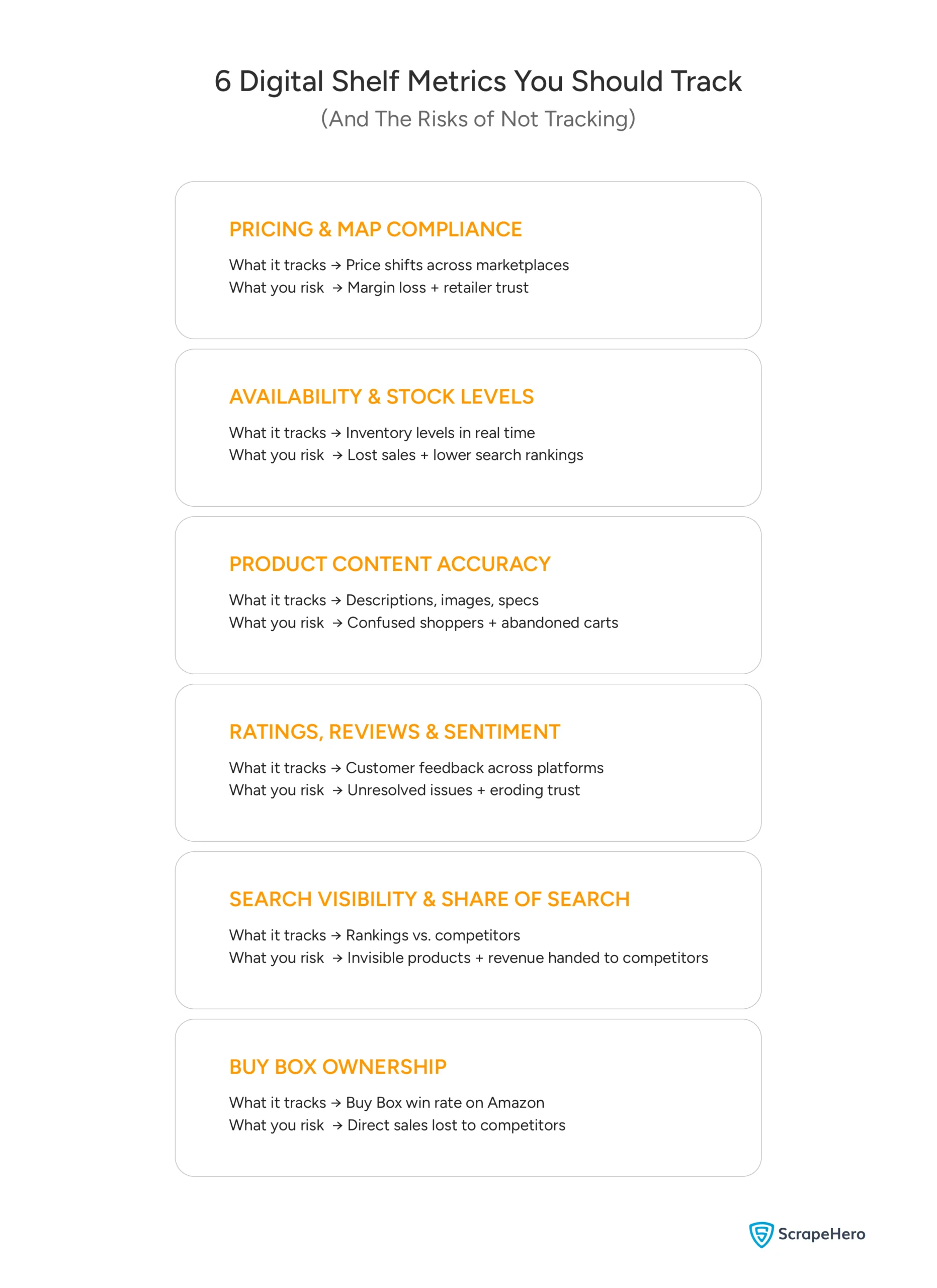
You can’t improve what you’re not measuring. If you’re running an e-commerce business, these are the metrics that directly move the needle on visibility, sales, and how customers see your brand.
- Pricing and MAP Compliance
- Availability and Stock Levels
- Product Content Accuracy
- Ratings, Reviews, and Sentiment
- Search Visibility and Share of Search
- Buy Box Ownership
Pricing and MAP Compliance
Price shifts on large marketplaces happen fast and hit your margins harder than most brands expect. Staying within MAP guidelines matters because violations don’t just cost you money; they cost you trust. This is where the MAP monitoring ecommerce teams rely on becomes non-negotiable. It allows you to track pricing in real time, and your pricing will stay consistent across all the places that matter.
Availability and Stock Levels
Running out of stock is a ranking problem as much as a logistics one. When your product goes out of stock, platforms push it down in search results, and getting that position back takes time you don’t have.
That’s why keeping a close eye on inventory means your products are there when customers are ready to buy, and your brand stays reliable in their eyes.
Product Content Accuracy
A confused customer doesn’t buy.
If your descriptions are incomplete, your images are inconsistent, or your details don’t match across platforms, you’re losing conversions you didn’t know were possible.
Your product listing is doing the selling when no one else is in the room. So, tracking it regularly keeps everything accurate, optimized, and working across every platform you’re on.
Ratings, Reviews, and Sentiment
Your customers are talking. The question is whether you’re listening. Ratings and reviews are signals that tell you what’s working and what’s quietly killing your conversions. Brands that monitor sentiment regularly catch problems early and fix them before they compound.
Beyond that, responding to reviews builds the kind of trust that actually influences whether a stranger buys from you or scrolls past.
Search Visibility and Share of Search
If customers can’t find you, it doesn’t matter how good your product is. Tracking your search rankings and share of search shows you exactly where you stand against competitors in your category.
On marketplaces like Amazon, visibility drives revenue directly. So, optimizing your content for better rankings keeps your products in front of people who are already looking for them. This is a core part of digital shelf optimization that most brands overlook until it’s too late.
Buy Box Ownership
Most purchases on Amazon happen through the Buy Box, and most brands don’t track it closely enough. If you’re not winning it consistently, you’re handing sales to a competitor, sometimes without realizing it.
Your pricing, stock levels, and seller metrics all affect your chances. So, monitoring your Buy Box performance tells you what’s working in your favor and what’s costing you the win.
- Untracked data is lost revenue.
- Pricing shifts hit margins fast.
- Real-time MAP monitoring is non-negotiable.
- A stockout tanks your search rankings, too.
- Incomplete product content kills conversions.
- Reviews are signals, not just feedback. Ignoring them compounds the damage.
- Search visibility and Buy Box ownership directly determine how much you sell.
- The brands winning see problems before they happen.
Challenges in Monitoring Digital Shelf at Scale
Knowing what to track is one thing. Actually tracking it across thousands of SKUs and multiple marketplaces is where most brands hit a wall. It’s an execution problem, and without the right ecommerce monitoring tools, it gets overwhelming fast.
- Handling Multiple Marketplaces and Retailers
- Frequency of Data Updates
- Monitoring Large SKU Sets
- Data Refresh Cycles
Handling Multiple Marketplaces and Retailers
Amazon, Walmart, eBay, they all play by different rules. Different pricing models, different data structures, different ways of presenting your product to customers. As a result, monitoring listings, stock levels, and competitor activity across all of them manually means constantly working with fragmented data that makes you miss things with a direct cost.
Frequency of Data Updates
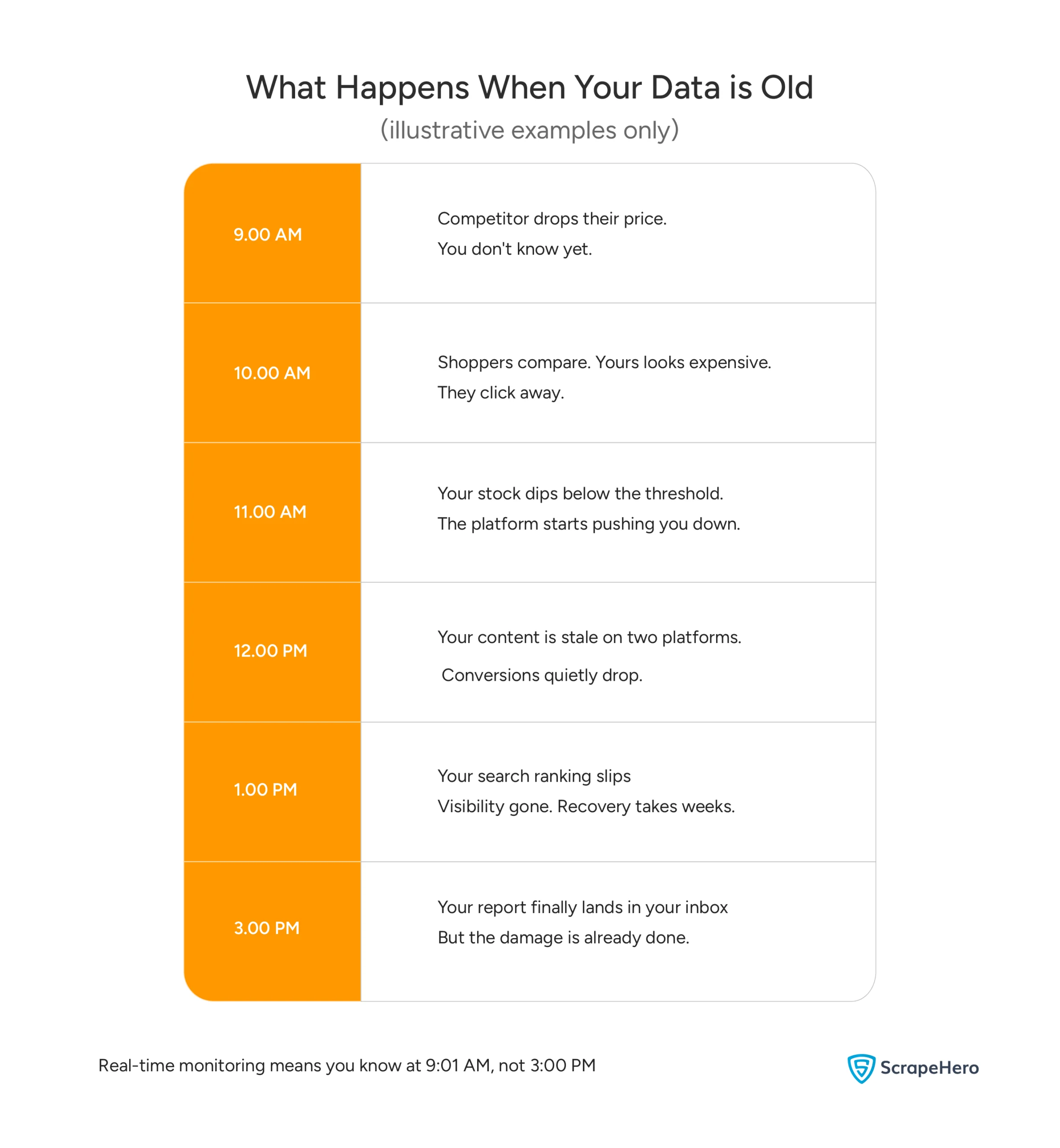
Market conditions don’t wait for your next scheduled report. Prices shift, stock levels change, and content gets updated constantly. Working with data that’s even a few hours old means you’re already behind. Lack of real-time or hourly updates is the reason you are making decisions based on information that’s no longer true.
Monitoring Large SKU Sets
The bigger your catalog gets, the more invisible your problems become. When you’re managing thousands of SKUs, ecommerce product monitoring becomes impossible to do manually. As a result, critical issues slip through, and you don’t find out until they’ve already affected the numbers.
Data Refresh Cycles
A lag in pricing data means you could be violating MAP without knowing it. A delay in availability updates means a stockout goes unnoticed while your rankings quietly drop. The speed at which your data refreshes is directly tied to how fast you can respond to what’s happening in the market. Slow data equals slow decisions, and slow decisions equal lost revenue.
Without the right solution, all of this becomes a bottleneck that holds your entire operation back. Only automation can keep your data accurate, your team focused, and your business moving at the speed the market demands.
Challenges in Overcoming Data Gaps
Fragmented data has a price tag. When your information is scattered across platforms and none of it lines up, you’re making educated guesses, and in e-commerce, guesses have a cost.
- Data Fragmentation Across Platforms
- Need for Clean and Structured Data
- Need for Real-Time Alerts and Benchmarks
Data Fragmentation Across Platforms
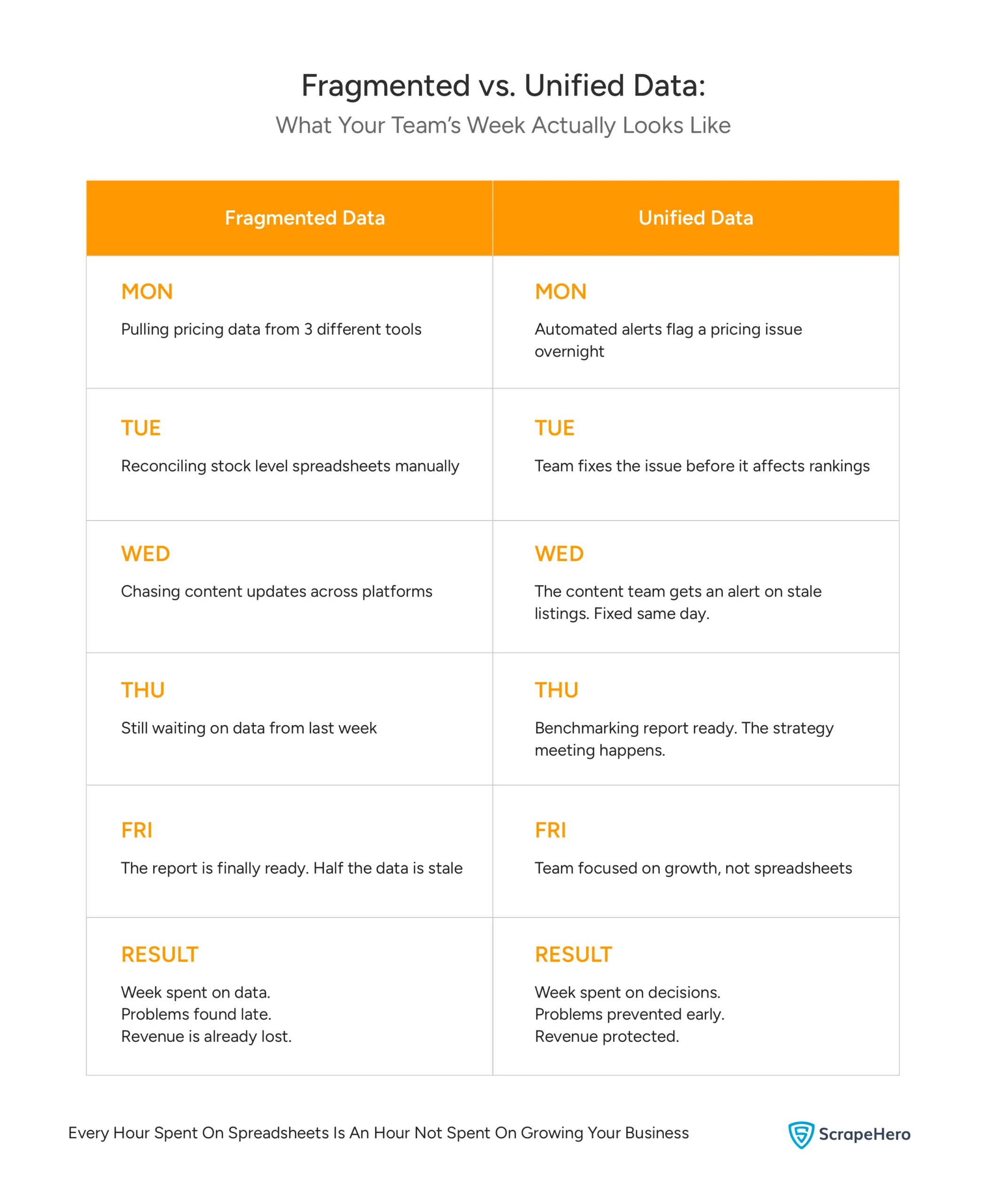
Fragmentation looks like this in practice. Your pricing data lives in one place, your stock levels in another, and your content performance somewhere else entirely. None of it’s talking to each other. So instead of your team focusing on growth, they’re spending hours manually pulling data together. Every hour spent reconciling spreadsheets is an hour not spent on decisions that drive revenue.
Need for Clean and Structured Data
Product descriptions, reviews, and ratings pulled from multiple platforms mean nothing if they’re not standardized and comparable. But clean and structured data is what lets you spot a trend before it becomes a crisis, catch an issue before it hits your bottom line, and make strategic calls with actual confidence.
Need for Real-Time Alerts and Benchmarks
Checking your metrics once a day is catching up, not monitoring. By the time you notice a pricing issue or a content error, it’s already been affecting your sales for hours. Real-time alerts notify your team the moment something shifts, so you’re responding while the problem is still small.
Similarly, clear benchmarks mean you’re not just reacting. You’re measuring your performance against competitors and knowing exactly where you stand.
So, fixing data gaps is a competitive move. Clean, structured, real-time data is what separates brands that react to the market from brands that stay ahead of it.
How to Turn Data into Actionable Insights
A gap between what your data is telling you and what your team is actually doing is a revenue gap. The brands winning on the digital shelf aren’t just collecting insights. They’re acting on them fast.
- Automating Actionable Alerts
- Cross-Functional Team Integration
- Benchmarking and Competitive Monitoring
Automating Actionable Alerts
By the time a weekly report lands in your inbox, a competitor has already adjusted their pricing, your stock has dipped below threshold, and your content is sitting outdated on three different platforms. Automating real-time alerts means your team isn’t hunting for problems. Instead, the problems surface immediately and get fixed quickly.
Cross-Functional Team Integration
Insights stuck in one department don’t drive revenue. Your pricing team doesn’t know what the content team is seeing. Your marketing team is running campaigns without the full picture. Digital shelf data only works when it moves across your entire organization.
As a result, pricing adjusts based on competitor data, and content responds to customer feedback.
Everyone’s working from the same information toward the same goal, and that alignment hits the bottom line directly. If content and campaign optimization is outsourced to a reliable SEO partner, that alignment across teams becomes easier to maintain.
Benchmarking and Competitive Monitoring
You need to know what your competitors are doing. Competitive benchmarking shows you exactly where you stand, what pricing trends are emerging, and which promotional tactics are gaining traction in your category. Brands that monitor their competitive landscape consistently aren’t reacting to the market. Instead, they’re anticipating it, and that’s a completely different position to be selling from.
How ScrapeHero’s Web Scraping Service Solves Digital Shelf Monitoring Challenges
ScrapeHero is built to fix exactly the fragmented data, the slow refresh cycles, and the missed pricing changes. Not as a workaround, but as the infrastructure that makes real digital shelf monitoring possible.
Continuous, Scalable Monitoring
Whether you’ve got 500 SKUs or 50,000, ScrapeHero tracks them across every marketplace and retailer in real time. As your catalog grows, the system tracks every new addition automatically. So, your team stops manually checking listings and starts spending that time on work that actually moves the business forward.
Real-Time Data Collection and Alerts
Acting on outdated pricing data costs you MAP compliance. Missing a stockout costs you rankings. To address both, ScrapeHero collects pricing, stock levels, and product content in real time, and the moment something significant changes, your team is notified before it has a chance to affect sales or customer experience.
Structured, Clean Data
Raw data from multiple platforms comes in different formats, different structures, and different levels of completeness. ScrapeHero standardizes all of it into a single unified structure. No more reconciling spreadsheets. No more questioning whether the numbers are accurate. Just data that’s ready to act on the moment you need it.
- Shelf monitoring isn’t optional. It’s the difference between owning your shelf and losing ground quietly.
- The six metrics that matter most: pricing, availability, content accuracy, ratings, search visibility, and Buy Box ownership.
- Manual tracking doesn’t scale. Automation is the only way to stay accurate across thousands of SKUs.
- Fragmented data costs you time, money, and decisions. Clean, structured data fixes all three.
- Real-time alerts turn your team from problem-hunters into problem-preventers.
- When shelf data moves across every department, the entire organization performs better.
- ScrapeHero gives you the infrastructure to monitor, respond, and stay ahead before the damage is done.
Final Thoughts
Pricing shifts, inventory gaps, and content errors don’t announce themselves. They compound quietly, and by the time they’re visible, they’ve already cost you. The brands doing it well have the right e-commerce monitoring tools and a clear digital shelf optimization strategy backing every decision they make.
ScrapeHero’s web scraping service gives you the automation, the real-time visibility, and the clean structured data to catch problems before they become losses. That’s the actual difference between brands that own their shelf and brands that are constantly catching up to it.
So, don’t let stale data cost you another sale. Upgrade your digital shelf strategy with ScrapeHero today.
FAQs
Digital shelf monitoring is the practice of tracking how your products appear across e-commerce platforms in real time, covering pricing, availability, content accuracy, and search visibility. It gives brands the visibility they need to catch problems before they quietly eat into revenue.
The six core metrics to track are pricing and MAP compliance, availability and stock levels, product content accuracy, ratings and reviews, search visibility and share of search, and Buy Box ownership. Each one directly affects how customers find, evaluate, and buy your products online.
Product content accuracy and search visibility work together as the most critical drivers. If your listings are incomplete or inconsistent, customers can’t find you, and even if they do, a confused shopper won’t buy. Getting both right is what keeps your products visible and your conversions moving.
A digital shelf gives you insights across pricing trends, competitor activity, stock gaps, content performance, customer sentiment, and search ranking shifts, all in one place. These insights help brands move from reacting to problems to anticipating them before they affect sales.