Choosing among enterprise web scraping solutions takes more than comparing feature lists. Pricing, engineering effort, data quality, and long-term costs all shape the value you get from a platform.
The Bright Data vs Zyte comparison comes up often, since both are established large-scale data extraction platforms. But they take different approaches. Their infrastructure, managed services, and developer experience all differ.
In this article, we’ll break down where each platform performs well. We’ll cover the tradeoffs too. And we’ll help you find the option that fits your team’s technical resources, scraping needs, and budget.

Bright Data offers broader infrastructure – its proxy network and product ecosystem provide more flexibility for enterprise scraping. Zyte simplifies web scraping – its unified API and AI-powered extraction reduce development effort. Both platforms require technical expertise – self-service scraping still demands engineering resources. Total cost goes beyond subscription fees – engineering effort and maintenance have a major impact on long-term ROI. There are alternatives with zero operational overhead – they manage complete scraping workflows so you can focus on using the data.
Bright Data vs Zyte overview
Both companies help you collect public web data at scale. Both provide the infrastructure for proxy-based data collection, handling modern anti-bot systems, rotating proxies, browser rendering, and large-scale scraping workloads.
Where they differ is in approach.
The core Bright Data features include proxy networks, scraping APIs, browser automation, ready-made datasets, and a fully managed data service. These make Bright Data a broad web data platform.
You can build your own scraping pipelines. Or you can outsource the whole process and get structured data on a schedule.
Zyte created the Scrapy framework. Since then, it has grown into an AI-powered data extraction platform. Its developer tools include Zyte API and Smart Proxy Manager. Its managed offering, Zyte Data, handles collection and delivery if you don’t want to run your own scraping infrastructure.
Who uses these platforms?
Mostly e-commerce brands, real estate, market intelligence teams, price-monitoring companies, and enterprises that rely on web data for daily decisions.
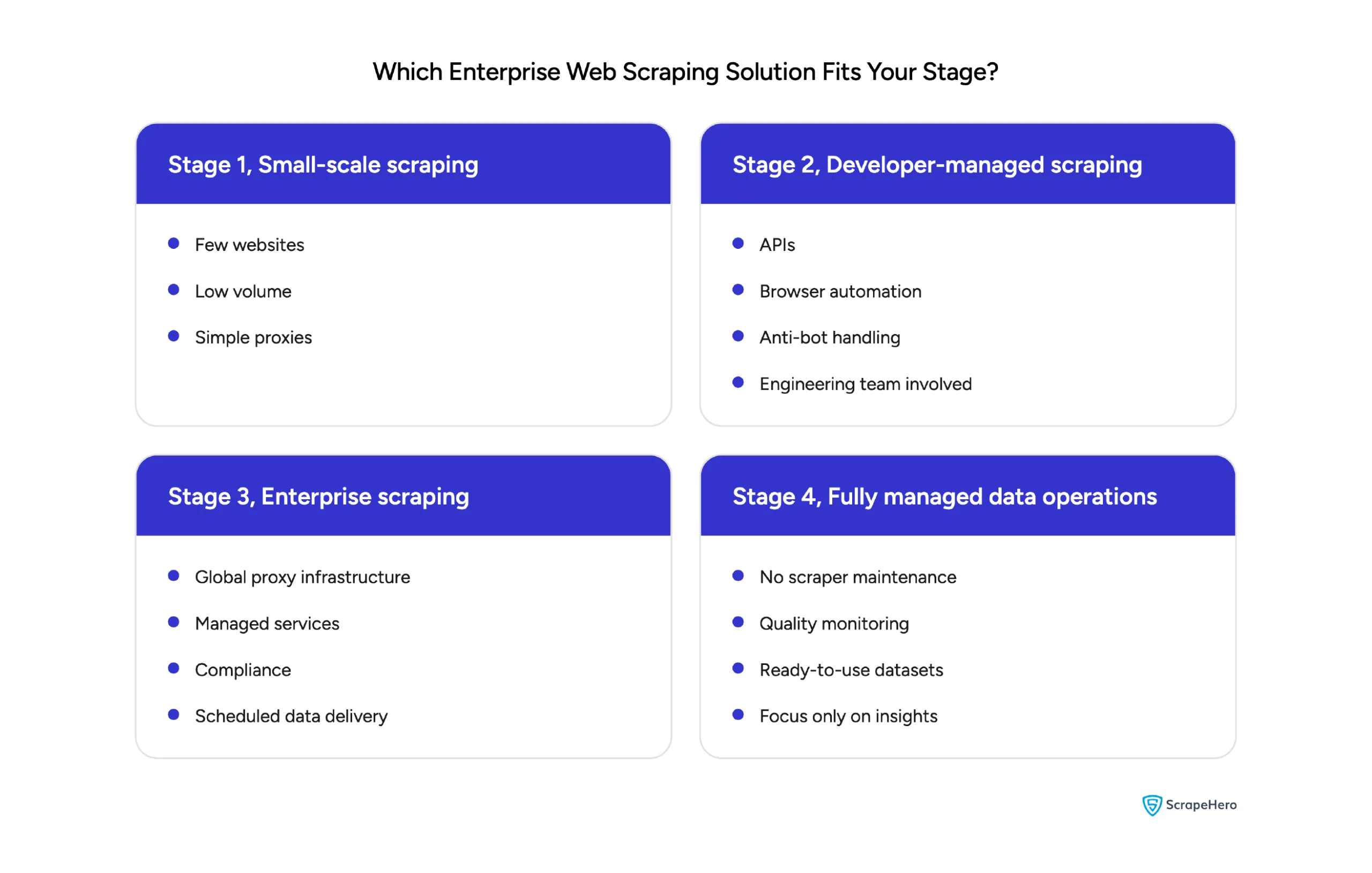
The biggest differences come down to a few things: infrastructure scale, developer flexibility, managed service options, pricing, and how much engineering work your team wants to take on. These factors shape your long-term costs far more than the monthly price tag alone.
Both platforms offer:
- Enterprise-grade proxy infrastructure
- Managed web scraping services
- APIs for custom data extraction
- Anti-bot and CAPTCHA handling
- JavaScript rendering support
- Scheduled delivery of structured data
- Enterprise support for large-scale scraping projects
Bright Data pros
Proxy network:
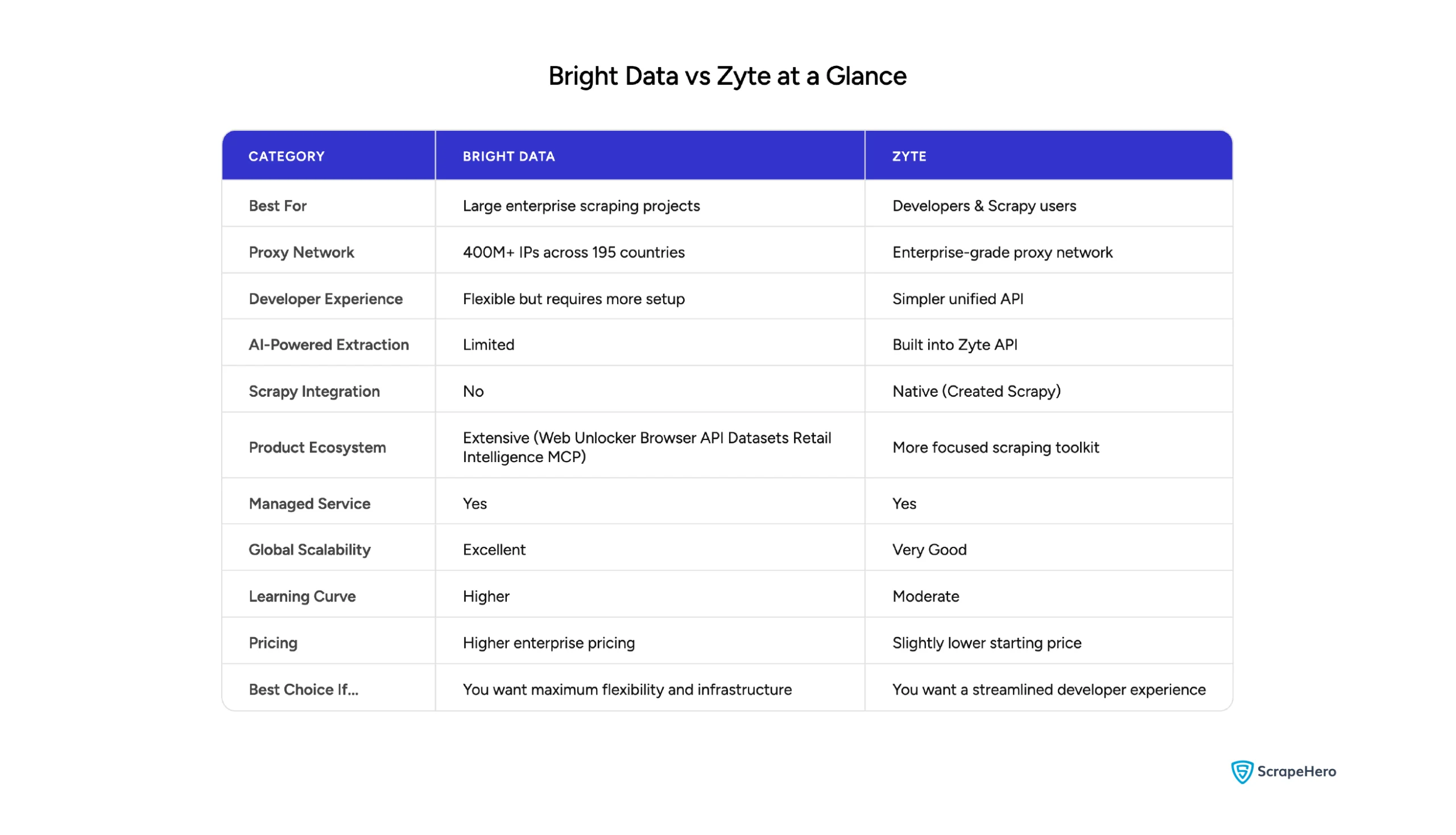
Bright Data’s biggest strength is its proxy infrastructure. It offers more than 400 million residential, ISP, mobile, and data center IPs. These span 195 countries. That scale drives strong performance in Bright Data for region-specific sites or multi-market projects.
Managed service:
Don’t want to maintain scraping infrastructure?
Use Bright Data’s Managed Data Acquisition service instead. Bright Data builds and maintains your scrapers. It rotates proxies, handles CAPTCHAs, and validates the data. Then it delivers structured datasets on a schedule.
So, your team can focus on using the data rather than maintaining the pipeline.
Product ecosystem:
Bright Data offers more than proxy services.
The platform includes Web Unlocker, Scraper APIs, Browser API, Scraper Studio, pre-collected datasets from 450+ domains, Retail Intelligence tools, and an MCP tool for AI applications.
This range gives your engineering team room to pick the products that fit your workflows.
Enterprise support:
The platform is built for enterprise deployments. You get dedicated project managers, structured onboarding, compliance certifications, and proactive monitoring. These help large organizations launch and run data projects with fewer headaches.
Flexible workflows:
Bright Data supports both technical and non-technical teams.
Your developers can build custom pipelines using its APIs. On the other hand, your business teams can lean on the managed service.
Either way, you choose the level of control and engineering work that fits your resources.
Bright Data cons
Enterprise pricing:
Bright Data’s enterprise features come with enterprise pricing, which is worth keeping in mind for any Bright Data pricing comparison.
The platform offers pay-as-you-go products. But its fully managed Data Acquisition service typically starts at $1,000 to $2,500 per month. It also requires a minimum monthly commitment. That makes it pricey if you’re a smaller or mid-sized team on a tight budget.
Cost predictability:
The self-service products use usage-based pricing. Your costs depend on bandwidth, proxy usage, request volume, and browser rendering.
This gives you flexibility. But it also makes monthly costs harder to predict as your scraping volume grows.
Setup time:
The managed service isn’t instant for custom projects.
Before data collection starts, Bright Data works with you to define requirements, build the scraper, and set up delivery. If you need fast access, plan for this onboarding period.
Technical expertise:
Bright Data’s developer tools are powerful. But they still require engineering skill. Choose the DIY route, and your team stays responsible for building workflows, integrating APIs, and managing data after collection.
No internal technical expertise? You’ll likely get more value from managed services.
Choose Bright Data if you need maximum flexibility, a massive proxy network, and a broad scraping ecosystem. However, be prepared for higher costs and a steeper learning curve if you manage scraping in-house.
Zyte pros
AI-powered extraction:
Zyte has invested heavily in AI-assisted extraction. Its platform uses machine learning to find and structure data from public websites. This cuts the custom parsing many scraping projects need. It’s especially useful for sites that change layouts often.
Anti-bot capabilities:
The Zyte API combines proxy management, browser rendering, and anti-bot handling into a single service.
It automatically handles JavaScript-heavy pages, CAPTCHAs, and other common obstacles. That means your developers spend less time building workarounds.
Scrapy foundation:
One of Zyte’s biggest advantages is its history. The company created Scrapy, one of the most widely used open-source scraping frameworks. Already using Scrapy? You can extend your workflows with Zyte’s cloud infrastructure. No need to rebuild your stack from scratch.
Unified API:
Bright Data offers separate products for rendering, proxies, and extraction.
On the other hand, Zyte bundles all three into one interface. Fewer services to integrate means less glue code. It also means fewer moving pieces to monitor as your stack grows.
Managed service:
No dedicated scraping engineers on your team?
Zyte Data offers a fully managed option. Zyte builds and maintains the extraction pipeline. It monitors website changes, runs quality checks, and delivers structured data on a set schedule. This cuts the operational effort needed to keep large projects running.
Structured delivery:
Zyte runs automated schema validation, field mapping, and quality checks before delivery. You can export data to CSV or push it straight to cloud storage. That means your web data fits into your existing analytics workflows with little extra processing.
Zyte cons
Managed pricing:
Zyte’s managed extraction service targets enterprise customers. The standard plans start around $500 per month, and custom data projects typically start at $1,000 per month and rise with volume and complexity.
However, that pricing can be hard to justify for smaller businesses or occasional needs.
Technical learning curve:
Zyte offers managed services. But its self-service products are built for developers.
If your team uses Zyte API, Smart Proxy Manager, or Scrapy Cloud, you should be comfortable building and maintaining scraping workflows.
That’s how you get the most value from the platform.
Data processing:
The DIY tools help you extract data. But downstream processing is still on you. Tasks such as normalization, validation, enrichment, and system integration usually require additional engineering work after collection.
Platform breadth:
Zyte offers a strong set of scraping tools. But its product range is narrower than Bright Data’s.
Looking for extras like pre-collected datasets or retail intelligence products? You may find fewer built-in options here.
Choose Zyte for a simpler developer experience with AI-powered extraction and a unified API. It’s a strong fit for Scrapy users, though it offers a narrower product ecosystem than Bright Data.
Bright Data vs Zyte for engineering teams
Building and maintaining your own scraping infrastructure?
Both Bright Data and Zyte give you the tools to collect web data at scale. The better choice depends on how much flexibility you need and how much operational work your team wants to take on.
APIs and developer tools:
Both platforms offer APIs for proxies, browser automation, and data extraction.
Bright Data provides separate products like Scraper API, Browser API, Web Unlocker, and proxy services. This lets your developers combine only the pieces they need.
On the other hand, Zyte takes a more unified path with the Zyte API. It bundles proxy management, browser rendering, and extraction into one interface.
Custom scraping:
Bright Data gives your developers more control over workflow design. Zyte also supports custom scraping. But its ecosystem stands out if your team already uses Scrapy, since it’s easier to extend existing projects.
Scalability:
Zyte scalability holds up well for most workloads, but Bright Data has an edge if you scrape multiple sites across different countries. Its larger proxy network gives you more flexibility for high-volume, global data collection.
Engineering effort:
Neither platform removes the need for engineering work on self-service products.
Your developers still handle scraper logic, monitor website changes, manage data quality, and integrate data into internal systems. Zyte’s unified API may cut your integration effort. Bright Data offers more customization for complex projects.
Recommendation:
Comparing Bright Data vs other scraping tools?
Value flexibility, control, and a broad infrastructure ecosystem?
Bright Data is the stronger choice.
Already use Scrapy, or prefer a single API for multiple scraping tasks?
Zyte offers a more streamlined experience.
Bright Data vs Zyte: Which platform is better for large-scale enterprise scraping?
If you want structured web data without building your own infrastructure, both Bright Data and Zyte offer fully managed services. They handle scraper development, monitoring, and maintenance.
So your team can focus on using the data rather than collecting it.
Engineering involvement:
Both providers cut the need for internal engineering work. Once the project is scoped, they build and maintain the pipeline. They monitor website changes and update scrapers when sites shift their layouts or anti-bot measures.
Data quality:
Bright Data and Zyte both validate data before delivery. They run quality checks, monitor accuracy, and reduce the number of missing or inconsistent records.
That means less manual verification for your team.
Data delivery:
Both services support scheduled delivery in formats like JSON, CSV, and Excel. Both integrate with cloud storage platforms and APIs. This makes it easier to move scraped data into your analytics or machine learning workflows.
Enterprise support:
Each provider offers enterprise onboarding, dedicated account management, and ongoing support.
Bright Data has a broader set of enterprise services, though. It includes pre-collected datasets, retail intelligence products, and more tools for larger data programs.
Pricing and fit:
Managed services from both providers target enterprise workloads.
Both usually require a monthly commitment based on project scope and data volume.
Want a broader platform with room to expand?
Bright Data offers more flexibility.
Need a focused, managed extraction service?
Zyte gives you that, with less emphasis on infrastructure management.
What people say about Bright Data vs Zyte
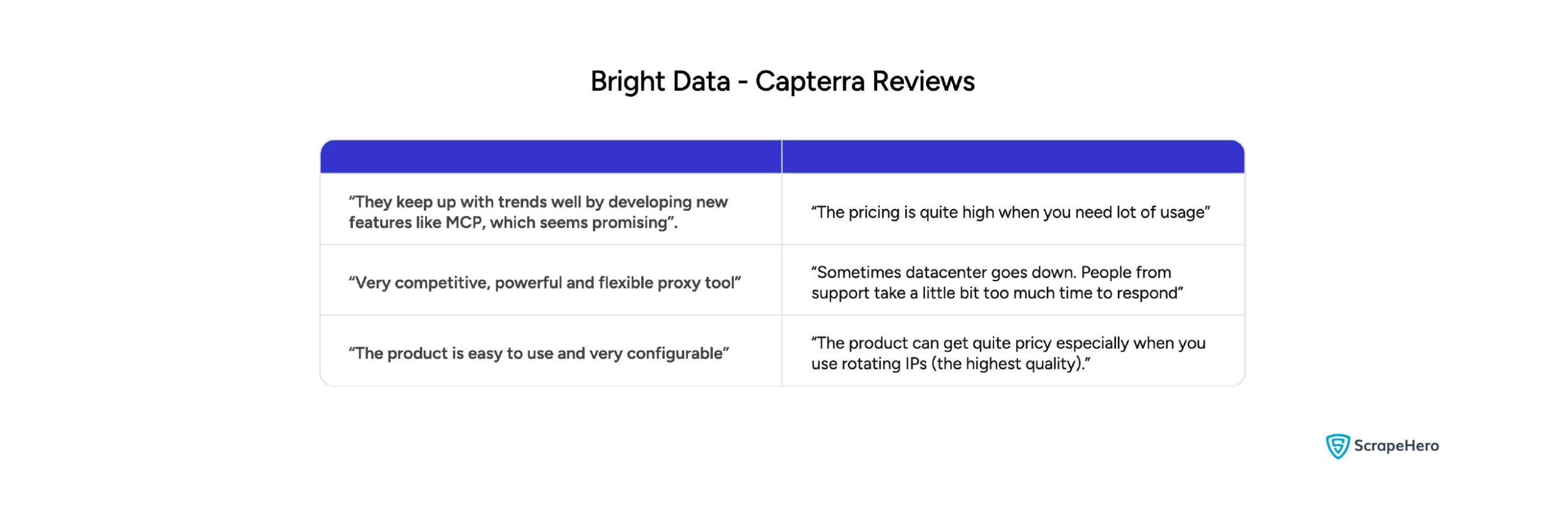
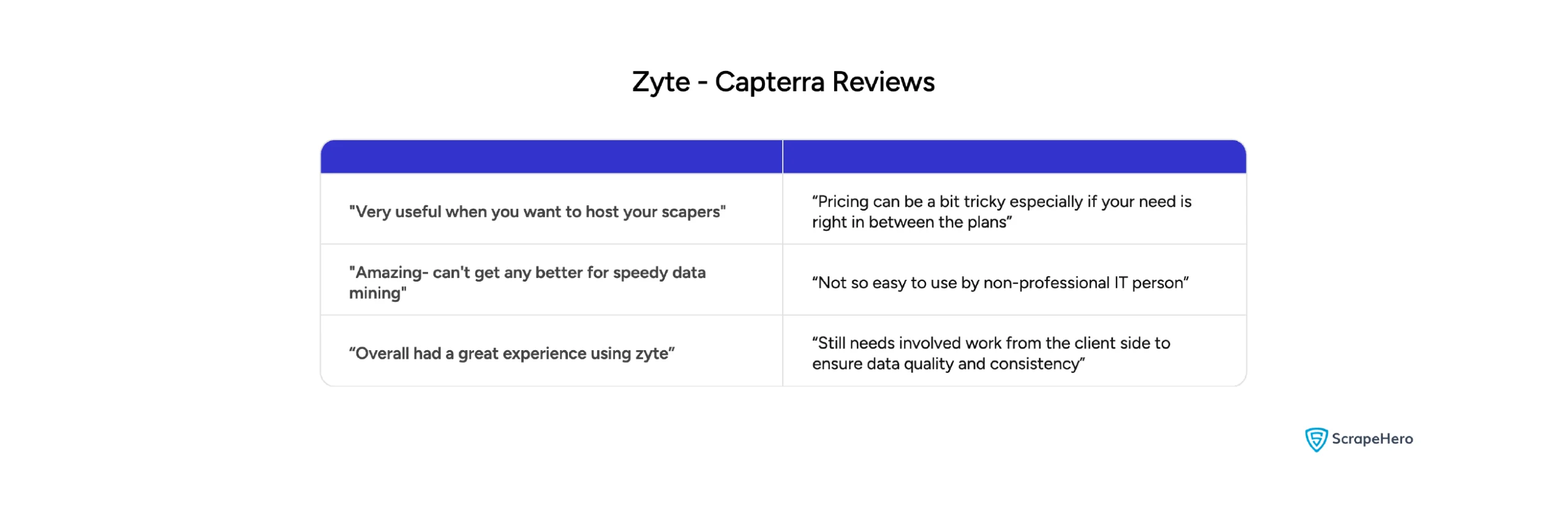
We pulled the following user reviews directly from Capterra, so you can see how Bright Data and Zyte hold up in real-world use.
Bright Data review average – 4.7/5
Zyte review average – 4.4/5
Bright Data and Zyte alternative
Want to cut engineering work from web scraping altogether? ScrapeHero is worth a look as a Bright Data competitor and one of the more capable Zyte alternatives on the market.
With a 4.7-star rating on Capterra, it emphasizes human-led service more than either of the platforms mentioned above.
Human-led from start to finish
ScrapeHero’s web scraping service combines automation with dedicated engineering support throughout your project.
Real engineers build and maintain your scrapers. They monitor website changes, run manual quality checks alongside automated ones, and fix issues before they hit your data pipeline.
Also, with dedicated project managers and responsive support, you work with people who know your data needs. For support, you’ll get responses from real scraping experts within one business hour—not an automated support queue.
Fully managed scraping
ScrapeHero owns the entire scraping operation.
That includes scraper development, proxy management, browser rendering, anti-bot handling, monitoring, maintenance, data cleaning, and normalization.
So, your team gets structured, ready-to-use data through scheduled deliveries or custom APIs, with no IT background needed on your end to get value from it.
In short, you don’t need to maintain any scraping infrastructure.
Faster ways to access data
Don’t need a custom solution?
If you’re weighing Bright Data alternatives, ScrapeHero Cloud offers a marketplace of pre-built scrapers for hundreds of popular sites. Unlike typical self-service tools, the ScrapeHero team maintains every scraper. You don’t need to manage updates when websites change.
For commonly requested data, ScrapeHero Data Store offers ready-made datasets you can use right away. This helps your team skip building a new scraping project altogether.
Does your web data support pricing intelligence, digital shelf monitoring, competitor tracking, or AI work? ScrapeHero cuts your engineering overhead while keeping experienced people involved at every stage.
Final thoughts
The Bright Data vs Zyte decision comes down to priorities more than price.
Bright Data offers flexibility and broad infrastructure. Zyte offers a unified, Scrapy-native API. Your right pick depends less on price and more on your team’s technical resources, scraping volume, and the long-term cost of running your own pipelines.
Want to hand off scraping infrastructure entirely?
ScrapeHero, the best web scraping company, is worth a look. Its human-led approach pairs dedicated engineers and manual quality checks with fully managed delivery. Your team spends less time maintaining scrapers and more time using the data.
FAQs
E-commerce brands, market intelligence teams, retailers, price-monitoring companies, and other enterprises that rely on web data for daily decisions use Bright Data.
It typically involves proxy infrastructure to avoid blocks, browser automation or APIs to extract data from target sites, and a managed or self-built pipeline to clean, validate, and deliver structured data on a schedule.
Scraping publicly available data is generally legal, but compliance depends on factors like the site’s terms of service, the type of data collected, and applicable regulations, so businesses should review these specifics for their use case.
They use rotating proxies, anti-bot and CAPTCHA handling, and JavaScript rendering to mimic real user behavior and avoid detection by target websites.
Bright Data provides web scraping infrastructure, proxy networks, and managed data collection services, while Coresignal primarily offers pre-collected public datasets for talent, company, and job market intelligence. The better choice depends on whether you need custom data collection or ready-made datasets.
Bright Data offers a massive proxy network of 400M+ IPs across 195 countries with separate proxy products, while Zyte bundles proxy management into its unified Zyte API alongside rendering and extraction.
The best web scraping tool depends on your team’s needs. Bright Data is ideal for organizations that want maximum infrastructure flexibility; Zyte suits developer-centric teams, while ScrapeHero is often the better choice for enterprises that want fully managed web scraping without maintaining proxies, scrapers, or anti-bot systems.