Apify is one of the best web scraping platforms for developers building custom scrapers with Actors and proxies. But in 2026, many teams are actively looking for other options.
Why?
For starters, Apify’s compute unit pricing can be unpredictable. On top of that, anti-bot systems often break fragile Actors. And teams are tired of the constant work needed to keep infrastructure running when it should just work.
If you’re weighing your options, this guide covers the five best Apify alternatives for web scraping in 2026, grouped by use case. Specifically, we’ll compare each platform on pricing models, anti-bot capabilities, coding requirements, and data delivery. This will help you pick the option that best matches your team’s skill level and business goals.
Key Takeaways
- Apify’s compute unit (CU) pricing and Actor-based architecture create predictability and reliability challenges for teams operating at scale.
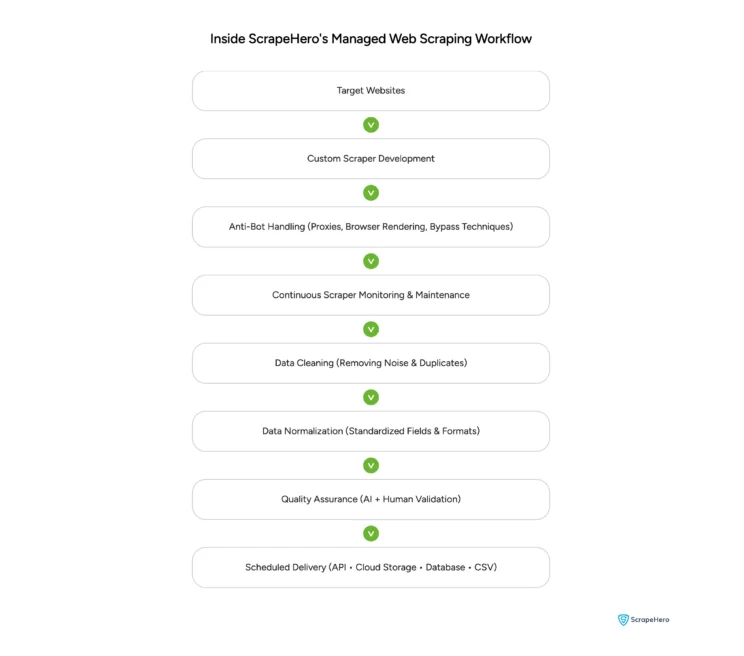
- The five strongest Apify alternatives in 2026 are ScrapeHero, Bright Data, Oxylabs, Zyte, and Octoparse — each suited to a different buyer profile.
- Fully managed web scraping providers like ScrapeHero remove proxy management, anti-bot handling, and scraper maintenance from your team entirely.
- No-code tools like Octoparse work well for small business users, while enterprise-grade proxy networks like Bright Data and Oxylabs suit teams that still want to build in-house.
- Predictable, flat pricing and clear SLAs are the two most-cited reasons teams switch away from Apify.
Why Teams Look for Apify Alternatives in 2026
Apify’s Actor-based platform gives developers deep control over how their scrapers are built. That flexibility is also its biggest source of friction. Teams commonly cite three reasons for evaluating alternatives.
-
Unpredictable pricing
The question “Why is Apify so expensive?” often comes up when teams see their bills. Apify charges based on compute units, memory usage, and proxy add-ons. So, bills can spike sharply when target sites add JavaScript rendering, CAPTCHAs, or anti-bot walls that require heavier browser sessions. For teams planning quarterly budgets, this variability is difficult to justify.
-
Anti-bot friction
Cloudflare, DataDome, PerimeterX, and Akamai have grown far more sophisticated.
Across the board, teams using actor-based scraping platforms report higher maintenance demands on protected e-commerce sites, travel aggregators, and social platforms.
So, keeping scrapers working on these targets often requires rewriting logic, cycling proxy strategies, or adding third-party unblocking layers on top.
-
Engineering opportunity cost
Building and babysitting scrapers pulls senior engineers away from core product work. When leadership sees pipelines fail silently before quarterly reports, the calculus shifts toward outsourcing extraction entirely.
Add to this the growing demand for clean, LLM-ready Markdown output for AI applications, and the pressure to evaluate alternatives is high across almost every buyer profile.
Apify also offers end-to-end managed web scraping services. So the decision isn’t simply between Apify’s self-service platform and outsourcing scraping elsewhere. Teams can work with Apify’s team to manage scraping end to end—but may still look at alternatives when they want different pricing models, deeper specialization, stronger hands-on support, or a more fully managed approach to data collection.
What Are the Top 5 Apify Alternatives, and How Do They Compare?
1. What Does ScrapeHero Offer, and How Much Does It Cost?
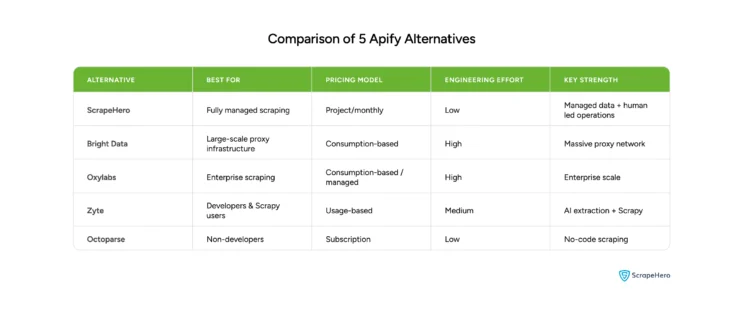
ScrapeHero serves businesses that want data delivered rather than scrapers to run. The platform offers a fully managed web scraping service and ScrapeHero Cloud, a library of prebuilt scrapers for popular e-commerce, travel, retail sites that customers can use in a self-serve model.
In short, this gives buyers a choice: DIY through Cloud when speed matters, or fully managed when reliability and SLAs matter.
Also, ScrapeHero offers prebuilt datasets for teams that need POI data instantly, with no scraping tools, setup, or pipeline required.
Key Features:
- Fully managed extraction with human QA and dedicated engineering support
- ScrapeHero Cloud with prebuilt scrapers for hundreds of common data sources
- Custom extraction projects backed by SLAs on accuracy, uptime, and delivery
- Compliance frameworks aligned with GDPR, CCPA, and ethical scraping practices
- Multiple delivery formats: JSON, CSV, Excel, direct database, S3, or API
Pros:
- Predictable, transparent pricing with no compute unit surprises
- Human-led QA catches issues that automated pipelines miss
- Zero infrastructure or proxy management for the customer
- Real data engineers available for onboarding and ongoing support
Cons:
- Managed pricing is designed for business budgets and may not fit hobbyist or one-off use cases
Pricing:
- Managed plans start at $199/month
- Enterprise plans start at $1,500/month, priced by project scope rather than infrastructure usage
- ScrapeHero Cloud offers pay-as-you-go tiers.
2. What Makes Bright Data Different from Apify?
Bright Data operates one of the largest proxy networks in the industry, covering residential, mobile, ISP, and datacenter IPs. In addition, its scraping APIs sit on top of that network to handle unblocking automatically.
Where Bright Data shines is its range of control.
At one end, teams can deploy custom pipelines directly on its proxy and scraping infrastructure; at the other, they can outsource the entire job to Bright Data’s Managed Data Acquisition team.
Key Features:
- 150M+ residential IPs and a dedicated Web Unlocker API
- Ready-made datasets and a Web Scraper IDE
- Enterprise compliance certifications (SOC 2, ISO 27001)
Pros:
- Best-in-class proxy pool for hard-to-scrape sites
- Extensive documentation and community
Cons:
- Complex pricing spread across multiple product lines
- Steep learning curve for teams new to proxy management
- Requires meaningful engineering effort to integrate
Pricing:
- Self-service pricing is consumption-based, tied to proxy volume, bandwidth, and request frequency.
- The managed service comes at a premium, with monthly commitments generally starting at $1,000–$2,500 and increasing based on the scope of the project.
Also Read: Top 5 Bright Data Alternatives to explore the best options for your scraping needs.
3. Is Oxylabs a Better Fit for Enterprise Scraping Than Apify?
What makes Oxylabs stand out is its enterprise credibility. You get a robust proxy network, a versatile Web Scraper API, and the capacity to handle massive data volumes without breaking a sweat. If your team has the bandwidth to manage its own infrastructure, Oxylabs gives you the tools to do it effectively.
For teams seeking a lighter operational lift, Oxylabs offers a fully managed solution that handles every stage of the pipeline—from collection and validation to cleaning and final structured delivery. The result is usable, polished data rather than unprocessed output.
Key Features:
- 100M+ residential proxies and dedicated Web Scraper APIs for e-commerce, SERP, and real estate
- OxyCopilot AI assistant for query building
- Enterprise-grade support and SLAs
Pros:
- Reliable proxy performance and a strong compliance posture
- Dedicated account managers on enterprise plans
Cons:
- Higher minimum commitments than mid-market alternatives
- Still requires internal engineering to operate at scale
Pricing:
- Pricing for the self-service tier is consumption-based, with rates determined by proxy selection, bandwidth usage, and API request frequency.
- For managed services involving custom datasets, monthly plans begin at $800.
4. How Does Zyte Compare to Apify?
Zyte (formerly Scrapinghub) is a developer-focused platform built by the creators of the open-source Scrapy framework. It combines a Smart Proxy Manager, AI-assisted extraction, and hosted Scrapy Cloud.
The Zyte API deserves special mention among premium web scraping API options.
Its strength lies in handling JavaScript-heavy and dynamically rendered content as it combines proxy rotation, headless browsing, and AI-driven data extraction through one unified endpoint.
For e-commerce companies operating on intricate and modern site infrastructures, this capability offers great value.
Key Features:
- Zyte API with automatic anti-bot bypass
- AI-powered extraction for e-commerce, articles, and jobs
- Native Scrapy integration for teams already using the framework
Pros:
- Strong fit for teams already invested in Scrapy
- Reasonable pricing for mid-scale projects
Cons:
- Developers still write and maintain spiders in self service plans
- Fewer prebuilt datasets than Bright Data or Oxylabs
Pricing:
- Developer tools are usage-based, scaling with request volume and rendering needs
- Managed services typically start between $500 and $1,000/month, with custom pricing that can increase significantly depending on the scope and complexity of the project.
5. Is Octoparse a Good No-Code Alternative to Apify?
Octoparse is the leading no-code visual scraper for non-technical users. It handles pagination, form filling, and cloud scheduling through a desktop client and cloud dashboard.
Octoparse serves two distinct audiences. First, a no-code desktop tool with a visual workflow builder—no programming required. So, operations, analytics, and business teams can launch scraping tasks independently.
Second, a fully managed enterprise service that handles anti-bot mitigation, data cleaning, quality control, and recurring delivery.
Before evaluating Octoparse, decide which model fits your needs—that choice shapes everything else.
Key Features:
- Point-and-click visual builder
- Cloud execution and scheduling
- Prebuilt templates for popular sites
Pros:
- Genuinely usable by non-developers
- Free tier for small projects
Cons:
- Silent failures when target site layouts change
- Limited enterprise features like SSO, audit logs, and dedicated proxies
- May struggle with heavily anti-bot-protected sites
Pricing:
DIY no-code tool: Subscription-based. Free plan available. Paid plans start at approximately $69–83$ per month for the Standard plan, going up to $249–$299 per month for the Professional plan. Enterprise custom pricing is also available.
Fully managed Data Service: Project-based or monthly pricing. Starts at $699/project. Custom quotes are available for larger volumes.
How Do You Choose the Right Apify Alternative for Your Business?
Which Apify Alternative Is Best for Developers?
If your team has the engineering bandwidth and wants to keep control over extraction logic, evaluate Bright Data, Oxylabs, or Zyte.
These platforms give you enterprise-grade proxies and scraping APIs while letting your engineers own the pipeline.
For teams that want to skip the maintenance grind entirely, ScrapeHero Cloud offers a different proposition—prebuilt scrapers for popular sites that are fully maintained by ScrapeHero. They handle site redesigns, anti-bot changes, and data structure shifts behind the scenes, so you get reliable data with zero technical upkeep.
Choose ScrapeHero when your team wants to skip the operational overhead and go straight from request to usable data for applications, dashboards, or internal tools.
Which Apify Alternative Is Best for a Fully Managed Service?
If scraping is mission-critical, if your team has no engineering bandwidth to spare, or if you need guaranteed SLAs on data accuracy and delivery, a fully managed web scraping service provider is the right choice.
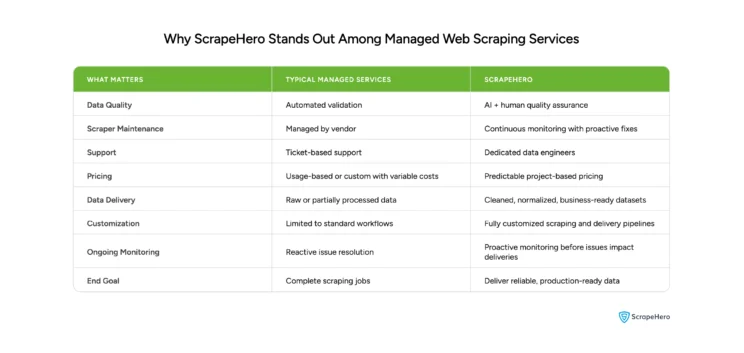
On paper, ScrapeHero, Zyte Data, and Octoparse all offer the same checklist: extraction, anti-bot, cleaning, and delivery. However, the real difference isn’t in what they do—it’s in how they do it.
ScrapeHero puts accessible, experienced people at every touchpoint: support, QA, project management, and execution. No faceless chatbots, no AI-only dashboards. Instead, they use automation to make their humans faster and more accurate.
If your pricing, analytics, or AI models depend on accurate, fresh web data, that human layer is your safety net. It transforms a generic data feed into a resilient, trusted pipeline you can actually rely on.
ScrapeHero also sets itself apart with straightforward, project-based pricing—clearer and more cost-effective than competitors’ consumption-driven structure, with no surprise bills lurking at month’s end.
Final Thoughts
Apify is still a great fit for engineering teams that want to build and customize their own scraping logic from the ground up. That said, the alternatives we’ve covered are designed to solve the specific burdens that come with that DIY approach. Such as, unpredictable costs, coding requirements, scaling proxies, cleaning messy output, and ongoing maintenance.
This brings you to a fundamental choice: infrastructure versus service.
Infrastructure (like Apify or Bright Data’s self-serve tools) gives you powerful building blocks,but your engineers still have to write the code, handle site changes, and keep everything running.
Service (like ScrapeHero’s complete web scraping service) means a dedicated team handles the entire pipeline: extraction, anti-bot evasion, cleaning, and structured delivery. You just get the final, ready-to-use data.
Which one should you pick?
It depends on your team’s technical depth and how you want to spend your engineering resources.
For most enterprises where web data drives pricing, strategy, or AI models, a fully managed web scraping service like ScrapeHero is the obvious choice. It delivers better reliability, faster delivery, and higher ROI than renting infrastructure that still leaves your engineers babysitting scrapers.
With that in mind, if you need more guidance on web scraping tools like Apify, talk to our data experts. Tell them your team’s reality, your data needs, your biggest fear about getting this wrong. They’ll tell you what actually works—even if it’s not us.
FAQs
Apify is a DIY platform where developers build, deploy, and maintain their own scrapers (called Actors). ScrapeHero is primarily a fully managed web scraping service provider — you request the data you need and the ScrapeHero team handles extraction, QA, and delivery. ScrapeHero also offers self-serve prebuilt scrapers through ScrapeHero Cloud.
Managed services remove operational risk. Enterprises get guaranteed SLAs on data accuracy and delivery, human QA on every pipeline, compliance guarantees for GDPR and CCPA, and freedom from proxy management, site changes, and anti-bot patches.
Yes. Octoparse and Browse AI both offer visual point-and-click builders for non-developers. For fully managed data without any tool to configure at all, ScrapeHero handles everything on your behalf.
Apify is a cloud platform for building and running web scrapers called Actors. It provides proxy management, dataset storage, and scheduling for developers who want to build scrapers themselves. Apify also provides a fully managed web scraping service for enterprises.
The paid plans start around $26/month for individuals, scaling up based on compute usage, storage, and task execution volume.
Meanwhile, their fully managed service’s pricing starts at $2000, and you’ll need to contact their team directly for a custom quote.
Apify is primarily built for developers comfortable with JavaScript, TypeScript, or Python. Beginners often find the Actor model and platform configurations complex; no-code alternatives like Octoparse or managed services like ScrapeHero are usually a better fit.
ScrapeHero for fully managed delivery. Bright Data or Oxylabs work well if you want to keep extraction in-house with enterprise-grade proxy infrastructure.
The five strongest Apify alternatives in 2026 are ScrapeHero, Bright Data, Oxylabs, Zyte, and Octoparse. ScrapeHero leads for fully managed delivery, Bright Data and Oxylabs for enterprise proxy scale, Zyte for developer-friendly APIs, and Octoparse for no-code users.
ScrapeHero’s fully managed service requires zero engineering — you receive clean data on the schedule you specify. Octoparse is the leading no-code option for smaller-scale needs.
They solve different problems. Apify is a hosting and orchestration platform for custom scrapers. Bright Data is primarily a proxy network with layered scraping APIs. Bright Data is stronger for hard-to-scrape sites at large scale.
Oxylabs delivers stronger enterprise proxy infrastructure and compliance guarantees, while Apify offers more developer flexibility for custom scraper logic.
ScrapeHero is the strongest fully managed option, with human QA, dedicated engineering support, and SLAs on accuracy and delivery.
Octoparse’s free tier is the cheapest starting point for non-developers. For developers, ScraperAPI and ScrapingBee offer low-cost flat-rate plans. For business users, ScrapeHero cloud offers pre-built scrapers at affordable costs.
For fully managed e-commerce data across Amazon, Walmart, Target, and Shopify sites, ScrapeHero is purpose-built for the category. For DIY at scale, ScrapeHero Cloud, Bright Data and Oxylabs both offer dedicated e-commerce scraper APIs.