Every web scraping project ends up at the same fork. You either give your developers a platform and let them build, or you get the data delivered ready for the business to use.
As it happens, this Apify vs Zyte comparison finds both platforms answer that question well. Both are developer-first, both have a decade or more expertise behind them, and both can pull data from hard sites at scale.
This detailed Apify Zyte comparison covers pricing, features, engineering effort, scalability, data quality, and total cost of ownership. It also covers when a fully managed service becomes the better choice for a business that would rather use the data than run the pipeline.
Both companies target the same broad problem of collecting public web data reliably. However, they differ in how much of the pipeline they own and how much they leave to you. This Apify vs Zyte breakdown starts with what each platform actually is. Apify is a cloud-based scraping and automation platform built around Actors. An Actor is a containerized program that runs on Apify’s cloud, takes inputs, and returns structured output. For instance, the Apify Store lists thousands of prebuilt Actors for popular sources like Google Maps, LinkedIn, Amazon, TikTok, and Instagram. The core building blocks include:
Apify is developer-first in the real sense of the term. It gives engineering teams the freedom to build almost any scraping or automation workflow, and it removes the need to manage servers. Zyte, formerly Scrapinghub, is the company behind Scrapy, the widely used open-source Python scraping framework. Its commercial offering now includes three main products.
Zyte’s prioritizes delivering clean, reliable data through anti-bot defenses, powered by AI-assisted extraction and the mature Scrapy framework, rather than offering a broad automation platform. Both platforms serve overlapping customer types, including: Feature parity between the two is broad. Both include cloud execution, browser automation, JavaScript rendering, anti-bot capabilities, structured storage, and enterprise support tiers. Even so, the differences show up in packaging, workflow model, and the depth of specific capabilities. The central distinction is straightforward. Apify emphasizes flexible developer workflows and a large library of reusable Actors. Meanwhile, Zyte emphasizes data extraction through a unified API and an ecosystem rooted in Scrapy. The Apify Store is one of the platform’s biggest differentiators. Thousands of prebuilt Apify Actors cover Google Maps, Amazon products, TikTok profiles, Instagram posts, LinkedIn pages, and hundreds of other popular targets. If you’d rather configure than code, this can shrink weeks of development into hours. Actors can be forked, customized, and republished. You can also chain Actors together to build multi-step workflows, such as pulling a list of URLs from one Actor and feeding them into another for extraction. Crawlee is Apify’s open-source scraping library. It handles browser automation, request queues, proxy integration, session management, and retries. As a result, developers who want to write their own scrapers get a mature foundation for free, and they can deploy those scrapers to Apify’s cloud when they need to scale. Actors can be scheduled, triggered through APIs, or called by webhooks. Run histories, logs, and dataset outputs are stored automatically. This takes the operational load of running servers, queues, and cron jobs off your plate. That said, monitoring and maintenance of the scraping logic itself still stays with you. Apify has strong documentation, official SDKs for JavaScript and Python, and a well-designed console for creating and inspecting runs. Local development is straightforward with the Apify CLI. Integrations exist for Zapier, Make, n8n, Slack, Airbyte, and various data warehouses.
Apify command-line interface (Apify CLI) helps you create, develop, build and run Apify Actors, and manage the Apify platform from any computer. Apify extends beyond scraping into broader automation. Teams use Actors for lead enrichment, content monitoring, AI agent workflows, and any task that requires structured web interaction on a schedule. Prebuilt Actors help, and they don’t remove maintenance. Websites change layouts, anti-bot systems tighten, and Actors break. However, some Actors in the store are well maintained by professional developers; others less so. So, your team still has to monitor runs, catch silent failures, and either fix broken Actors or wait for the community maintainer to push a fix. Apify’s pricing in 2026 runs from $0 to $29 (Starter), $199 (Scale), and $999 (Business), with custom enterprise pricing above that. The monthly fee is prepaid platform usage, and it isn’t a flat subscription. Compute units, proxy bandwidth, storage operations, and paid Store Actors all draw down that budget. Getting the data is one part of the workflow. Beyond that, cleaning it, normalizing SKUs across retailers, deduplicating listings, validating fields, and loading into a warehouse all still fall on you if you’re not on the professional services tier. Apify is easier than building scraping infrastructure from scratch. However, self-service users still need to understand Actors, compute units, concurrency, proxy configuration, and dataset schemas to get real value from the platform.
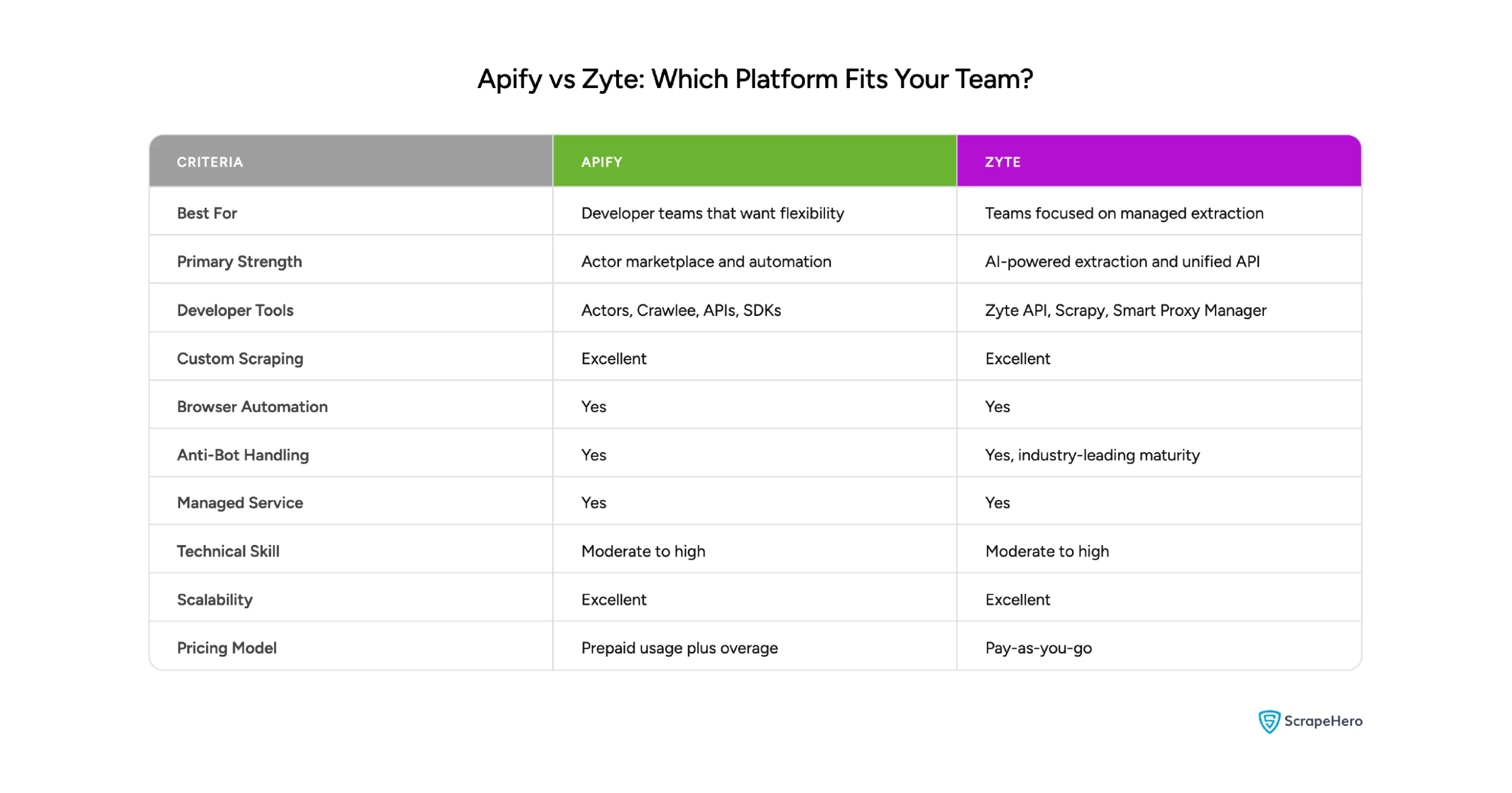
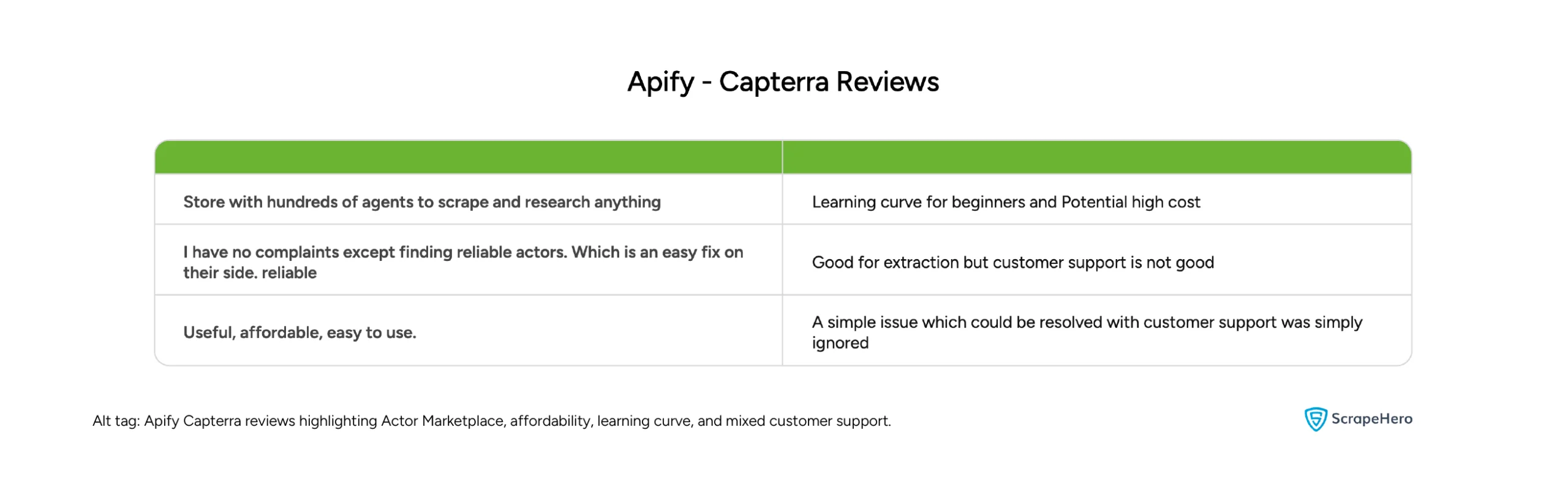
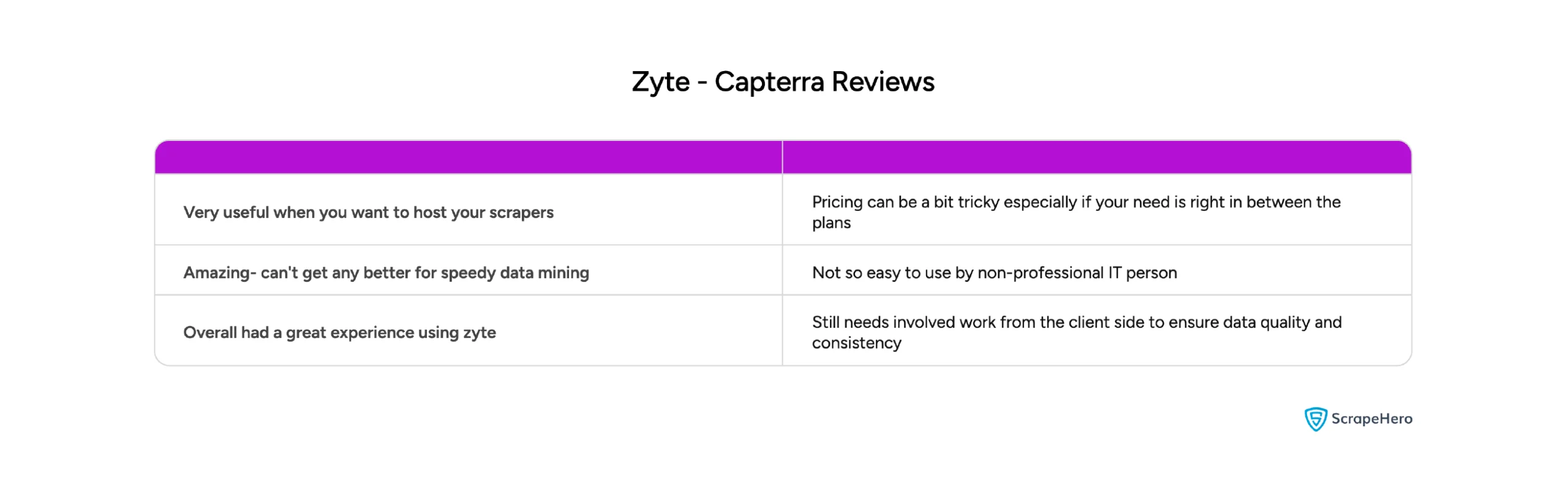
Choose it if you want a flexible developer platform with a large marketplace of reusable Actors and strong cloud automation. Avoid it if you need predictable fixed costs or lack the engineering bandwidth to monitor, debug, and fix Actors when they break. Zyte API can identify and extract structured product, article, and job posting data automatically. Instead of writing selectors for every site, you send a URL and specify the entity type. In turn, Zyte returns a normalized JSON object with fields such as name, price, currency, availability, images, and description. For teams scraping dozens of retailers with varying page layouts, this cuts parser development by a lot. Zyte API rolls proxies, browsers, and extraction into a single endpoint, so you don’t stitch together separate services. You configure the behavior per request: browser rendering on or off, geolocation, session cookies, extraction schema, and screenshots. The API handles the rest. Zyte has been solving the anti-bot problem for more than a decade. The platform includes automatic proxy rotation, browser fingerprint randomization, CAPTCHA handling, and ban detection. Independent benchmarks place its success rate on protected sites in the top tier of managed scraping APIs. Zyte maintains Scrapy, which is still the most widely used Python scraping framework. Teams already running Scrapy spiders can deploy them to Scrapy Cloud with minimal changes. That continuity is a real advantage if you have an existing Scrapy investment. Zyte Data is the fully managed tier. Zyte’s engineers build the spiders, run them, watch for breakage, validate the output, and deliver structured data to your endpoint on a schedule. Compliance review is part of the service. Data can be delivered as JSON or CSV to Amazon S3, Google Cloud Storage, or other destinations. Schema validation and field mapping are included, which cuts the downstream cleaning burden. Zyte’s pricing follows a pay-as-you-go with no minimum commitment. Request cost varies by target-site difficulty and features enabled. Scrapy Cloud runs completely free for small projects and $9 per unit per month for professional usages. More units unlock parallel jobs and longer retention. Zyte Data pricing starts at $500 per month for standard data types and pricing for custom data types starts at $1000 per month which is slightly on the expensive side . The model is transparent, and it still requires modeling. In practice, estimating a monthly bill demands assumptions about how many pages need browser rendering, how many require premium proxies, and what percentage will succeed on the first try. Self-service solutions of Zyte still expects developers who understand Scrapy, request semantics, and structured extraction schemas. Even with AI-assisted extraction, teams often need to normalize output across sources, resolve variant SKUs, deduplicate listings, and connect the data into internal systems. Zyte focuses on extraction. It doesn’t offer the same breadth of automation Actors, marketplace scrapers, or general workflow orchestration as Apify. If you want a broader platform, that focus is a limitation. Choose Zyte, if you want AI-assisted extraction, a unified API, and a streamlined developer experience, especially if your team already works with Scrapy. Avoid it if you need a broader automation platform beyond just extraction or if you want simple, predictable pricing. Apify gives you Actors, Crawlee, a REST API, webhooks, and integrated storage. Meanwhile, Zyte gives you the Zyte API, Smart Proxy Manager, Scrapy Cloud, and AI-powered extraction. Both have official SDKs and both work with modern CI/CD pipelines. Apify is more flexible when you want to build reusable, composable workflows. An Actor can wrap any scraping logic, expose it through an API, and be scheduled or triggered from external systems. By contrast, Zyte is more streamlined when the goal is extracting structured data from a page and moving on. The AI-assisted schemas cut parser code, which matters at breadth. Both platforms scale to millions of pages per day. Apify concurrency runs from 5 concurrent runs on Free up to 256 on Business. Similarly, Zyte API scales elastically on the pay-as-you-go model, and Scrapy Cloud units control parallel spider jobs. Neither platform removes engineering work for their self-service solutions. Website changes will break selectors. Anti-bot systems will tighten. Silent extraction failures will happen. Your team has to monitor runs, validate output, and respond to incidents. Apify cuts the effort through reusable Actors and cloud automation. Zyte cuts it through AI-assisted extraction and a unified API. Where the reduction lands depends on your workload. Choose Apify when developer flexibility, a large Actor marketplace, and workflow automation are the priorities. Choose Zyte when unified extraction, AI-assisted parsing, and Scrapy continuity are the priorities. Apify wins on breadth and reusability, while Zyte stands out for extraction quality and advanced anti-bot capabilities. However, both still require significant engineering effort unless you opt for their fully managed data extraction services. Under self-service, both platforms expect you to own the scraping logic, monitor jobs, and respond to failures. Under their managed tiers (Apify Professional Services, Zyte Data), the vendor takes over more of that operational load. Costs scale accordingly. Zyte’s automatic extraction cuts missing fields on standard e-commerce pages. Apify’s Store Actors vary in quality depending on the maintainer. Both platforms require you to validate accuracy, monitor for drift, and handle regional inconsistencies in currency, taxes, and language. Both Apify and Zyte support JSON and CSV output, cloud storage integrations, scheduled delivery, and API-based retrieval. Zyte Data leans more heavily into schema-validated delivery to S3 and GCS. Apify integrates with Airbyte, Zapier, Make, and webhooks for pipeline connection. Both Apify and Zyte offer enterprise contracts with dedicated account management, SLAs, and priority support. Zyte has a longer track record with compliance-sensitive enterprises, given its Scrapy heritage. Apify also has grown its enterprise offering quickly as the Actor marketplace expanded. Subscription and request pricing tells only part of the story. The full cost includes: For a team processing millions of pages a month across dozens of retailers, the internal engineering cost often exceeds the platform bill. That’s the calculation to run before you commit. We pulled the following user reviews directly from Capterra, so you can see how Apify & Zyte hold up in real-world use. Apify review average – 4.8/5 Zyte review average – 4.4/5 As we discussed, both Apify and Zyte are powerful platforms. Both offer self-service tools for developer teams and enterprise-grade managed services that include data cleaning, normalization, and delivery. So if both platforms already offer both self service and fully managed solutions, why would a business choose ScrapeHero as one of the best Apify alternatives or Zyte alternatives? The answer lies in cost, service model, human oversight, and flexibility. 1: Price Barrier Apify Professional Services starts at $1,749/month. Zyte Custom Plan starts at $1,000/month. For many mid-sized businesses, these are significant commitments. On the other hand ScrapeHero’s fully managed web scraping service starts at $199, dramatically lowering the barrier to entry for smaller teams and budget-conscious projects. 2: Human-Led Quality Assurance Both Apify’s and Zyte’s managed service uses either manual or automated monitoring systems. But, ScrapeHero ensures data quality by combining AI-powered automated checks with manual human validation. This catches issues that automated systems often overlook while ensuring speed. 3: Dedicated Human Support Apify and Zyte offer standard enterprise support with defined SLAs. You get a team, but the level of personal engagement can vary. But, ScrapeHero includes dedicated engineers and a project manager on every crucial project. You have direct access to the people building and maintaining your pipeline, not just a support ticket system. 4: Faster Proactive Maintenance Both Apify and Zyte maintain their spiders proactively. However, turnaround time depends on their engineering queue. But, ScrapeHero assigns a dedicated team specifically to your important projects. When a site changes, the engineers fix it immediately, not when the queue clears. 5: Breadth of Pre-Built Solutions Apify has a large marketplace of community-maintained Actors. Zyte focuses on AI-driven extraction for e-commerce and other sites. ScrapeHero Cloud provides prebuilt scrapers of popular sites maintained by ScrapeHero’s own engineers, removing the “community-maintained” uncertainty. Additionally, if you need POI data, ScrapeHero Data Store delivers pre-collected, refreshed datasets with zero scraping effort, something neither Apify nor Zyte offers. When to Choose ScrapeHero Choose ScrapeHero if you want: Apify and Zyte are two of the most capable web scraping platforms available in 2026. Apify wins for developer teams that want a marketplace of Actors, cloud automation, and a broad platform they can build on. Meanwhile, Zyte wins for teams that want managed extraction through a unified API, and for anyone with existing Scrapy investment. This Apify vs Zyte guide should make the decision easier, but the right choice depends less on feature lists and more on engineering effort, long-term maintenance, support, clear pricing, and the quality of the data you get in the end. If you need an Apify or Zyte alternative, ScrapeHero, the best web scraping company, is worth a look. Its human-led approach pairs skilled engineers and automated workflows with fully managed delivery. So, your team spends less time maintaining scrapers and more time using the data. With that in mind, if you need more guidance on choosing the right web scraping platform, talk to our data experts. Tell them your team’s reality, your data needs, your biggest fear about getting this wrong. They’ll tell you what actually works—even if it’s not us.Key Takeaways
How Do Apify and Zyte Compare Overall?
What is Apify?
What is Zyte?
Who Uses Apify and Zyte?
What Do Apify and Zyte Have in Common?
What Are the Advantages of Apify?
Actor Marketplace
Crawlee Framework
Cloud Automation
Developer Experience
Flexible Automation
What Are the Disadvantages of Apify?
Engineering Responsibility Doesn’t Disappear
Usage-Based Pricing Can Surprise You
Data Processing Sits Downstream
Learning Curve
What Are the Advantages of Zyte?
AI-Powered Data Extraction
Unified API
Anti-Bot Capabilities
Scrapy Ecosystem
Managed Data Service
Structured Data Delivery
What Are the Disadvantages of Zyte?
Pricing Complexity
Learning Curve
Downstream Processing Still Applies
Narrower Platform Scope
How Do Apify and Zyte Compare for Engineering Teams?
APIs and Developer Tools
Which Platform Is Better for Custom Scraping?
Which Platform Scales Better?
How Much Engineering Effort Do Apify and Zyte Require?
Which Should You Choose, Apify or Zyte?
Which is the best web scraping platform for large-scale data extraction?
How Much Engineering Involvement Do Enterprises Need?
Which Platform Delivers Better Data Quality?
How Do Apify and Zyte Deliver Data at Scale?
What Enterprise Support Do Apify and Zyte Offer?
Pricing and Total Cost
What People Say About Apify vs Zyte
ScrapeHero – The Best Apify and Zyte Alternative
The Five Gaps ScrapeHero Fills
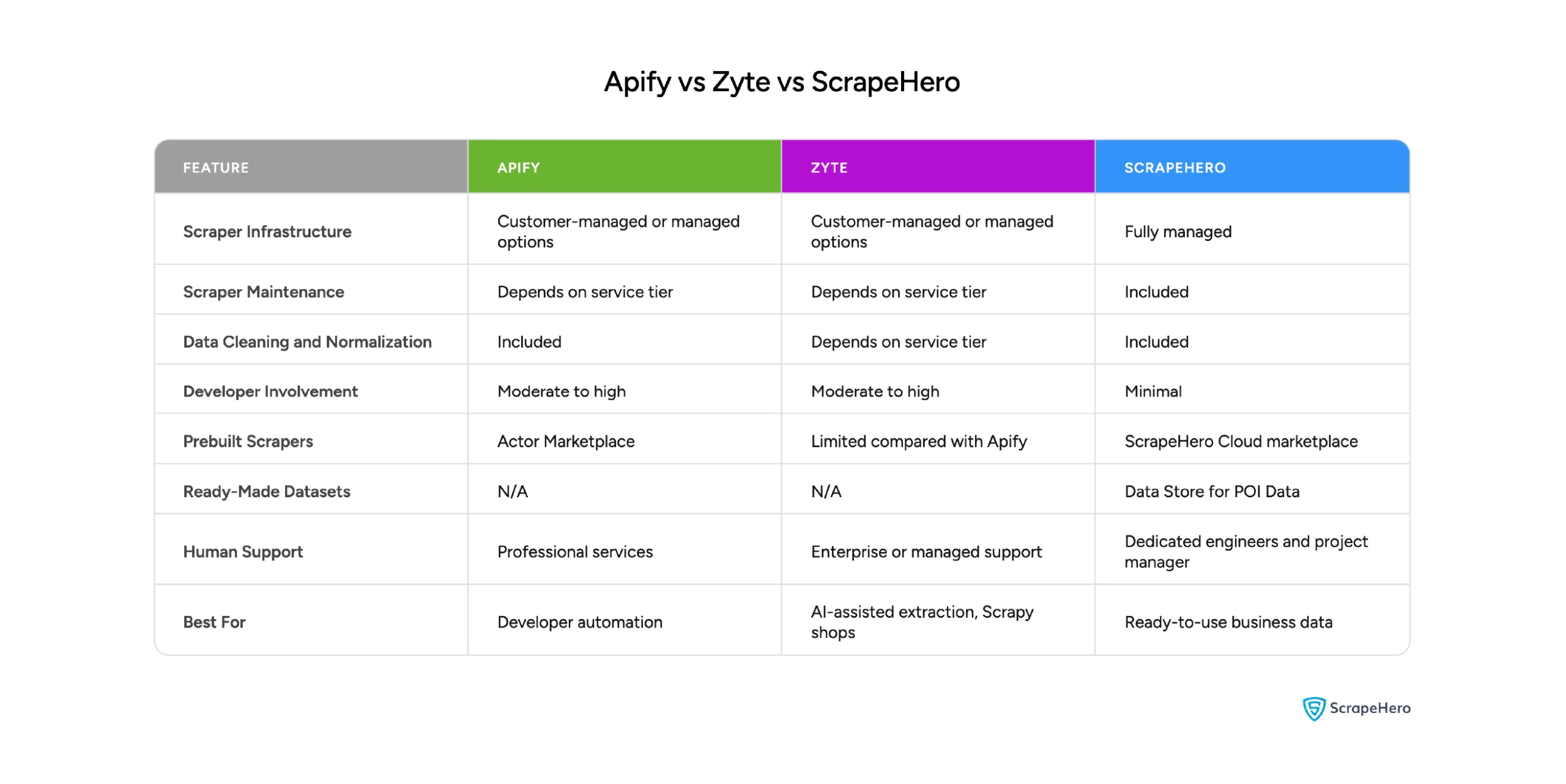
TL;DR: Apify vs Zyte vs ScrapeHero
Final Thoughts
FAQs
Apify is a developer-first automation platform built around Actors, Crawlee, and a large marketplace of prebuilt scrapers. Zyte is a managed extraction service built around a unified API, AI-assisted extraction, and the Scrapy ecosystem. In short, Apify is broader; Zyte is more focused on extraction quality.
It depends on the workload. Apify is better for teams that want reusable Actors, marketplace scrapers, and workflow automation. Zyte is better for teams focused on managed extraction, especially those already using Scrapy.
ScrapeHero for fully managed web scraping. Bright Data and Oxylabs for enterprise proxy infrastructure. ScraperAPI for simpler proxy API workloads.
Apify’s plans in 2026 run from $0 to $29 (Starter), $199 (Scale), and $999 (Business), with custom Enterprise pricing above that. The monthly fee is prepaid platform usage, and it isn’t a flat subscription. Compute units, proxy bandwidth, storage operations, and paid Store Actors all draw down that budget.
Zyte API bills pay-as-you-go with no minimum commitment. Request cost varies by target-site difficulty and features enabled.
Scrapy Cloud runs completely free for small projects and $9 per unit per month for professional usages. More units unlock parallel jobs and longer retention.
Zyte Data pricing starts at $500 per month for standard data types and pricing for custom data types starts at $1000 per month which is slightly on the expensive side.
There’s no single best web scraping platform. Apify and Zyte are strong for developer teams. However, ScrapeHero is stronger for businesses that want fully managed data delivery.
For structured data extraction with AI-assisted parsing, Zyte API is a leading choice for any web scraping API need. For automation and prebuilt actors, Apify’s API is a strong option. For fully managed data delivery, ScrapeHero handles the API layer as part of the service.
Apify includes datacenter, residential, and SERP proxies along with browser fingerprint handling. It handles common anti-bot systems, and difficult targets may still require Actor-level tuning.
Yes. Apify for developers means Crawlee, Actor development in JavaScript and Python, a mature CLI, and strong integration options — all built with engineering teams in mind.