If you’re comparing Apify vs ScrapingBee, this article breaks down how Apify and ScrapingBee compare on architecture, pricing, developer experience, scalability, and total cost of ownership. It also introduces an alternative for teams that want reliable data without managing scrapers themselves.
Along the way, we’ll answer key questions like:
- Is ScrapingBee better than Apify?
- Which API is better for web scraping?
- Is ScrapingBee cheaper than Apify?
- What is the best web scraping API?
- Does ScrapingBee rotate proxies?
- Does ScrapingBee have pre‑built scrapers?
- What are the alternatives to ScrapingBee?
By the end, you’ll know which platform fits your team — and whether a fully managed option might save you time, money, and maintenance headaches.
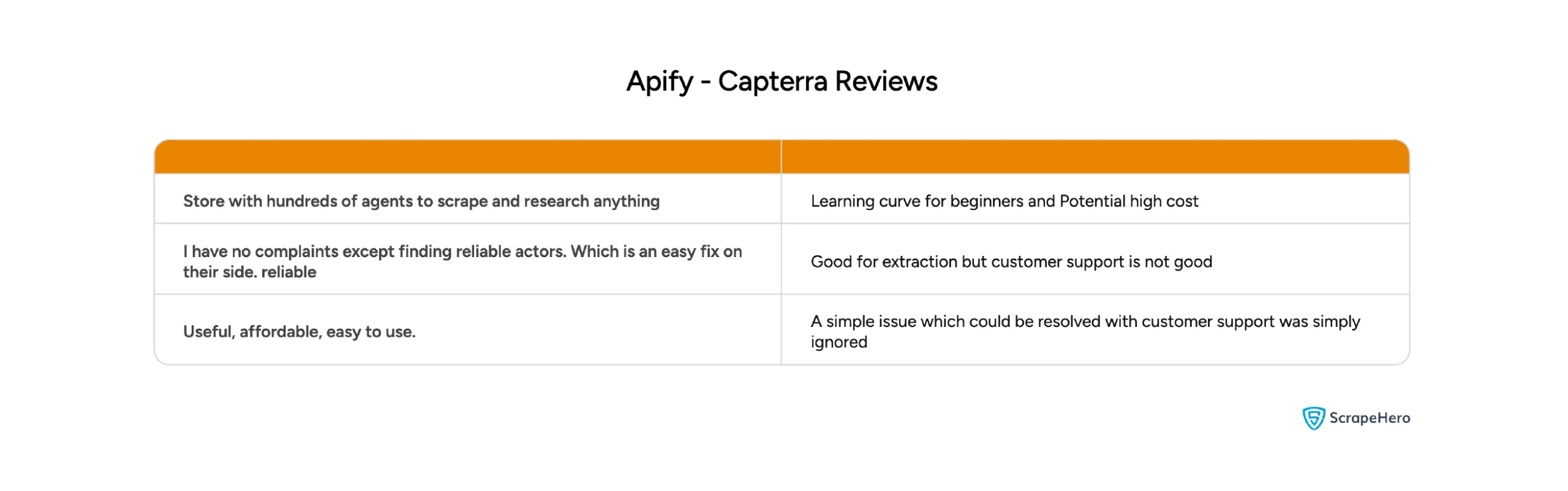
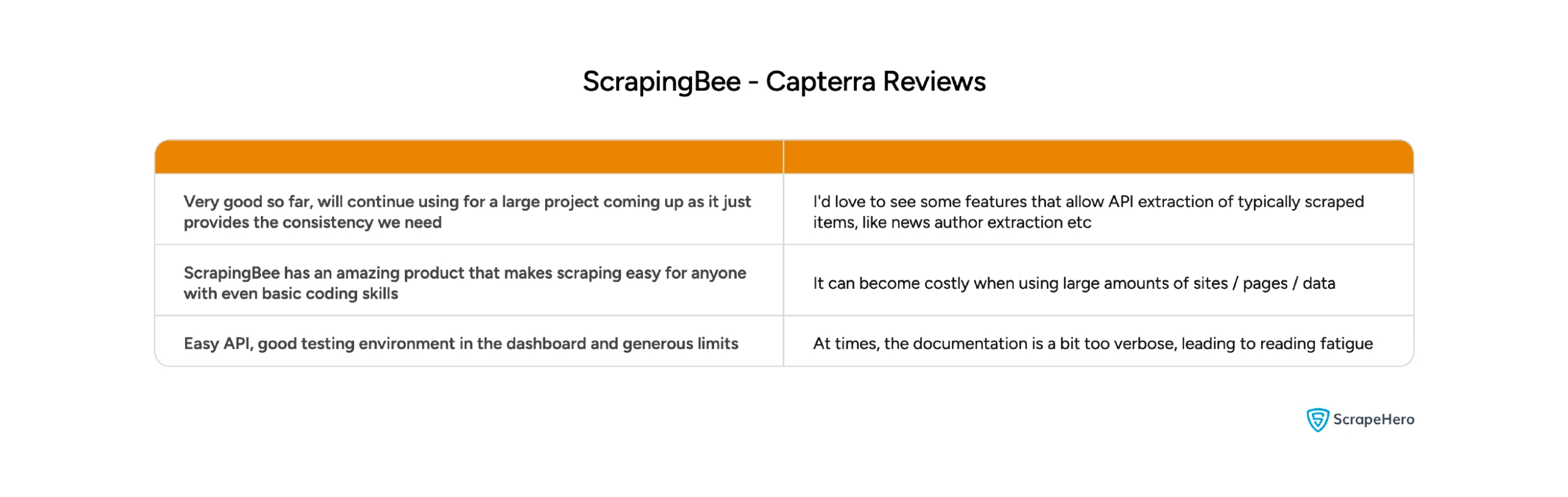
Quick Answer: Apify is a broader cloud platform for building and automating scraping workflows, while ScrapingBee is a lightweight API that handles fetching, rendering, and proxies for scrapers you already own. Apify is a cloud platform for building, running, and scaling web scrapers and automation workflows. Its core building block is the Actor – a serverless program that runs in Apify’s cloud, takes an input, and produces structured output. The platform includes: In short, Apify is a place where teams build, deploy, automate, and monitor scraping workflows without provisioning their own servers. Apify browser automation is handled through Puppeteer and Playwright, giving teams flexibility for JavaScript-heavy sites. In addition, Apify has a fully managed web scraping service where they handle end to end data extraction for large businesses. ScrapingBee is a web scraping API. Specifically, you call one endpoint with a URL and a few parameters, and ScrapingBee handles the parts most teams find hardest: JavaScript rendering, proxy rotation, and anti‑bot handling. The service includes: In practice, ScrapingBee is a “send a URL, get the page back” service that slots directly into an existing codebase. Both platforms serve overlapping customer types, including: Both platforms attract e‑commerce teams, developers, market intelligence firms, price monitoring teams, data teams, AI companies, research groups, and SaaS builders. However, the difference comes down to what a team already has in place: teams building from scratch tend toward Apify, while teams with an existing scraper that just needs better proxies and rendering reach for ScrapingBee. Apify gives you more of the scraping workflow; ScrapingBee gives you a simpler API layer for accessing websites. In fact, every other difference follows from that one. Quick answer: Apify’s biggest strengths are its 30,000+ Actor marketplace, the open-source Crawlee framework, and fully managed cloud infrastructure that removes the need to run your own servers. The key strengths of Apify are as follows: The Actor marketplace is Apify’s biggest advantage. Specifically, it hosts more than 30,000 pre-built scrapers for popular sites, including Amazon, Google Maps, TikTok, LinkedIn, Instagram, and Booking.com. For teams evaluating Apify web scraping capabilities, the marketplace is usually the biggest draw. For common targets, you can go from zero to structured data in minutes without writing a scraper. You can also fork and customize existing Actors, which shortens development time for site-specific work. Underneath is Crawlee, Apify’s open-source Node.js and Python crawling framework. It handles browser automation, request queues, proxy integration, and retries out of the box, and it’s the same framework Apify uses internally. As a result, teams that want deeper control get a well-maintained framework instead of a proprietary black box. Everything runs in Apify’s cloud, so there’s no scraping infrastructure to provision, patch, or scale. Runs can be scheduled, triggered by webhook, or started through the API. On top of that, every run is logged and monitored in the dashboard. Apify also includes datasets, key-value stores, and request queues by default. Results can be exported as JSON, CSV, Excel, or HTML, or streamed to external systems through webhooks and the API. For teams that would otherwise stand up S3 buckets and a database just to hold scraped output, that alone saves real setup time. Finally, Apify handles workflows that go beyond a single fetch. You can chain Actors, run recurring collections, feed data into AI pipelines, and build multi‑step processes that combine scraping with enrichment, deduplication, and delivery. Quick answer: Apify still requires ongoing maintenance and monitoring, its usage-based pricing can burn through credits quickly on heavier workloads, and the platform has a real learning curve. The key strengths of Apify are as follows: Apify’s platform isn’t zero maintenance. In other words, teams still have to monitor Actors, fix broken workflows when websites change, validate output, maintain custom Actors, and manage anything downstream of the dataset. Understanding Apify pricing matters before you commit, since it runs on a subscription‑plus‑usage model. The monthly fee is effectively a prepaid usage budget, and compute units, proxy bandwidth, storage, and rented Actors all draw it down. As a result, unoptimized scrapers on heavier RAM tiers can burn through credits faster than teams expect. There’s also a learning curve. Apify is developer‑friendly, but Actors, Crawlee, the API, cloud execution settings, and pay‑per‑event Store pricing all take real time to learn well. TL;DR: Apify. Choose Apify if you want a complete platform for building, running, and automating scraping workflows. Avoid Apify if you’re cost‑sensitive, since the subscription‑plus‑usage model can burn through credits faster than expected, especially with unoptimized scrapers. Quick Answer: ScrapingBee’s core strengths are its one-call API integration, built-in headless browser rendering, and proxy rotation that removes the need to run your own proxy pool. Following are the key strengths of ScrapingBee: ScrapingBee is designed around one API call. You pass a URL, set a few parameters, and get back the rendered page or a structured extraction. For developers who already have their own parsers and pipelines, integration is often a matter of hours. The service runs a full headless Chrome for you. Single‑page apps, lazy‑loaded content, waits for selectors, and custom click‑and‑scroll scenarios all get handled server‑side, so your team doesn’t have to run a Puppeteer or Playwright fleet. ScrapingBee also ships with rotating datacenter proxies by default, plus premium residential and stealth options and country‑level geolocation. That removes an entire class of work: procuring, monitoring, and rotating an in‑house proxy pool. Extraction options go well past raw HTML. You can pass CSS selectors or XPath in the request, use AI extraction with a natural‑language query, get Markdown or plain text, or take a full‑page screenshot. On top of that, dedicated endpoints cover Google, Amazon, Walmart, YouTube, and ChatGPT. Because it’s just an HTTP call, ScrapingBee slots cleanly into existing applications, data pipelines, automation platforms, and AI workflows. In other words, it doesn’t ask you to adopt an ecosystem. Quick answer: ScrapingBee leaves parsing, storage, and orchestration to you, has no pre-built scraper marketplace, and its credit multipliers can create budget surprises on heavier configurations. Following are the key limitations of ScrapingBee: You still own the scraper. ScrapingBee handles page fetching, so proxies, browsers, and anti‑bot work are off your plate. However, everything else – parsing logic, data schemas, storage, scheduling, validation, downstream integrations, stays with your team. There’s no broad marketplace of pre‑built scrapers. ScrapingBee’s model centers on its API, so you don’t get the equivalent library of site‑specific scrapers you can rent or fork with Apify. For teams that want to skip building common scrapers from scratch, that gap matters. Credit multipliers can catch you off guard, so it helps to understand ScrapingBee pricing before you commit. ScrapingBee’s per‑request credit cost varies with configuration. A basic request costs 1 credit, JavaScript rendering adds 5 credits, premium proxies cost around 25 credits, and stealth mode can run 75 credits per request. For example, on the 250k‑credit Freelance plan, a stealth‑mode workload could translate to roughly 3,300 requests, not 250,000. Reviewers consistently flag this as the biggest source of budget surprises. Scheduling, datasets, retries, and orchestration sit outside ScrapingBee’s core. Instead, you add them yourself or plug in another tool. TL;DR: ScrapingBee. Choose ScrapingBee if you already have scraping logic and want a simple API for browser rendering, proxy management, and reliable page retrieval. Avoid ScrapingBee, if you need a complete workflow out of the box as scheduling, datasets, retries, and orchestration sit outside ScrapingBee’s core. You’ll have to build or bolt on those pieces yourself. Quick Answer: For engineering teams, Apify functions like a PaaS where scrapers live inside the platform, while ScrapingBee acts as a gateway your own codebase calls for the fetch step. When you weigh Apify vs ScrapingBee API design side by side, the gap becomes clear: Apify gives you Actors, Crawlee, a REST API, SDKs in Node.js and Python, webhooks, cloud execution, and the marketplace. ScrapingBee gives you a REST API with browser rendering, JavaScript scenarios, proxy controls, extraction rules, and AI extraction. Put simply, Apify is a broader development environment. By contrast, ScrapingBee is a scraping service you drop into your existing stack. Both handle custom scraping well. The difference is architectural. With Apify, your scraper lives inside the platform as an Actor. With ScrapingBee, your scraper lives in your own codebase and calls ScrapingBee for the fetch step. Apify’s model is closer to a PaaS. ScrapingBee’s model is closer to a proxy‑and‑browser gateway. For pre‑built scrapers, Apify has thousands of Actors in its marketplace. ScrapingBee’s dedicated endpoints for Google, Amazon, Walmart, YouTube, and a handful of others cover the largest use cases, but there’s no comparable open library of site‑specific scrapers. For teams targeting popular sites, Apify’s marketplace is faster. Looking specifically at Apify vs ScrapingBee for Amazon, Apify offers ready-made Amazon Actors in its marketplace, while ScrapingBee provides a dedicated Amazon endpoint instead. Both scale, in different shapes. ScrapingBee’s concurrency is tier‑based, from 50 concurrent requests on Freelance to 400 on Business+. Apify’s concurrency and RAM ceilings also scale by tier, up to 512 GB of RAM and 256 concurrent runs on Business plan. If your workload is API‑based fetching, ScrapingBee scales linearly by tier. If it’s end‑to‑end workflows with orchestration, Apify’s model fits better. Quick Answer: At small volumes, both platforms work well; at scale, Apify absorbs more of the operational burden while ScrapingBee still leaves parsing, storage, and orchestration to your team. Apify’s cloud handles execution, scheduling, and storage, so a lot of the operational plumbing is off your plate. What stays on your plate is Actor maintenance, dataset validation, and monitoring for broken workflows. By contrast, ScrapingBee removes proxy and browser pain, which alone can save weeks of work. Everything else – parsing, storage, orchestration, retries, monitoring – still sits inside your codebase. Successful page retrieval and business‑ready data are two different things. Both platforms return raw HTML or lightly processed output by default. Turning that into clean, deduplicated, normalized records with consistent schemas is the customer’s job in both cases. If your business decisions depend on the data, that quality gap turns into engineering work you can’t avoid. However, if you choose Apify’s professional scraping service, its team can handle the entire data pipeline end to end. ScrapingBee does not offer a comparable fully managed service. For delivery, Apify has native datasets, JSON/CSV exports, cloud storage, scheduled delivery, and webhooks. By contrast, ScrapingBee returns responses to your application, and you handle delivery yourself. Maintenance is where a lot of scraping projects quietly go over budget. When a website redesigns, when selectors move, when Cloudflare tightens up, when a proxy pool starts getting blocked, someone has to fix it. With ScrapingBee, that someone is your engineer rewriting parsers. With Apify, it depends. For rented Actors, the Actor author may push updates. For custom Actors, it’s your team. Neither tool removes this problem. They shift where it lives. Beyond either sticker price, the honest total cost includes engineering time, maintenance hours, storage, monitoring, failed request retries, and the internal operational overhead of running the workflow. That’s where “cheap” tools often turn expensive. We pulled the following user reviews directly from Capterra, so you can see how Apify & ScrapingBee hold up in real-world use. Apify review average – 4.8/5 ScrapingBee review average – 4.9/5 The choice between Apify and ScrapingBee ultimately comes down to how much of the scraping operation you want your team to own. Apify gives you a broader platform to build and automate workflows, while ScrapingBee simplifies the infrastructure layer but still leaves your team responsible for parsing, validation, storage, and maintenance. That works well when you have developers who want to build and manage the scraping stack. But what if your team doesn’t want to own that operational workload at all? If you’re browsing Apify alternatives or scrapingbee alternatives, this is the point in the comparison where a managed option usually enters the conversation. That’s where a fully managed alternative like ScrapeHero fits. Instead of giving you another set of tools to operate, ScrapeHero, the top enterprise data provider, takes responsibility for the scraping operation and delivers business-ready data to you. ScrapeHero is a fully managed web scraping service. You describe the data you need, and ScrapeHero handles scraper development, proxy management, browser rendering, anti‑bot handling, website‑change monitoring, maintenance, validation, cleaning, normalization, and scheduled delivery. You use the data. The scraping operation is someone else’s job. Every part of the pipeline, from writing scrapers to delivering validated data, sits inside ScrapeHero’s scope. When a site redesigns, ScrapeHero’s engineers fix it. When Cloudflare tightens, ScrapeHero’s team adapts. When data quality drifts, the QA process catches it before it reaches your systems. ScrapeHero combines AI-assisted validation with human review to catch errors that automated checks alone can miss. Data is checked for accuracy, completeness, consistency, and anomalies before delivery—helping you get clean, reliable data you can actually use. Onboarding, implementation, and ongoing operations run through real engineers and project managers, not just ticket queues. For teams where data reliability directly affects business decisions, that direct access is a meaningful difference. For teams that want a DIY option on common websites, ScrapeHero Cloud offers pre‑built scrapers for popular platforms. Those scrapers are maintained by ScrapeHero, so website changes get handled without customer effort. Some use cases like POI datasets don’t need a custom scraper at all. For those, ScrapeHero Data Store provides pre-collected POI datasets. If the data already exists, there’s no reason to build a scraper for it. TL;DR DIY tools like Apify and ScrapingBee work well for small projects and for teams with engineers who want to own the scraping stack. For businesses where scraping directly feeds core operations and data reliability shapes decisions, a fully managed service takes the maintenance tax and the billing surprises off the table. If your goal is reliable web data without maintaining a scraping system, ScrapeHero’s web scraping service is the stronger choice. At the end of the day, the Apify vs ScrapingBee decision comes down to how much operational ownership your team wants to take on. So, if you’re weighing Apify, ScrapingBee, or a fully managed alternative like ScrapeHero, the right choice depends on your team’s goals and resources. To explore which approach best aligns with your workflow and long-term data needs, schedule a call with our experts and get tailored guidance before you commit It depends on your needs. Apify is better for teams that want an end‑to‑end platform with pre‑built scrapers, scheduling, and storage. ScrapingBee is better for developers who just need a reliable fetching and rendering layer. ScrapingBee is a strong choice if you want a simple API that handles browser rendering, proxy rotation, and anti‑bot protection. Apify, meanwhile, is more than an API — it’s a full platform for building and automating scraping workflows. Neither is universally cheaper. ScrapingBee’s credit multipliers can inflate costs on JavaScript‑heavy or stealth workloads. Meanwhile, Apify’s compute‑unit model can get expensive on memory‑intensive jobs. The real cost depends on your workload shape and scale. The “best” depends on your goals. ScrapingBee is excellent for developers who already have parsing logic and just need reliable page retrieval. Apify is better if you want a broader platform with workflow automation. Yes. ScrapingBee includes automatic proxy rotation by default, with options for premium residential proxies, stealth mode, and country‑level geotargeting. Not broadly. ScrapingBee offers dedicated endpoints for Google, Amazon, Walmart, YouTube, and ChatGPT, but it doesn’t have a large marketplace of pre‑built scrapers like Apify. The main alternatives are: Key takeaways
How Do Apify and ScrapingBee Compare Overall?
What is Apify
What is ScrapingBee
Who Uses Apify and ScrapingBee?
What Do Apify and ScrapingBee Have in Common?
What Are Apify’s Strengths?
The Marketplace Advantage
The Crawlee Framework
Fully Managed Cloud Infrastructure
Built‑in Storage & Data Export
Workflow Automation Beyond a Single Fetch
What Are Apify’s Limitations?
Operational Maintenance & Monitoring
Usage‑Based Pricing & Cost Management
Learning Curve & Developer Onboarding
What Are ScrapingBee’s Strengths?
One API Call – Simple Integration
Headless Browser Rendering
Proxy Rotation & Geolocation
Flexible Extraction Options
Ecosystem‑Agnostic – Slots Into Any Stack
What Are ScrapingBee’s Limitations?
You Own the Scraper – ScrapingBee Only Fetches
No Pre‑Built Marketplace for Common Sites
Credit Multipliers Can Create Budget Surprises
Orchestration & Storage Are Your Responsibility
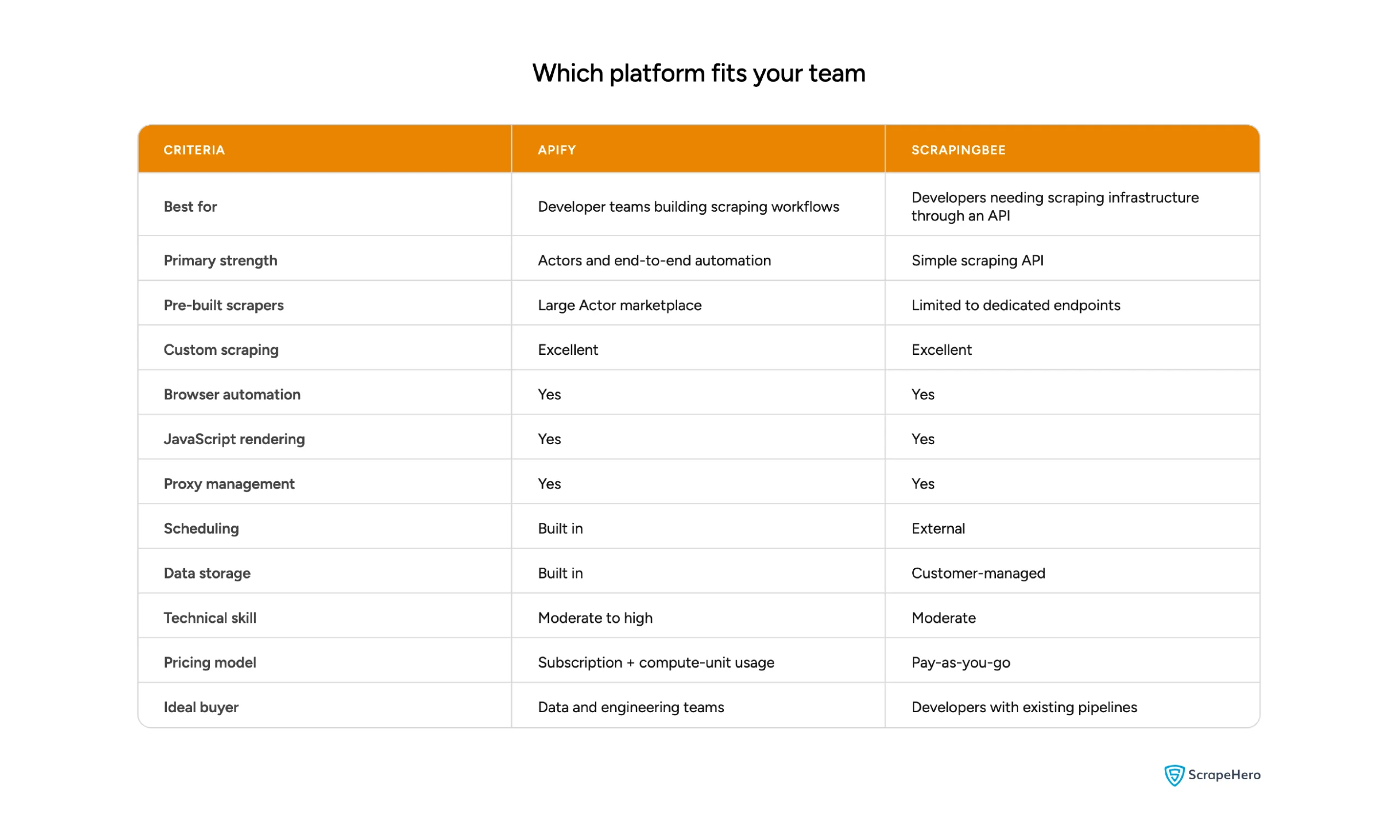
How Do Apify and ScrapingBee Compare for Engineering Teams?
Core Offerings – Platform vs. Service
Architectural Model – PaaS vs. Gateway
Pre‑Built Scrapers – Marketplace vs. Dedicated Endpoints
Scaling – Shapes & Tiers
Which is better for large-scale web scraping
Operational Maintenance – What Gets Handled for You
Turning HTML into Business‑Ready Data
Data Delivery – Native vs. DIY
Maintenance – The Hidden Budget Drain
The True Total Cost of Ownership
What Do Users Say About Apify vs ScrapingBee?
Is There an Alternative to Apify and ScrapingBee?
End‑to‑End Scope – You Just Use the Data
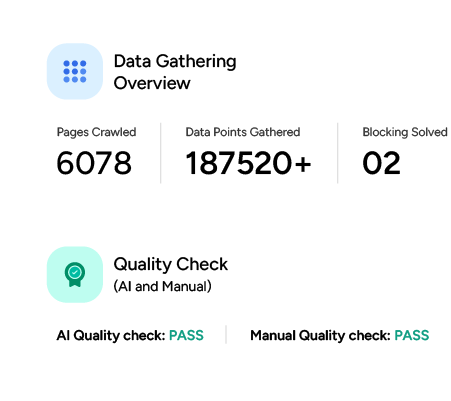
AI + Human Validation for Higher-Quality Data
Human‑Driven Support & Onboarding
ScrapeHero Cloud – Pre‑Built Scrapers, Maintained
ScrapeHero Data Store –Pre-Built POI Datasets
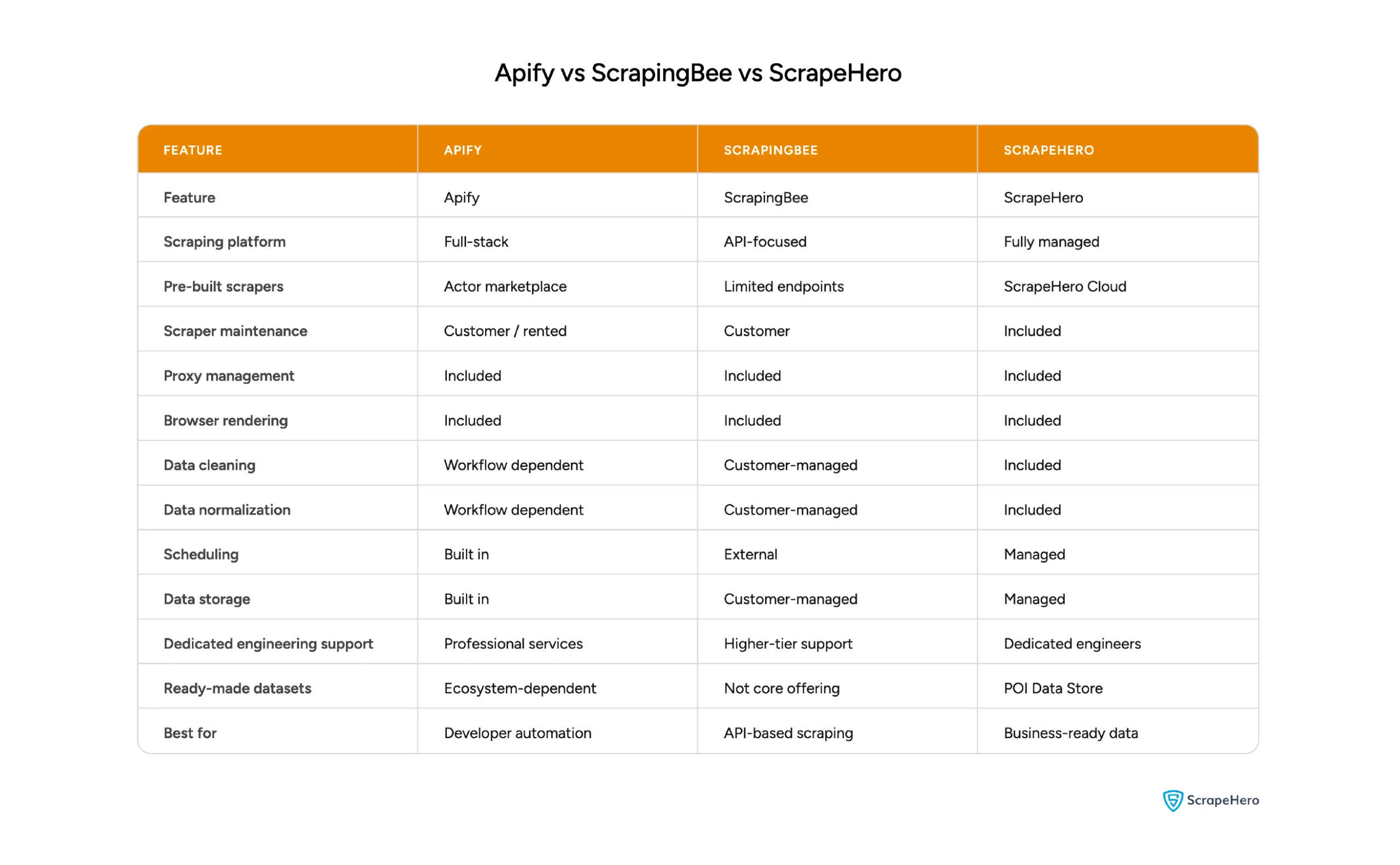
Apify vs ScrapingBee vs ScrapeHero
Final thoughts
FAQs
But if your team wants business‑ready data without owning the scraping stack, ScrapeHero offers a managed API tailored to your needs. Instead of a generic endpoint, ScrapeHero builds a custom API for your business, delivering validated, normalized data directly into your systems.
For enterprises or teams where scraping directly supports revenue, ScrapeHero’s managed API often proves the best fit. It’s not just one‑size‑fits‑all endpoint. Instead, ScrapeHero designs a custom API around your specific data requirements, handles scraper maintenance, and ensures clean, consistent delivery.
Apify — a full‑stack scraping platform with an Actor marketplace and workflow automation.
ScrapeHero — a fully managed service that delivers clean, business‑ready data without requiring you to maintain scrapers.