Bright Data is a recognized name in enterprise web scraping, but it isn’t the right fit for every team. Some organizations want less infrastructure overhead. Others need a more managed approach to data delivery, different support structures, or pricing that scales with actual usage rather than raw bandwidth.
This guide compares five Bright Data alternatives: ScrapeHero, Oxylabs, Apify, Zyte, and Octoparse. For each, you’ll see what the platform actually does well, who it’s built for, where it falls short, and how it prices.
Let’s discuss these in detail now.

What Do Businesses Actually Need From a Bright Data Alternative?
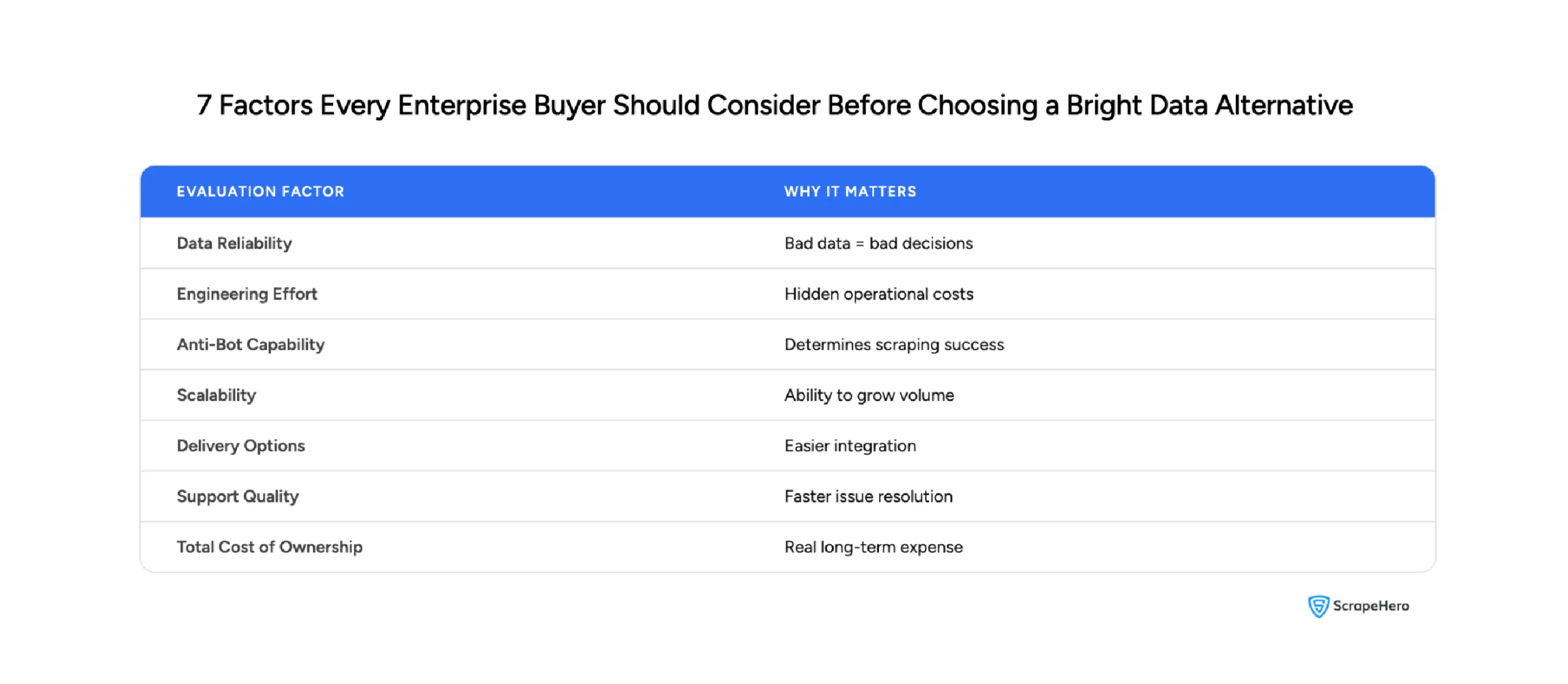
If you’re evaluating Bright Data alternatives, the decision probably goes beyond proxies or technicalities alone.
What most businesses are actually trying to solve is bigger: how do you collect reliable web data without wasting hours on building or managing an entire internal infrastructure layer? That’s the question worth starting with.
Here’s what makes it complicated. When looking closely at Bright Data competitors, you’ll realize that not all web scraping providers work the same way.
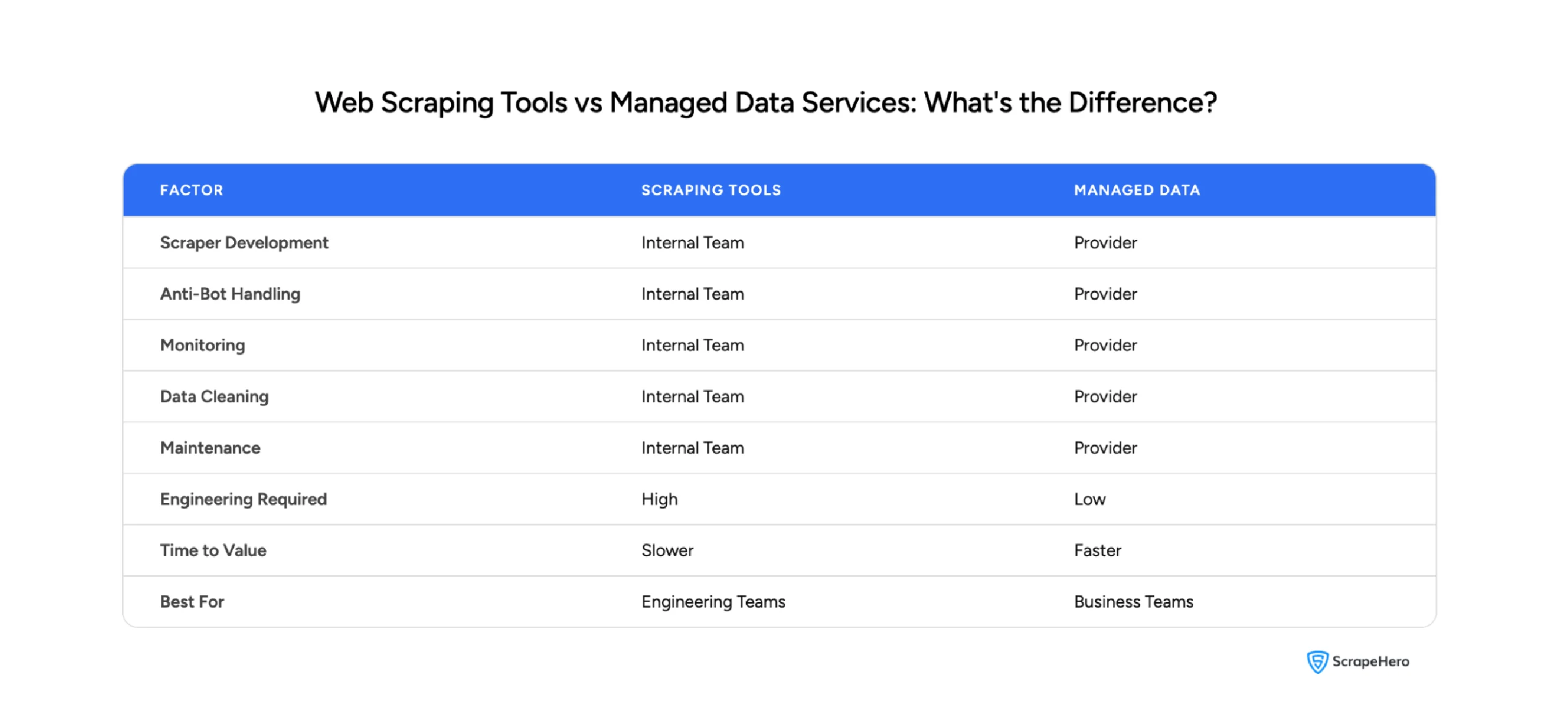
Some platforms give you the infrastructure — proxies, browser automation, scraping APIs, etc. That’s genuinely useful if you have an engineering team that wants direct control. But it also means someone internally is responsible for scraper development, anti-bot handling, monitoring, and data quality. The tool does its job. The operational burden stays with you.
In contrast, other providers take a more managed approach. They handle the full workflow — extraction, maintenance, normalization, scheduling, and delivery. You receive the data. They own the complexity.
So before comparing features, it’s worth asking a more grounding question: how much of this do you actually want to own? That answer narrows the field faster than any feature comparison will.
What Are the 5 Best Bright Data Alternatives?
- ScrapeHero
- Oxylabs
- Apify
- Zyte
- Octoparse
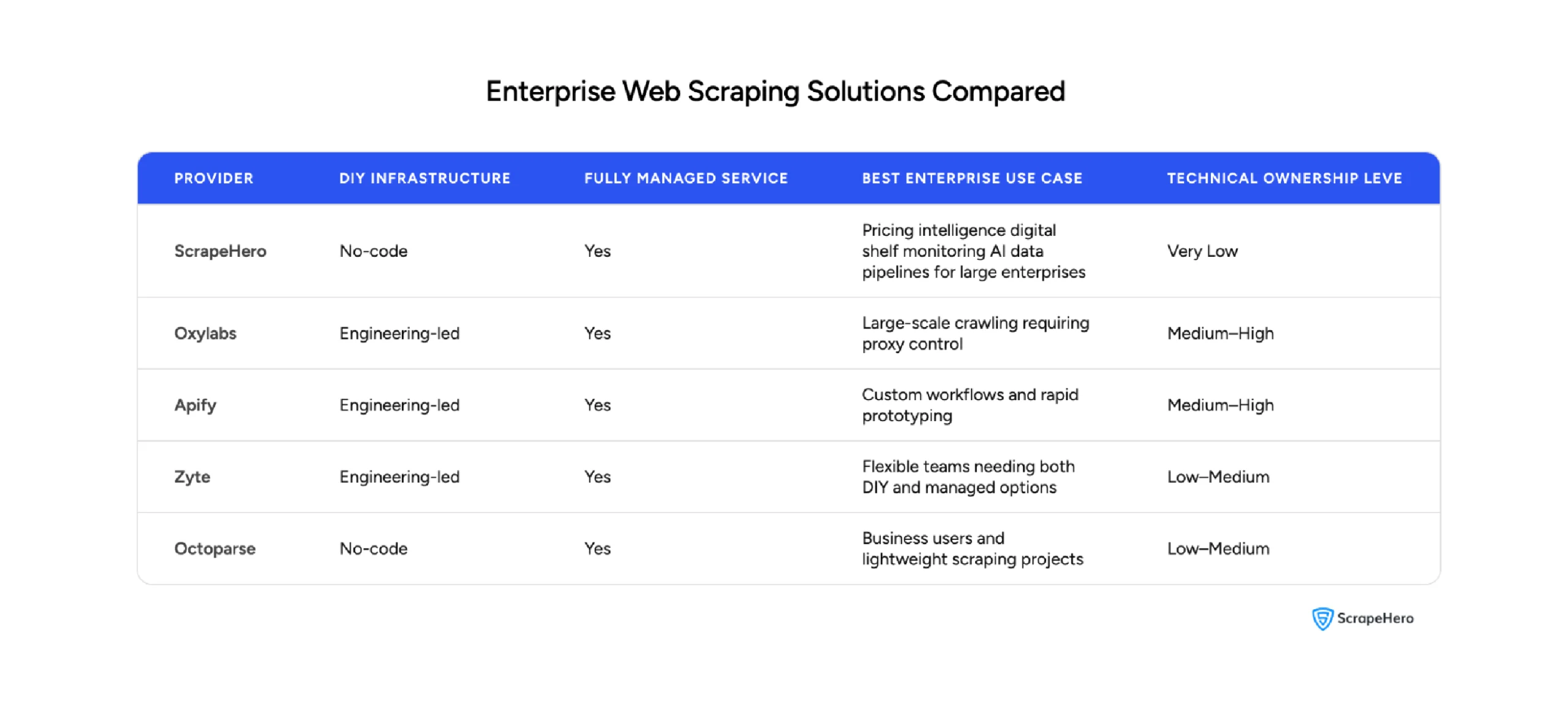
Not all these Bright Data alternatives solve the same problem. Some excel in scraping infrastructure and developer control, while others deliver fully managed data with minimal operational effort.
Here’s a comparison chart for a quick overview:
Web Scraping Services Comparison
Web Scraping Services Pricing Comparison
Comparing pricing isn’t always straightforward because each provider uses a different pricing model. The table below shows how the leading Bright Data alternatives structure their costs.
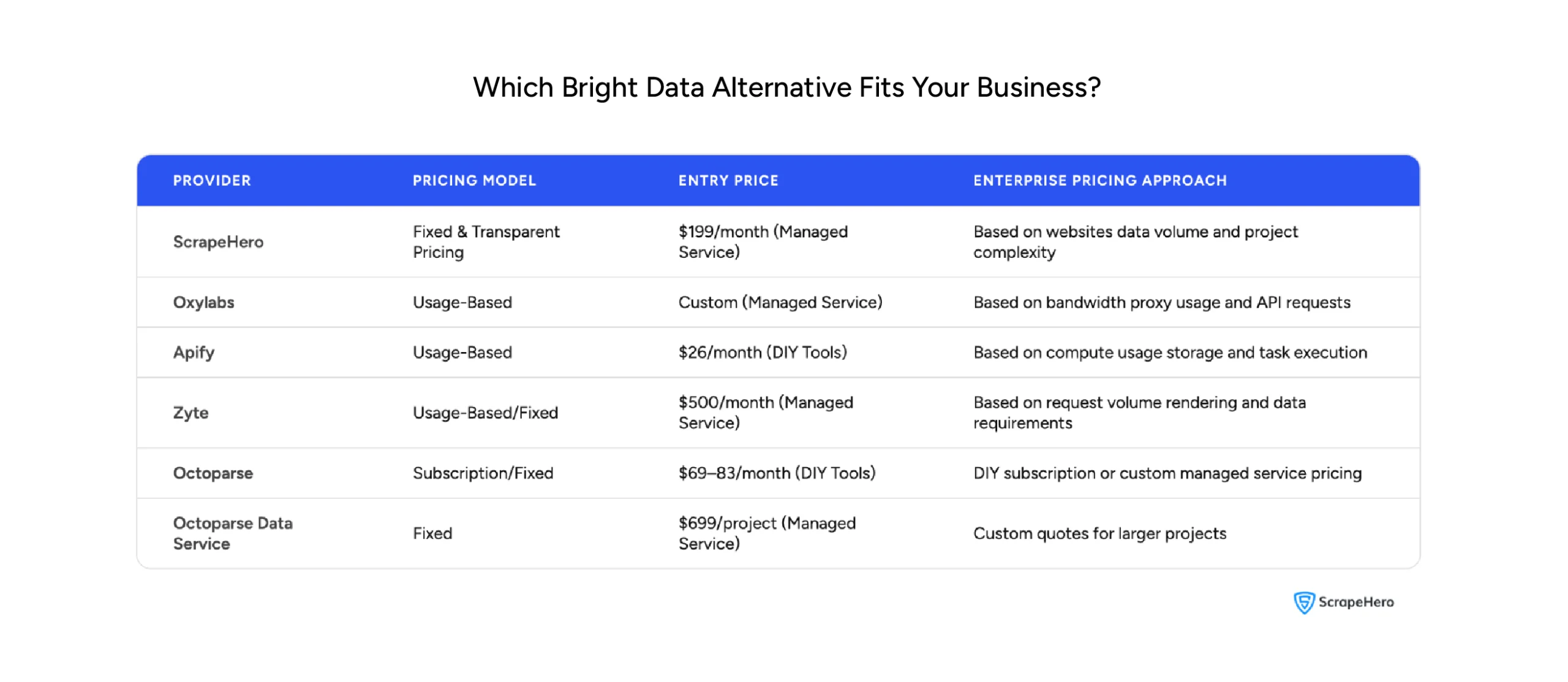
The high-level comparison provides a quick overview, but the real differences emerge when you look at each platform in detail. Here’s a closer look at the capabilities, limitations, pricing, and ideal use cases of the top Bright Data alternatives.
1. How Does ScrapeHero Stack Up?
What is ScrapeHero?
ScrapeHero is a fully managed enterprise web scraping service. It focuses on delivering structured, reliable web data to businesses that don’t want to handle the infrastructure side of data extraction.
It’s a different model from platforms built around proxies or DIY scraping tools.
ScrapeHero handles the operational work — scraper development, anti-bot handling, monitoring, maintenance, data normalization, and delivery. The idea is that your team receives usable data, not raw output that still requires significant downstream work.
Beyond the fully managed service, ScrapeHero also offers ScrapeHero Cloud, a marketplace of pre-built scrapers for many popular websites.
Where most other vendors in this space offer self-service tools that still require your team to handle setup, maintenance, and engineering, ScrapeHero Cloud’s pre-built scrapers are maintained and managed entirely by the ScrapeHero team. You pick the scraper you need, run it, and get the data. No internal engineering required.
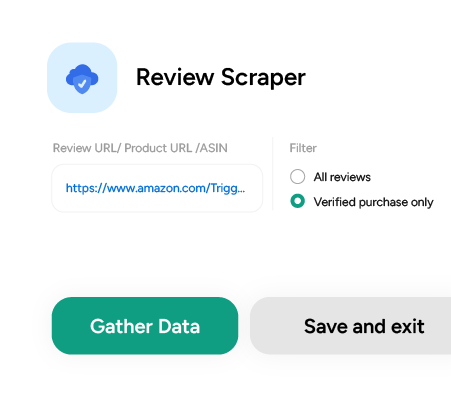
Both of these models tend to fit companies where web data supports critical capabilities such as pricing intelligence, digital shelf monitoring, competitor tracking, analytics, or AI pipelines.
Because ScrapeHero delivers data that’s already structured and normalized, it can meaningfully reduce the internal engineering time spent cleaning and maintaining pipelines after extraction.
What are ScrapeHero’s core capabilities?
Some of ScrapeHero’s core capabilities include:
- Fully managed web scraping infrastructure
- Custom APIs and automated data delivery
- Data cleaning and normalization
- AI-ready dataset preparation
- Robotic Process Automation (RPA)
- Enterprise-scale scraping support
- Ongoing monitoring and scraper maintenance
- Custom workflow development for large data operations
- ScrapeHero Cloud — a marketplace of pre-built scrapers for popular websites, fully maintained and managed by ScrapeHero. Unlike self-service tools from other vendors, there’s no internal engineering or maintenance required on your end.
ScrapeHero’s managed web scraping service is particularly useful for businesses scraping multiple websites at high frequency, where infrastructure maintenance can become a recurring operational task.
What are the limitations of ScrapeHero?
- Less focused on self-serve proxy tooling
- Custom pricing of managed service may not suit smaller one-time projects
- May offer more operational support than smaller teams require
How much does ScrapeHero cost?
ScrapeHero offers a transparent pricing structure with no hidden costs.
Their fully managed service starts at an accessible $199/month; enterprise plans start at $1,500/month.
For enterprise teams, ScrapeHero’s pricing structure can be more practical because it is tailored around the actual business use case rather than raw proxy or API usage alone.
Who is ScrapeHero best for?
ScrapeHero is generally a strong fit for:
- Teams tracking competitor pricing, product catalogs, and shifting market trends
- Market intelligence and business strategy units
- Enterprises looking to replace brittle, homegrown scraping systems
- Companies building AI models and analytics pipelines that rely on clean, structured web data
- Any business that wants a fully managed data extraction without tying up engineering resources
Compare the two platforms side-by-side across pricing, support, engineering effort, data quality, and enterprise scalability.
2. Is Oxylabs the Right Choice For You?
What is Oxylabs?
Oxylabs is one of the more recognized Bright Data Competitors in enterprise proxy infrastructure. If you need high scraping concurrency, broad global coverage, and direct control over your scraping operations, it’s built for that.
The platform goes well beyond pure proxy services.
Features like OxyCopilot, AI-Scraper, and an MCP Server reduce the manual engineering you’d normally handle when setting up and running scrapers.
And if you want even less hands-on involvement, their managed solution takes care of the entire pipeline — collection, validation, cleaning, and structured delivery. So you’re working with ready-to-use data, not raw output.
That said, how much Oxylabs handles depends on which product you’re using.
If you’re working directly with their proxy or scraper APIs, the pipeline is still yours to manage. But if you’re looking to offload that work entirely, the managed data acquisition option is worth a serious look.
What are the key features Oxylabs provides?
Oxylabs provides several tools designed for enterprise-scale scraping operations, including:
- Residential and datacenter proxy networks
- Web Scraper API with JavaScript rendering support
- Proxy rotation and session management
- Geographic targeting
- High concurrency support
- OxyCopilot and AI-Scraper for semi-automated workflow assistance
Who should use Oxylabs?
Oxylabs works well for:
- Data engineering teams with in-house crawler development capability
- Organizations running high-volume, multi-region scraping operations
- Businesses that need reliable proxy infrastructure and prefer to control extraction logic themselves
What are the limitations of Oxylabs?
- Data normalization, cleaning, and pipeline management are internal responsibilities if you’re using Self-Service APIs / Scrapers
- Engineering overhead is real and ongoing, even with AI-assist features
- Pricing scales with bandwidth and request volume, which can grow quickly at enterprise scale
- Less suitable for non-technical stakeholders or teams without dedicated scraping engineers
How does Oxylabs price its services?
Pricing for self-service APIs and scrapers is usage-based. What you pay depends on the proxy type you use, how much bandwidth you consume, and your API usage volume.
For managed services with custom datasets, pricing starts at $800/month.
3. Should Enterprises Choose Apify?
What is Apify?
Apify is a cloud-based scraping and automation platform built primarily for developers. Its main differentiator is the Actor marketplace, a library of over 33,000 prebuilt scrapers and automation templates covering a wide range of websites and use cases.
Apify provides your team with a cloud environment to build, deploy, schedule, and run scraping workflows. The Actor marketplace speeds things up; instead of writing every crawler from scratch, teams can start from something that already works and adapt from there. But someone still has to own it internally. A developer needs to select the right actors, configure them, monitor performance, and handle maintenance when things break.
That said, Apify offers professional services for businesses seeking a more hands-off experience.
In that model, their team handles the end-to-end workflow — so it’s not strictly a self-serve platform if you don’t want it to be.
Which direction makes sense depends largely on how much internal ownership your team is willing to take on. For businesses with developer resources that want flexibility, the self-serve model is a real advantage. For decision makers looking to hand off the data problem entirely, the managed route is worth exploring.
What are Apify’s key capabilities?
- Actor marketplace (33,000+ prebuilt scrapers and automation tools)
- Cloud-based scraping infrastructure
- Browser automation and JavaScript rendering
- Scheduled task execution and orchestration
- API integrations and webhook support
- Custom scraper deployment and management
- Data storage and export
Who is the target audience for Apify?
Apify suits:
- Startups and product teams that want flexible, developer-controlled scraping
- Technical teams building custom automation workflows
- Organizations that want to prototype quickly using existing marketplace actors
- Teams that are comfortable managing their own scrapers and handling output processing
- Businesses that prefer a hands-off approach, through Apify’s professional services
What are the limitations of Apify?
- Actors require ongoing maintenance as target websites change structure
- Enterprise-scale operations may eventually outgrow marketplace actors and need custom development
- Data quality and consistency depend heavily on how well the implementation is managed — whether that’s internally or through their professional services
How much does an Apify subscription cost?
Free plan and usage-based tiers are available for self-scraping tools. The paid plans start around $26/month for individuals, scaling up based on compute usage, storage, and task execution volume.
Meanwhile, their enterprise pricing starts at $2000, and you’ll need to contact their team directly for a custom quote.
4. Is Zyte Better for DIY or Managed Scraping?
What is Zyte?
Zyte is one of the longest-standing names in web scraping, built on the foundation of Scrapy, the open-source framework that many scraping engineers have worked with at some point in their careers.
What makes Zyte’s position interesting is that it genuinely serves both ends of the spectrum.
On one side, there’s developer-facing infrastructure — Smart Proxy Manager, Zyte API, and Scrapy Cloud for teams that want direct control.
On the other hand, Zyte Data is a fully managed service tier where they handle extraction and delivery end-to-end.
The Zyte API is worth calling out specifically as one of the premium web scraping API alternatives on the market. It’s particularly strong on JavaScript-heavy and dynamically rendered sites — combining proxy management, browser rendering, and AI-assisted extraction into a single endpoint. For e-commerce businesses dealing with modern, complex site architectures, that matters more than it might seem on paper.
What features does Zyte offer?
- Smart Proxy Manager
- Zyte API (proxy + rendering + AI-powered extraction, unified)
- Scrapy Cloud (managed cloud deployment for Scrapy spiders)
- Zyte Data (fully managed service — zero engineering involvement)
- AI-assisted extraction tools
- Dynamic website and JavaScript rendering support
Which user profiles fit Zyte best?
Zyte works well for two distinct user profiles:
DIY path: Engineering teams already running Scrapy-based workflows, or those building custom scraping infrastructure, who want reliable proxy and rendering infrastructure without managing it at the network level.
Managed path (Zyte Data): Teams with no scraping engineering resources who want clean, structured data delivered on a schedule. This is a premium service priced accordingly.
What are the limitations of using Zyte?
- The DIY path has a steeper learning curve and requires meaningful engineering investment
- Data normalization and downstream processing are still internal responsibilities on the DIY path
- Zyte Data pricing is at the higher end of the managed options
- Less community visibility than Apify for teams building from scratch
How does Zyte structure its pricing?
The self-service tools offer mid-to-enterprise usage-based pricing. Costs scale with request volume, rendering requirements, and proxy usage.
For the managed services, Zyte uses custom project-based pricing, with standard plans starting at $500/month for AI-supported data types. However, their custom-tailored data solutions start at $1,000/month based on specific business requirements.
5. Can Octoparse Truly Handle Enterprise Scale?
What is Octoparse?
Octoparse is another platform that’s genuinely built with two distinct offerings under one roof, and they serve pretty different needs.
The first is a no-code desktop tool. It uses a visual workflow builder, so operations teams, analysts, and business users can set up scraping tasks without writing a single line of code. If your team doesn’t have dedicated scraping engineers, that’s a meaningful advantage.
The second is a fully managed enterprise data service. In this model, Octoparse handles everything — anti-bot evasion, data cleaning, quality assurance, and scheduled delivery. You provide the target URLs. They take it from there.
Here’s the part worth paying attention to: those two products aren’t really competing in the same space. The no-code tool is built for lighter projects, faster onboarding, and teams that want simplicity. The managed service is a different conversation entirely, one that puts it in direct competition with enterprise-level Bright Data alternatives like ScrapeHero and Zyte Data.
So before evaluating Octoparse, it’s worth deciding which product you’re actually looking at.
What are the core features of Octoparse?
Octoparse includes several features aimed at simplifying web scraping workflows, including:
- Visual no-code workflow builder
- Cloud-based scraping
- Scheduled scraping tasks
- Prebuilt templates for common websites
- Export integrations
- Automated task execution
- Browser-based extraction support
- Dedicated support via Slack channel
- Free sample data delivered in 1-2 business days
What are the limitations of Octoparse?
- DIY tool has limited flexibility for enterprise-scale projects
- DIY tool is less suitable for highly dynamic or complex websites
- DIY tool may struggle with advanced anti-bot protections (relies on manual proxy setup, cookie clearing, user-agent rotation, and CAPTCHA solving)
- DIY tool’s custom workflow capabilities are more limited than those of developer-focused platforms
- Managed service is significantly more expensive (starting at $699/project)
- Managed service offers less control over the technical details of the scraping process
- Both offerings may still require internal work for final data integration, depending on your use case
What are the pricing options for Octoparse?
DIY no-code tool: Subscription-based. Free plan available. Paid plans start at approximately $69–83$ per month for the Standard plan, going up to $249–$299 per month for the Professional plan. Enterprise custom pricing is also available.
Fully managed Data Service: Project-based or monthly pricing. Starts at
$699/project. Custom quotes are available for larger volumes.
Which Web Scraping Service Matches What You Actually Need?
You should choose the right web scraping service for your business because picking the wrong one could hurt revenue, waste effort, and create business risk. So let’s get you a clear answer by tonight.
Which Web Scraping Tool Offers the Most Developer Flexibility?
If your team wants direct control over scraping workflows and infrastructure customization, evaluating these web scraping API alternatives like Apify, Zyte, and Oxylabs offers strong developer tooling.
Apify excels at rapid prototyping through its Actor marketplace. Zyte integrates deeply with Scrapy‑based pipelines. Oxylabs provides large‑scale proxy networks for high‑concurrency crawls.
On the other hand, ScrapeHero Cloud offers a self‑service Marketplace of pre‑built scrapers. You simply choose the scraper you need, and you get clean, structured data immediately—no pipeline setup, no crawler maintenance, and no hidden technical complexities.
Choose ScrapeHero when your team wants to skip the operational overhead and go straight from request to usable data for applications, dashboards, or internal tools.
What is the Best Web Scraping Tool for Startups?
Startups typically need speed and low upfront engineering commitment. Apify lets developer‑focused teams spin up scrapers quickly from existing Actors. Octoparse’s no‑code tool can work for light, structured scraping without dedicated engineers. However, both still require internal time for configuration, maintenance, and troubleshooting.
For startups that want production‑ready scrapers with near‑zero maintenance, ScrapeHero’s Cloud Marketplace provides prebuilt, managed scrapers for Amazon, Walmart, Google Maps, and other major platforms. Infrastructure, anti‑bot handling, and updates are fully managed, freeing your team to use the data rather than maintain extraction systems.
Which is the Best Bright Data Alternative for Enterprises?
When the goal is reliable web data without any internal scraping engineering, fully managed services are the only fit. ScrapeHero, Zyte Data, and Octoparse Data Service all handle extraction, anti‑bot evasion, data cleaning, and delivery.
However, ScrapeHero differentiates by putting real humans at every layer of the service—not just in QA, but in customer support, execution, project management, and beyond. While many providers rely purely on automation or AI‑only interfaces (like Slack bots or chatbots), ScrapeHero ensures you have access to experienced people at every touchpoint.
In ScrapeHero’s web scraping service, AI and automation are used to boost efficiency, not to replace human judgment.
For businesses where web data feeds pricing, analytics, or AI initiatives, that human‑in‑the‑loop approach can be the difference between an unreliable pipeline and lasting peace of mind about your data accuracy, uptime, and support.
The Bottom Line: How Should You Choose Your Scraping Provider?
Look, let’s cut the fluff.
If you are looking for robust Bright Data alternatives and you actually want proxy‑level control? Then Oxylabs, Apify, or Zyte’s infrastructure path works. Just know what you’re signing up for.
Need something in the middle—developer tools plus a fully managed option? Zyte’s got that spectrum covered.
But here’s the thing this web scraping services comparison highlights: The “easy” options still eat your team’s time. Sometimes more than the hard ones.
So, if your real priority is clean, structured data without you or anyone on your team ever touching a crawler again? That’s what ScrapeHero, the web scraping company does: managed execution, human‑augmented QA, clean data on time and zero maintenance on your end.
If you need more guidance on this, talk to our data experts. Tell them your team’s reality, your data needs, your biggest fear about getting this wrong. They’ll tell you what actually works—even if it’s not us.
FAQs
The best Bright Data alternatives include ScrapeHero, Oxylabs, Apify, Zyte, and Octoparse. Among them, ScrapeHero stands out for enterprises that want clean, reliable data delivered without managing scraping infrastructure internally.
For businesses that prioritize fully managed data delivery over proxy infrastructure, ScrapeHero can be a stronger alternative to Bright Data. It handles extraction, maintenance, data cleaning, and delivery, reducing the operational burden on internal teams.
Bright Data’s costs can increase significantly as bandwidth, proxy usage, and scraping volume grow. Many enterprises evaluate managed alternatives like ScrapeHero because they offer predictable pricing and eliminate much of the engineering overhead associated with large-scale scraping.
ScrapeHero is one of the strongest managed web scraping services for enterprises that need reliable, structured data without building or maintaining scraping infrastructure. The service includes scraper maintenance, anti-bot handling, data normalization, and ongoing support.
Apify and Octoparse offer lower entry-level pricing than Bright Data, making them attractive for smaller projects. However, for organizations evaluating total cost of ownership, managed solutions like ScrapeHero can often reduce long-term engineering and maintenance expenses.
ScrapeHero requires the least maintenance because it manages the entire data collection process, including scraper development, monitoring, updates, anti-bot handling, and data delivery. This allows teams to focus on using the data rather than maintaining extraction systems.