Bright Data and Apify are often compared. Both help businesses collect public web data at scale. But they take different approaches.
Bright Data focuses on enterprise-grade infrastructure. It offers a broad portfolio of scraping products and managed services. Apify is built for developers. It offers a large marketplace of pre-built Actors, plus tools to build custom workflows.
So which one is right for you? This Bright Data vs Apify comparison looks at pricing, engineering effort, scalability, and total cost of ownership.
Bright Data is best for enterprises that need extensive proxy infrastructure, global scale, and maximum control over scraping workflows. Apify is ideal for developer teams that want to build and automate scraping workflows using reusable Actors and cloud infrastructure. Both platforms offer managed services, but self-service users should still expect to maintain workflows, monitor site changes, and prepare data for downstream use. If your goal is business-ready data instead of scraping infrastructure, a fully managed alternative significantly reduces operational overhead. The best platform depends on how much of the scraping pipeline your team wants to own.
Bright Data vs Apify: The Overview
Both web scraping platforms help you collect public web data at scale. Additionally, both support browser automation, scheduled scraping, JavaScript rendering, and cloud execution. Furthermore, both can handle large workloads across many websites.
That said, the real difference is in how each platform approaches the work.
Bright Data is an enterprise web data platform.
Its ecosystem includes proxy networks, Web Unlocker, Scraper APIs, Browser API, ready-made datasets, and a fully managed data acquisition service. Here, teams can build their own pipeline. Or they can outsource the whole process and receive structured data on a schedule.
Apify takes a developer-first approach. It’s best known as a data extraction platform built for engineering teams. It offers a cloud platform for building, deploying, and managing scraping workflows. Teams can use custom code or choose from thousands of pre-built Actors in the Apify Store. For teams that want less hands-on work, Apify also offers professional services.
Who uses these platforms?
Typically, e-commerce brands, market intelligence teams, AI companies, etc. Most rely on public web data for pricing, product monitoring, or competitive research.
Both platforms offer:
- Cloud-based web scraping infrastructure
- Browser automation and JavaScript rendering
- APIs for custom data extraction
- Scheduled scraping and workflow automation
- Anti-bot handling
- Managed services for enterprise customers
- Enterprise support for large-scale projects
Ultimately, the right choice often comes down to your engineering resources, your scaling needs, your budget, and how much of the process you want to manage in-house.
This Bright Data vs Apify comparison comes down to control, speed, and budget.
Bright Data: The Good
Proxy infrastructure
This is Bright Data’s biggest strength. It offers residential, mobile, ISP, and datacenter proxies across hundreds of millions of IP addresses. Paired with Web Unlocker and Browser API, it works well for teams scraping across many countries or facing strong anti-bot defenses.
Managed service
Not every company wants to build and maintain its own scraping setup. For this reason, Bright Data’s Managed Data Acquisition service handles scraper development, proxy management, website changes, data validation, and scheduled delivery. As a result, your team gets clean data without running the pipeline.
Product ecosystem
Bright Data offers more than proxies.
Its lineup includes Scraper APIs, Browser API, Web Unlocker, Scraper Studio, pre-collected datasets, Retail Intelligence products, and AI-ready tools.
This gives engineering teams several ways to collect and use web data.
Enterprise support
Large companies often need more than a help document.
Bright Data offers real onboarding, dedicated account managers, compliance certifications, and support built for large, complex projects. This helps reduce risk on big projects, especially for enterprise web scraping projects.
Flexible workflows
Teams can build custom pipelines with Bright Data’s APIs. Or they can lean on the managed service if they have fewer engineering resources. This flexibility suits many enterprise use cases.
Bright Data: The Not-So-Good
Enterprise pricing
The fully managed service typically starts at $1,000 to $2,500 a month. Additionally, managed services often need custom contracts and minimum spend, which may not fit smaller companies.
Usage-based pricing
Most self-service products charge based on bandwidth, request volume, and browser rendering. As scraping grows, monthly costs can get harder to predict.
Setup time
Managed projects need an onboarding phase. Requirements get defined. Scrapers get set up. Delivery workflows get built. Teams that need data right away should plan for this lead time.
Technical expertise
Bright Data’s tools are powerful, but they still require skilled engineers. Teams running their own scraping remain responsible for workflow design, integrations, and monitoring.
Apify: The Good
Actor Marketplace
This is Apify’s standout feature. It gives developers access to thousands of pre-built Actors for popular sites and tasks. Teams can start with an existing Actor, customize it, and launch faster instead of building from scratch.
Crawlee framework
Apify has Crawlee, an open-source framework for building web crawlers.
It supports browser automation, request handling, proxy integration, and large-scale crawling. In short, it’s a solid base for custom scraping projects.
Cloud automation
Apify runs scraping jobs in the cloud, so you don’t manage servers.
Teams can schedule Actors, monitor runs, automate repeat jobs, and connect workflows through APIs and webhooks. This cuts down on operational work.
Developer experience
Apify is built with developers in mind. Its documents, SDKs, APIs, and cloud tools make it easy to build, test, and launch workflows. Also, it supports many languages and fits well into existing dev pipelines.
Flexible automation platform
Apify is known for scraping, but it does more.
Teams can build workflows for data extraction, browser automation, AI tasks, and other recurring business processes on the same platform.
Apify: The Not-So-Good
Engineering responsibility
Pre-built Actors save time, but they don’t remove maintenance work. When sites change their layout or anti-bot systems, your team still needs to update and fix workflows, unless you use Apify’s professional services.
Usage-based pricing
Pricing scales with compute use, storage, and task runs. This works well for small workloads, but costs can grow less predictable as volume increases.
Data processing after extraction
Getting the data is just one step. Most teams still need to clean and normalize the data before it’s ready for real use.
Technical learning curve
Apify is easier to learn than many infrastructure-heavy platforms. But it still targets technical users. Getting full value means learning Actors, cloud automation, and custom workflows.
Bright Data vs Apify for Engineering Teams
For engineering teams weighing Bright Data vs Apify, the decision often comes down to control versus speed.
If your team builds and maintains its own scraping setup, both platforms give you the tools to scale. The right pick depends on how much control your team wants, how fast you need to move, and how much maintenance you can handle.
APIs and developer tools
Both platforms offer APIs, browser automation, and cloud-based tools. Bright Data splits its offerings into separate products for proxies, browser automation, Web Unlocker, and extraction. This gives developers room to build custom pipelines.
Apify centers its tools around the Actor Marketplace and Crawlee, which usually means faster setup.
Custom scraping
Bright Data gives teams more control over every layer of the stack. Apify also supports custom scraping, but many teams start with an existing Actor and adjust it instead of building from zero.
Scalability
Both platforms handle large-scale projects well.
Bright Data has an edge for teams working across many regions or running high-volume workloads, thanks to its large proxy network.
Apify scales well too, especially for teams running many Actors and scheduled jobs.
Engineering effort
Neither platform removes the need for engineers on the self-service side. Developers still need to watch for site changes, maintain scrapers, manage data quality, and connect the data downstream. Apify can save development time through reusable Actors. Bright Data gives more room to build custom pipelines.
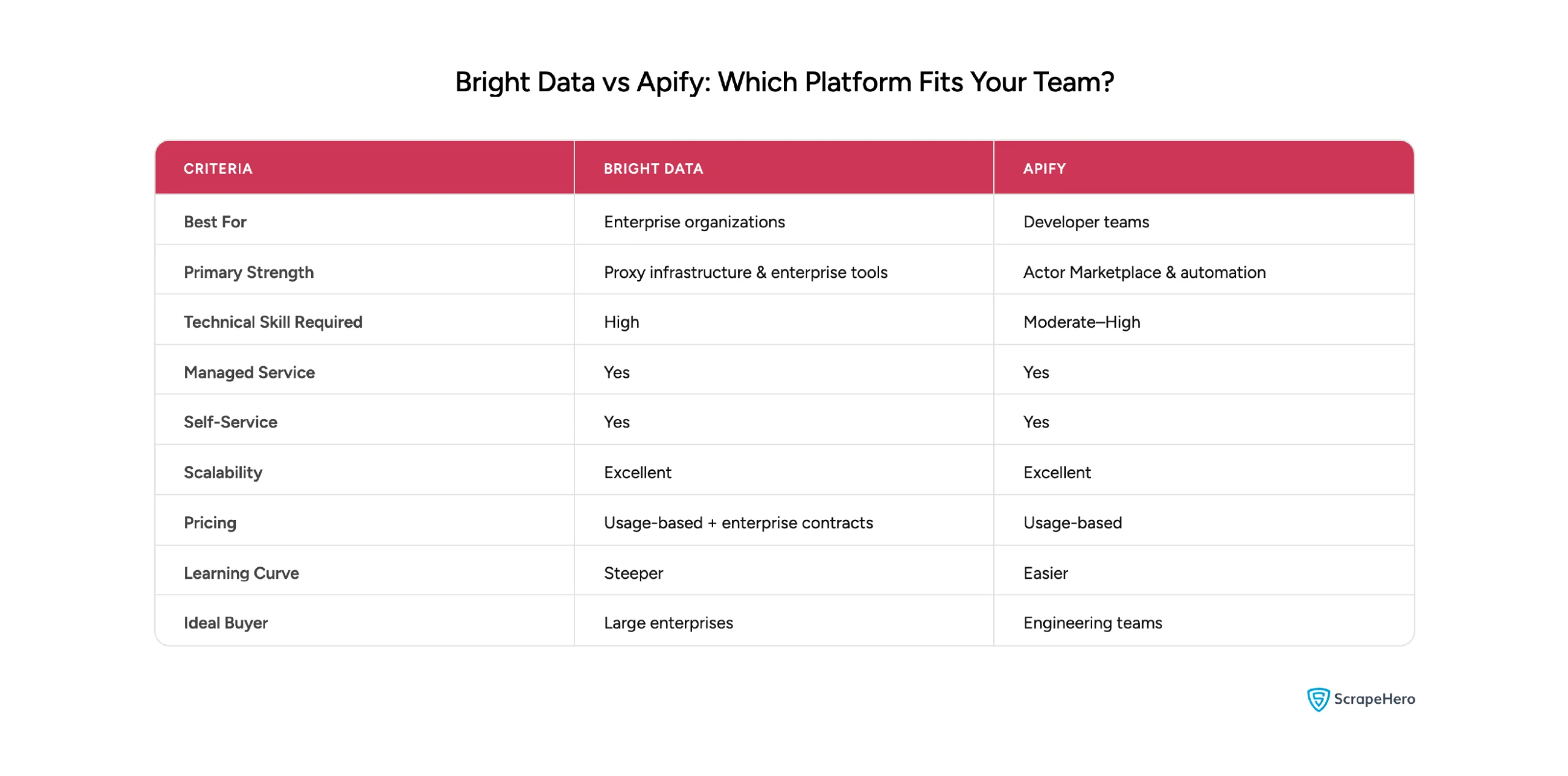
Bright Data vs Apify: Which Platform Is Better for Large-Scale Enterprise Scraping?
When it comes to Bright Data vs Apify for enterprise use, if you want structured web data without building your own infrastructure, both platforms offer managed services alongside self-service tools. The right pick depends on how much operational work you want to keep in-house.
Engineering involvement
Both providers cut down on internal dev work through their managed offerings. They handle scraper development, monitor site changes, and maintain workflows.
Data quality
Both platforms check data before delivery.
But the final quality still depends on how the project is set up. Teams using self-service tools may still need extra cleaning or checks before the data is ready for real use.
Data delivery
Both platforms support scheduled delivery through APIs, cloud storage links, and formats like JSON and CSV. This makes it easy to move data into dashboards, pricing tools, or machine learning workflows.
Enterprise support
Both companies offer enterprise onboarding and dedicated support.
Bright Data’s offerings go further, with pre-built datasets, retail intelligence products, and compliance-focused services. Apify leans more toward developer support, with professional services for teams that want extra help.
Pricing and fit
Both platforms use usage-based pricing for self-service tools. Managed services are priced through custom contracts. Bright Data fits companies that need heavy infrastructure and enterprise tools, though it comes at a higher cost. Apify fits dev teams that want flexible automation and reusable Actors.
What people say about Bright Data vs Zyte
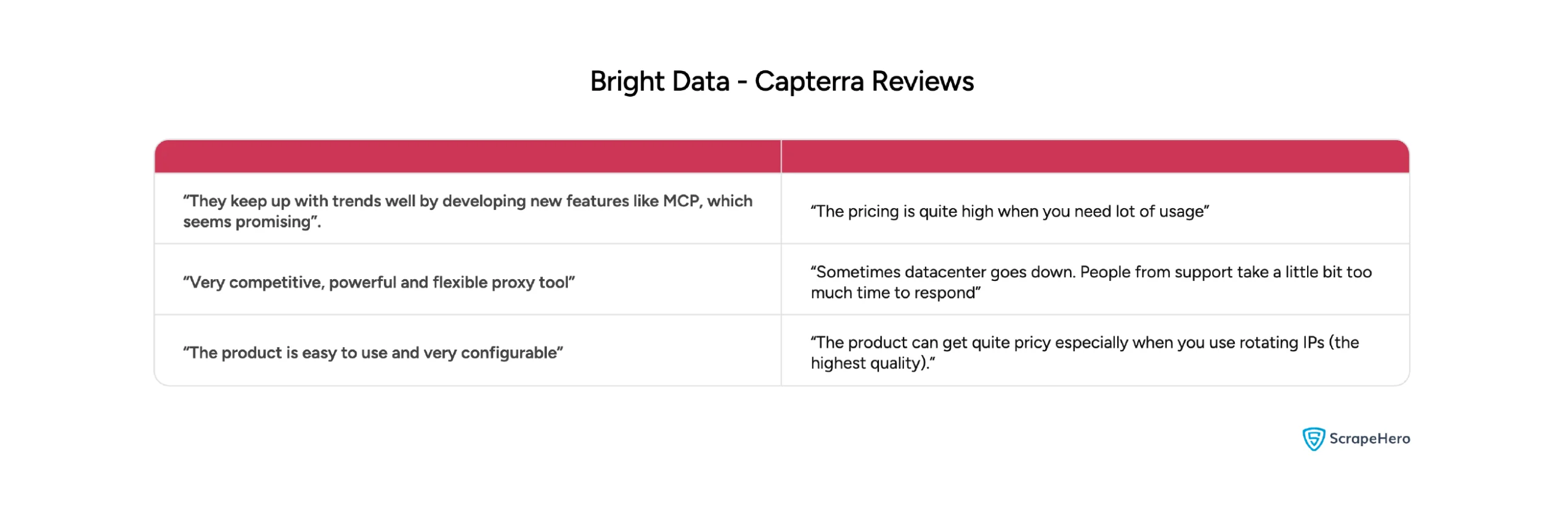
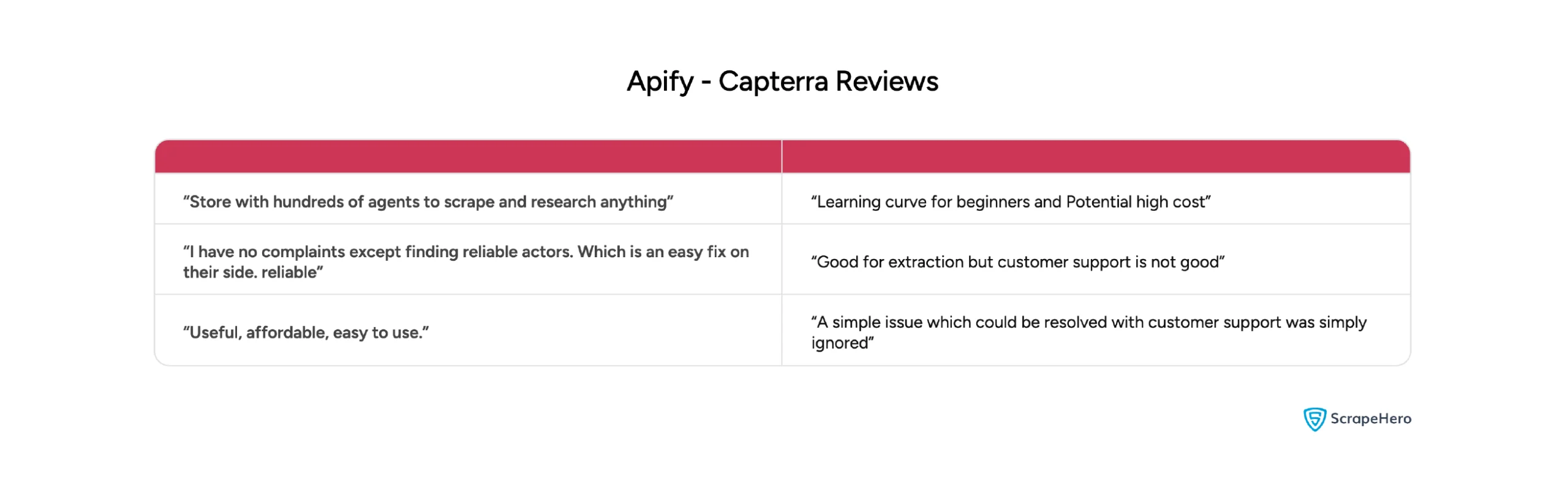
We pulled the following user reviews directly from Capterra, so you can see how Bright Data and Apify hold up in real-world use.
Bright Data review average – 4.7/5
Apify review average – 4.8/5
Bright Data and Apify Alternative
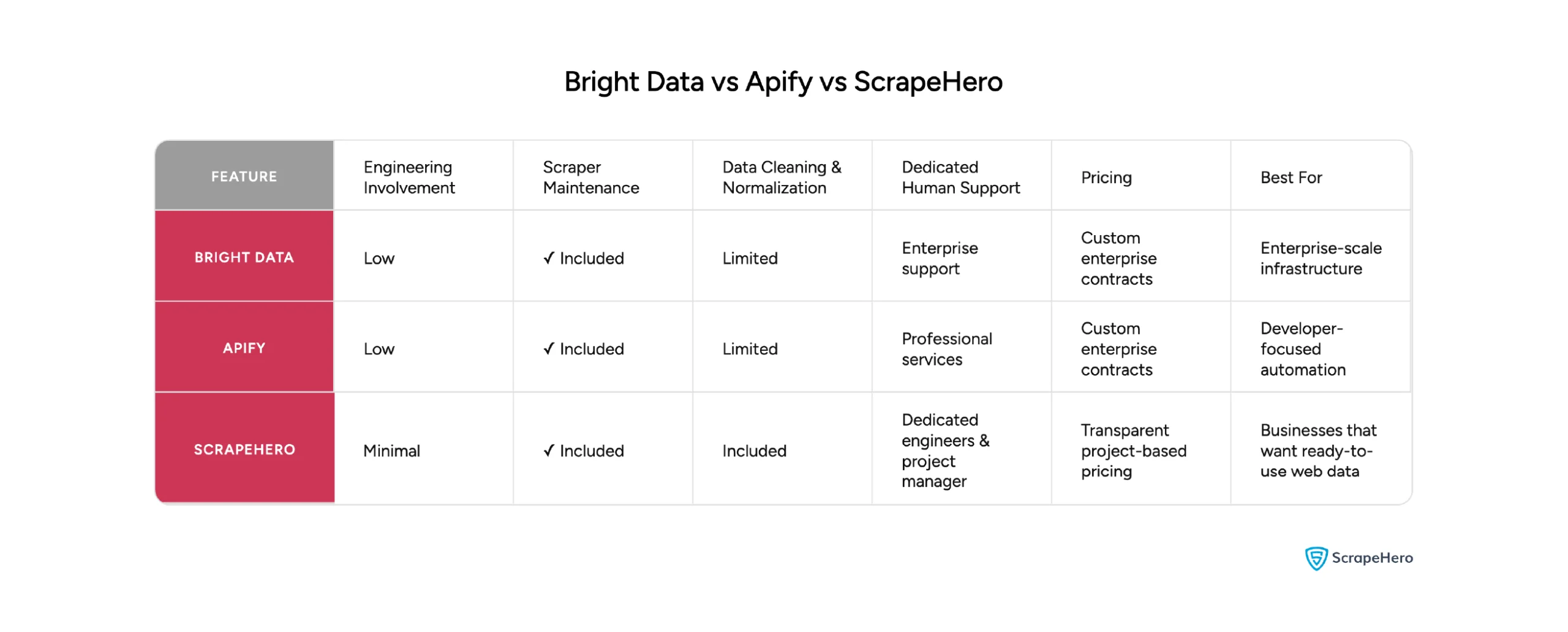
If your team wants web data without the work of building and maintaining scraping infrastructure, ScrapeHero is worth a look as a Bright Data alternative and Apify alternative. Instead of a self-service platform, ScrapeHero offers a fully managed web scraping service that handles the whole data collection process.
With a 4.7-star rating on Capterra, it emphasizes human-led service more than either of the platforms mentioned above.
Human-led service
ScrapeHero pairs automation with real engineering support. Specifically, experienced engineers build and maintain your scrapers, watch for site changes, run quality checks, and fix issues before they affect your data.
Additionally, you also get a dedicated project manager and support from data extraction specialists, not a general help desk.
Fully managed scraping
ScrapeHero handles every part of the pipeline. That includes scraper development, proxy management, browser rendering, anti-bot handling, ongoing maintenance, data validation, cleaning, normalization, and scheduled delivery.
So, your team gets clean, ready-to-use data without spending engineering time on upkeep.
ScrapeHero Cloud
For teams that want a self-service option, ScrapeHero Cloud offers pre-built scrapers for hundreds of popular sites. Unlike other self-service tools, ScrapeHero’s team maintains these scrapers. When a site changes, you don’t need to fix it yourself.
Faster ways to access data
ScrapeHero also offers pre-built, POI datasets, so teams can skip the setup and dive straight into analysis with geotargeted data ready to use from day one.
Transparent pricing
ScrapeHero uses simple, project-based pricing. That means you know what you’re paying before work starts. There are no usage-based charges tied to bandwidth, proxy use, or compute time. This makes it easier to plan a budget for long-term projects.
Final Thoughts
To wrap up this Bright Data vs Apify comparison, here’s what matters most: Bright Data and Apify are both strong enterprise scraping platforms, but they serve different needs. Bright Data offers wider infrastructure and enterprise tools. Apify focuses on developer-friendly automation through its Actor Marketplace and Crawlee framework.
Ultimately, the right choice depends less on feature lists and more on engineering effort, long-term maintenance, support, clear pricing, and the quality of the data you get in the end.
If you need a Bright Data or Apify alternative, ScrapeHero, the best web scraping company, is worth a look. Its human-led approach pairs skilled engineers and automated workflows with fully managed delivery. So, your team spends less time maintaining scrapers and more time using the data.
FAQs
Yes. Bright Data is an established enterprise web data platform with a broad product ecosystem, compliance certifications, and dedicated enterprise support, though its pricing and self-service setup are better suited to teams with technical resources.
ScrapeHero is a common alternative, offering a fully managed web scraping service with transparent, project-based pricing instead of Bright Data’s usage-based model and higher enterprise cost.
Yes, ScrapeHero is also a strong Apify alternative for teams that want fully managed scraping and maintenance, rather than building and maintaining workflows themselves using Apify’s Actor Marketplace and Crawlee framework.