E-commerce data is essential for staying competitive in today’s online marketplace. Insights from these data help businesses set better prices, manage inventory, and study their competitors. With real-time insights, e-commerce brands can adjust to market trends. This keeps them agile and profitable.
When collecting this data, businesses use two main approaches: web scraping APIs and managed services.
APIs offer a flexible way to gather data. But they need technical expertise and resources to maintain.
On the other hand, managed services provide a hands-off solution. They handle everything from data extraction to maintenance. However, they offer less flexibility for granular-level customization.
This article will explore the trade-offs between these two options. We’ll help you figure out which approach fits your goals, resources, and long-term needs. By the end, you’ll understand the advantages and challenges of each method. Ultimately, this will help you make the best choice for your e-commerce strategy.
What Are Web Scraping APIs?
Definition and Overview
A web scraping API is an interface that lets you automatically extract data from websites. By making HTTP requests, businesses can get information from various online sources without manual effort. These APIs let you access data from a website’s HTML. They then transform it into usable data for analysis or integration with other systems.
Common Use Cases in E-Commerce
In e-commerce, web scraping APIs gather data that supports key business functions.
Web scraping for e-commerce helps businesses stay competitive in several ways.
- Pricing: Track competitors’ prices to keep your products’ prices competitive.
- Competitor Tracking: Monitor competitor product listings, promotions, and sales trends.
- Product Availability: Keep tabs on stock levels, product updates, and new product launches.
Advantages of Web Scraping APIs
Flexibility to Customize Scraping Requirements:
With APIs, you can tailor the scraping process. You gather only the data you need. This helps if you have specific requirements. For example, tracking certain product categories or monitoring only certain competitors.
Greater Control Over Data Collection:
APIs give you direct control over the scraping process. You decide how often data is collected. You can adjust the scraping logic. You can also filter the data to meet your business needs.
Scalability for Large Data Sets:
APIs can handle large volumes of data. They adapt to complex scraping tasks. This makes them ideal for businesses that need to scale their data collection over time. For instance, you might need to monitor thousands of products across multiple sites. Or gather data on a frequent basis. Either way, APIs can grow with your needs.
What Are Managed Services for Web Scraping?
Definition and Overview
A managed scraping service is a fully outsourced solution. A service provider handles the entire web scraping process for you. This includes data extraction, maintenance, updates, and infrastructure management. In short, the provider takes care of everything.
This allows businesses to access the data they need without managing the technical aspects themselves. Managed services are ideal for companies looking for a hands-off approach to data collection.
How Does It Differ from APIs?
Web scraping APIs require businesses to manage the technical setup and maintenance in-house. Also, they give you complete control over the scraping process. In contrast, managed services are fully outsourced and relieve you of the burden of managing infrastructure, coding, and data storage.
Advantages of Managed Services
Hands-Off Approach:
With managed services, the provider handles all aspects of web scraping. This includes maintenance, troubleshooting, and updates. Therefore, your team can focus on using the data rather than managing the technicalities.
Reduced Need for In-House Technical Expertise:
The service provider manages the technical aspects. This means you don’t need a dedicated in-house development team. This is a huge advantage for businesses that lack technical resources. It also helps if you prefer to allocate your team’s efforts elsewhere.
Faster Time to Market:
Managed web scraping services let you start using your data quickly. The provider already has the infrastructure and processes in place. So, you can bypass lengthy setup times. You’ll be up and running faster and gain valuable insights for your business without delays.
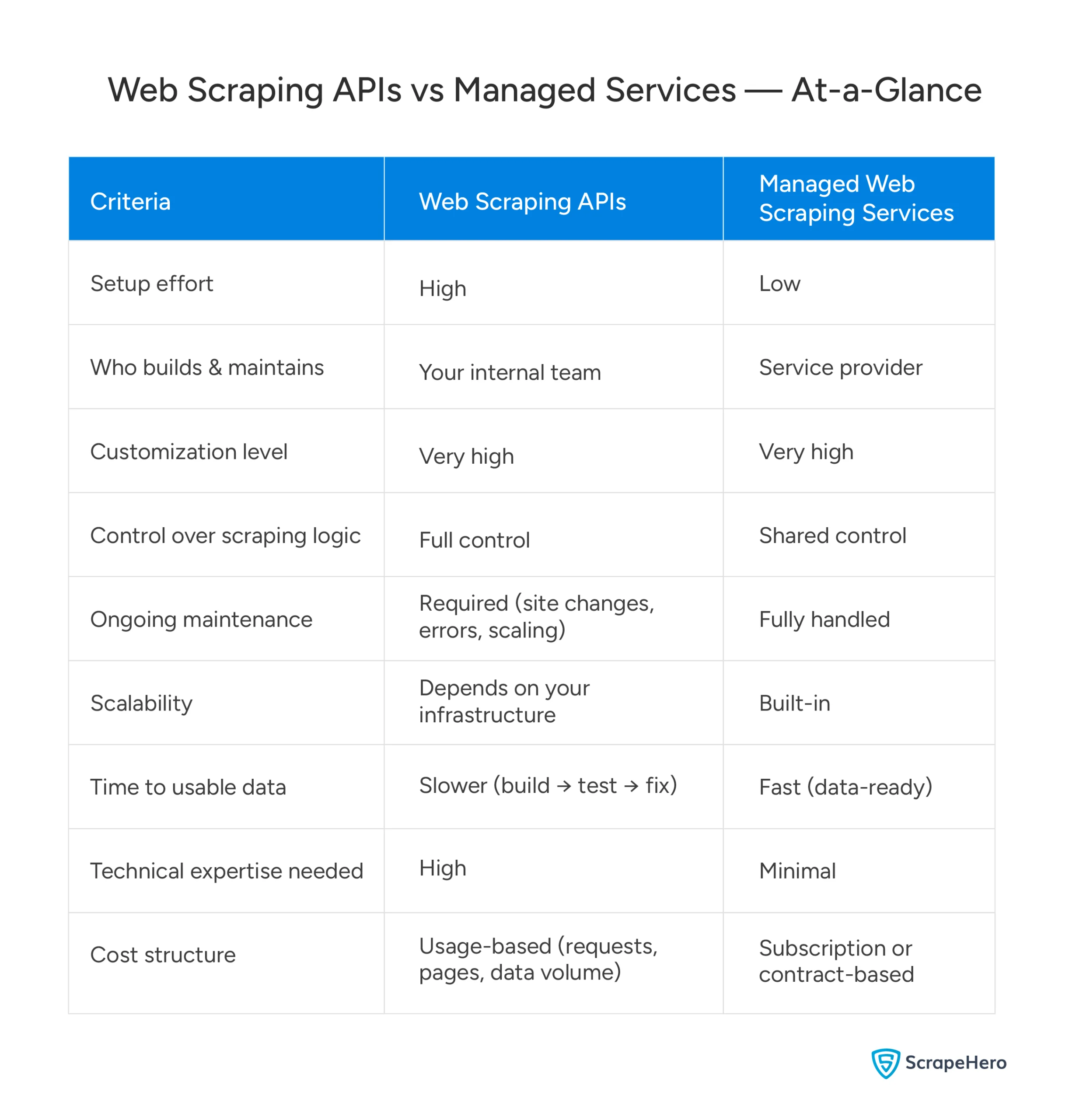
Which Is More Flexible and Convenient for Your Business?
Web Scraping APIs
Pros:
- Provides full control over the data collection process.
- Enables customization to meet specific business needs, such as:
- Tracking product prices.
- Monitoring inventory.
- Gathering competitive intelligence.
- Allow businesses to scale operations efficiently.
- Let organizations expand data collection efforts as needed.
- Offer the flexibility to build highly tailored scraping workflows
Cons:
- Offer significant flexibility, but require technical expertise to set up and maintain.
- Can become resource-intensive to manage as your scraping needs scale.
This leads to potential challenges, including:
- Error handling.
- Adapting to website changes.
- Infrastructure management.
These tasks add complexity and operational cost.
Managed Services
Pros:
- Provide an easy, hands-off solution for data collection.
- The provider handles all technical aspects:
- Initial setup.
- Ongoing maintenance and updates.
- Eliminate the need for an in-house technical team.
- Allow businesses to focus on using data rather than managing the scraping process.
- Are ideal for companies that want to access valuable data without dedicating internal resources to technical tasks.
Cons:
- Handle complexity easily, but come with a key trade-off: reduced granular control.
- May feel less adaptable than a direct API for projects requiring:
- Highly specific data strategies.
- Frequent changes to the collection approach.
Ultimately, the best choice depends on your core priority: the streamlined reliability of a managed service or the maximum customization of an API.
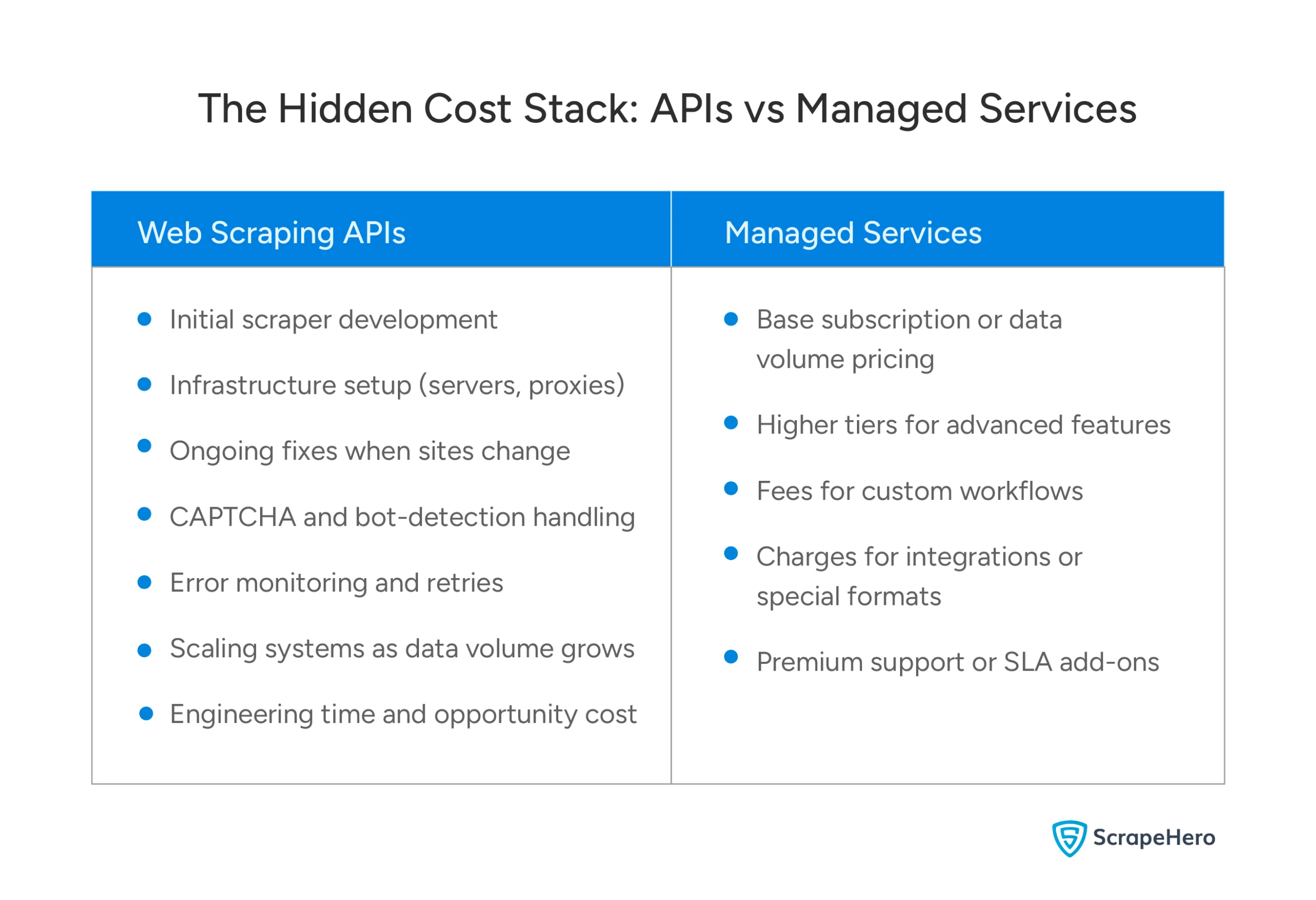
What are The Hidden Costs and Technical Complexities?
Web Scraping APIs
Handling Website Changes
Web scraping APIs rely on scripts that can break when websites update their layout or functionality.
This requires your team to:
- Dedicate time to troubleshooting script failures.
- Make regular adjustments and updates to the scripts.
Without consistent monitoring and maintenance to adapt to these changes, data quality can decline over time due to inconsistencies.
Scaling Challenges
Scaling an API solution to match business growth involves handling significantly larger data volumes.
This requires ensuring that several key components can keep up:
- Infrastructure: Servers and systems must be robust enough to handle increased load.
- Error Handling: Processes must be resilient and scalable to manage more frequent failures.
- Data Processing: Pipelines need to efficiently manage the higher volume of incoming data.
This scaling process typically demands additional technical resources.
In turn, it adds complexity to operations, increasing both management time and overall costs.
Managed Services
Pricing models:
Managed services typically charge based on the volume of data you need scraped. Or the frequency of scraping requests. This can simplify budgeting. But it’s important to keep track of how your data needs evolve.
Hidden fees for additional features or support:
Many managed services have tiered pricing with high initial investments. Basic plans offer limited features. Meanwhile, higher-tier plans provide access to more advanced capabilities. There may also be additional fees for custom scraping configurations, data integration, and premium support.
These hidden costs can add up quickly. This is especially true if your needs change or grow over time. Therefore, it’s important to understand all potential costs before committing to a service.
Risk of less control over data quality and customization:
Managed services offer clear convenience but come with common trade-offs.
Key trade-offs include:
- Reduced flexibility for granular-level configurations.
- Reliance on the provider’s external infrastructure.
- Less direct oversight of data quality.
These limitations can lead to:
- Missed opportunities for optimization.
- Data that may not perfectly fit unique business needs.
However, these aren’t inevitable. The key is choosing a partner designed to eliminate these gaps. At ScrapeHero, we’ve built our web scraping service around customization and transparency.
We work with you to implement highly specific scraping workflows. We provide clear insights into our collection processes. Additionally, we prioritize your oversight. This ensures you get precise, reliable data without sacrificing control or adaptability.
How to Assess Which Option is Right for Your E-Commerce Business
To make the best decision, consider these questions.
Do you have a technical team or resources to manage and maintain scraping operations?
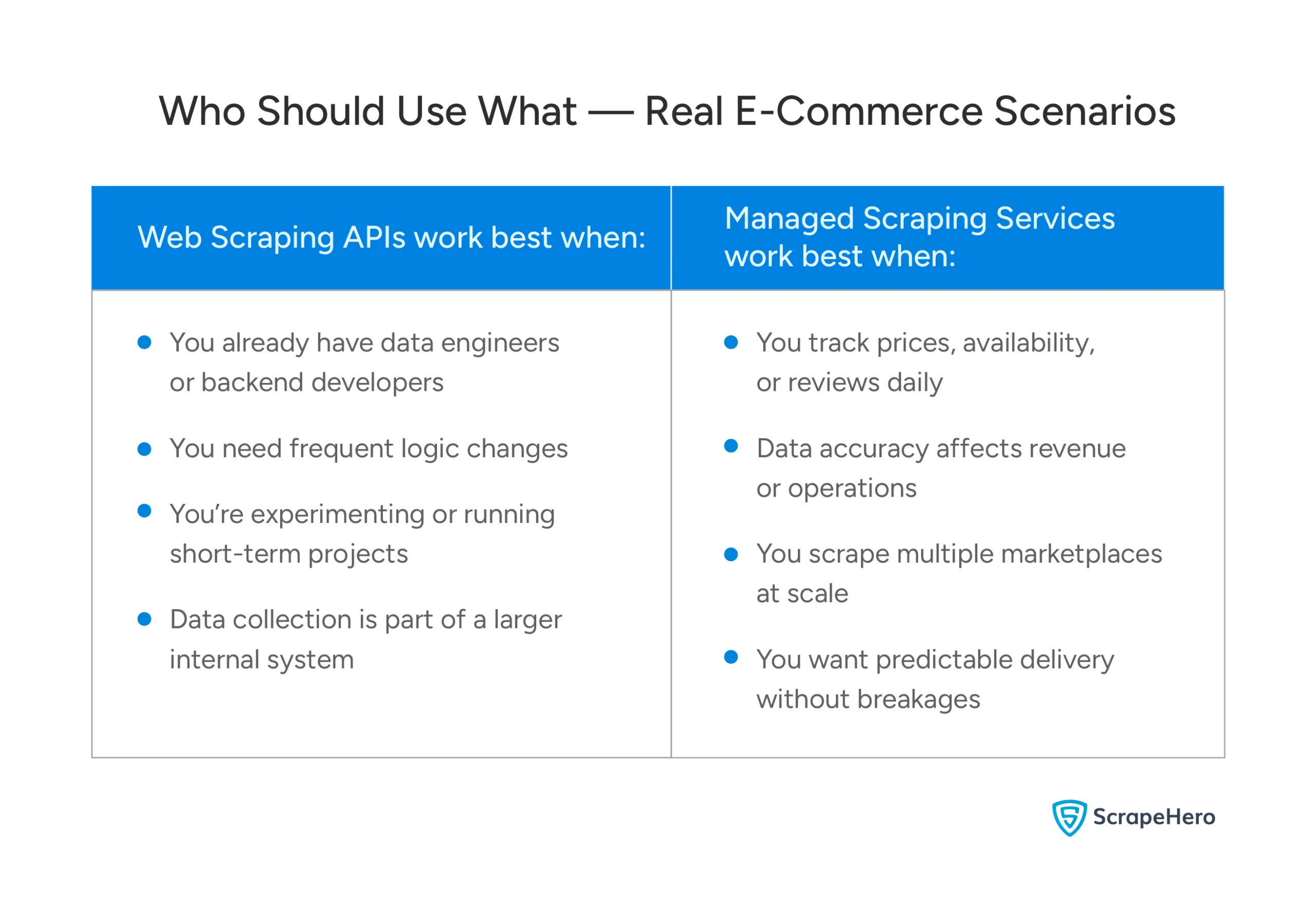
Web scraping APIs require an internal team. This team handles setup, maintenance, and troubleshooting. If your business already has developers or data engineers, an API might be the best fit. However, if you lack these resources, you may face challenges in managing ongoing operations and maintenance.
Do you need highly customized or complex scraping?
If your e‑commerce business requires tailored scraping workflows or needs to pull data from complex sources, an API gives you granular control, especially over the underlying infrastructure. You can fine‑tune every aspect of the extraction process.
With a managed web scraping service, you get the same ability to handle complex data retrieval, but without managing the infrastructure yourself. If you can define the data you need, a managed service can deliver it, no matter how complex the source.
Are you looking for a hands-off solution with minimal internal effort?
Managed services are ideal for e-commerce businesses seeking a solution that requires little to no internal technical involvement. If you prefer to focus on leveraging the data rather than managing the infrastructure, this is the best approach. It’s effortless, as the technicalities are handled by the provider.
Do you prefer a solution that lets you focus on using the data rather than managing extraction?
With managed services, your team can focus entirely on using the data. You can drive business decisions without being bogged down by the technical challenges of scraping. If this aligns with your company’s goals and resources, a managed service can offer a hassle-free experience. In fact, it makes data extraction as simple as possible.
Are you looking for long-term value or a one-time project solution?
When evaluating the long-term value, consider both direct and hidden costs. For APIs, upfront costs may seem lower. However, managing infrastructure, addressing errors, and scaling as your data needs grow can increase overall costs.
On the other hand, managed services offer clear subscription or usage-based pricing. But hidden costs may include limits on customization. Think about how each option scales with your business over time. This will help you choose the solution that delivers the best long-term value.
Making the Decision: Web Scraping APIs vs Managed Service
For high-volume businesses
For high-volume e-commerce businesses, data collection needs can scale quickly. When comparing web scraping APIs vs managed services, APIs offer flexibility. But managing large-scale scraping operations can become complex and resource-intensive.
A managed web scraping service can take the burden off your shoulders. It handles infrastructure, maintenance, and updates so you can focus on leveraging the data.
For small to mid-sized businesses:
Smaller businesses may find that APIs require a significant investment in technical resources. Both upfront and ongoing. For businesses with limited technical staff, a managed web scraping service is ideal. Or if you’re seeking a more cost-effective, hassle-free solution.
With a managed service, you don’t need to worry about coding, maintenance, or handling errors. The service provider handles all the technical work. As a result, this lets your team focus on growing the business. You get timely, accurate data without the complexity. In turn, this frees up your resources for other strategic initiatives.
Final Thoughts
Here’s what matters when choosing between web scraping APIs vs managed services. Consider your business’s size, data needs, and technical capabilities. E-commerce web scraping solutions, such as APIs, offer flexibility. But they require a dedicated team to manage and scale effectively.
On the other hand, managed services offer the convenience of having experts handle scraping. This makes them the best choice for businesses that want reliable data. They don’t want the burden of maintaining it themselves.
If you’re looking for an easy-to-implement, long-term solution to collect accurate e-commerce data, ScrapeHero’s managed service is the right choice for your business. You’ll get ready to use data in various formats, such as CSV, JSON & XML. You can also get real-time data delivery via APIs.
Contact ScrapeHero today to get started with a powerful, hassle-free web scraping service tailored to your e-commerce data needs.
FAQs
Web scraping APIs offer flexible, self-managed data extraction, while managed services are fully outsourced solutions that handle scraping end-to-end for eCommerce businesses.
It’s the automated collection of online retail data, like pricing, availability, and competitor listings, from websites to help eCommerce brands make data-driven decisions.
Web scraping can require ongoing technical effort to handle site changes, errors, and infrastructure issues, making it complex and resource-intensive to scale. But with the right scraping service like ScrapeHero, you can simplify and scale your data collection without the hassle.