Running an e-commerce business today means navigating constant pressure on pricing. Margins are tightening, competitors are discounting, and it can feel like the only way to stay relevant is to do the same.
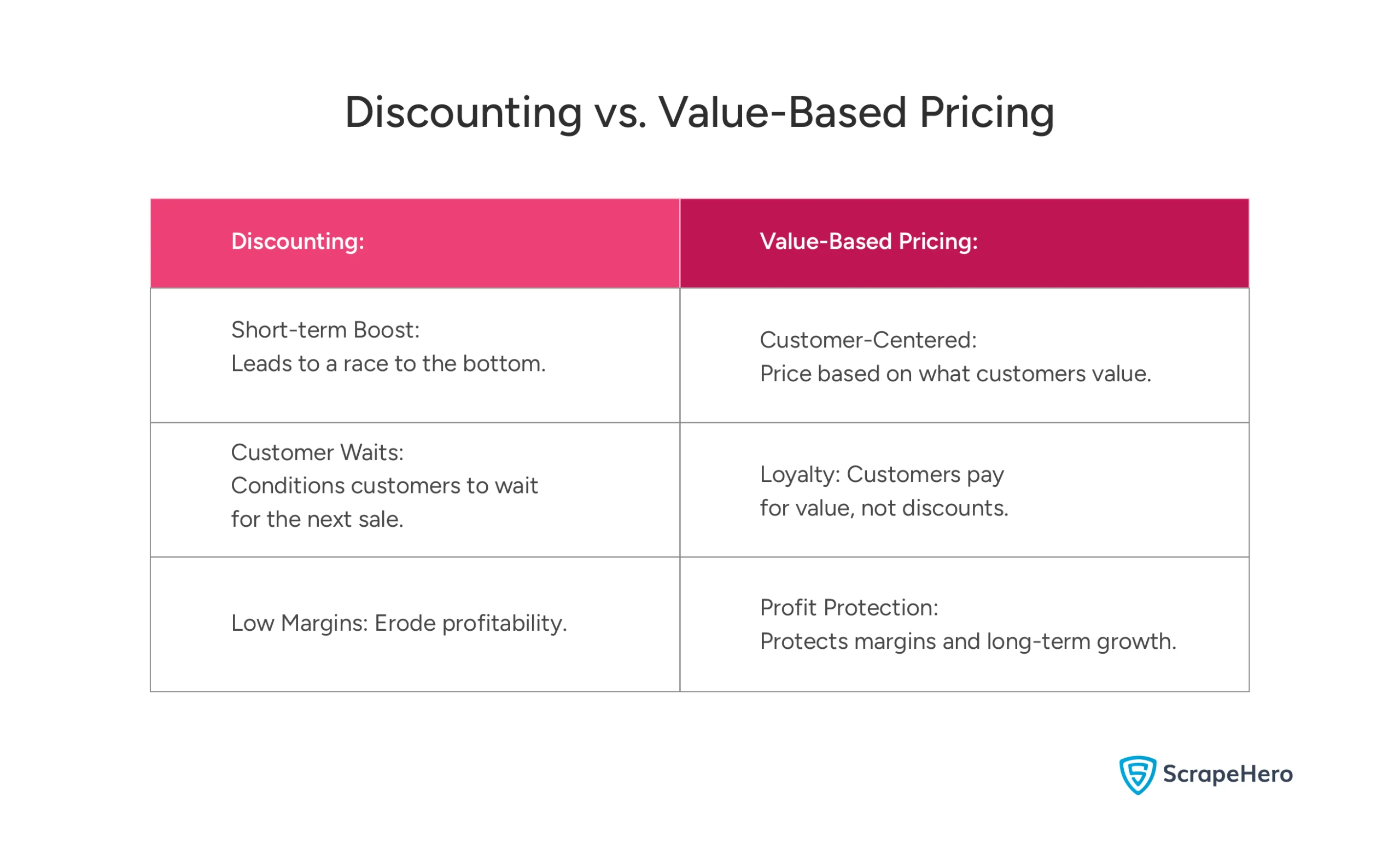
Here’s the uncomfortable truth: discounting doesn’t win customers. It conditions them to wait for the next sale.
The businesses quietly growing right now aren’t the ones with the lowest prices. They’re the ones who know what their customers actually value and price accordingly.
That’s what a value-based pricing strategy is. And to do it well, you need real-time market intelligence. That’s exactly where web scraping comes in.
In this article, you’ll see how web scraping gives you the data to price smarter, protect your margins, and stop competing on price altogether.
What is value-based pricing?
Value-Based Pricing:
Definition: “Value-based pricing is a strategy where prices are determined based on the perceived value of the product or service to the customer, rather than the cost of production or competitor prices.”
Simply put, it’s pricing based on what your customers value in your product. Not what it costs you to make, and not what your competitor charged last Tuesday.
Most businesses default to one of two approaches. They either calculate their costs, add a markup, and call it a day. Or they obsessively watch competitors and adjust accordingly. Both methods share the same blind spot: they ignore the person who actually opens their wallet.
Value-based pricing fixes that. It asks one question: how much does this customer believe this product improves their life? And builds the price around the answer.
“The moment you make a mistake in pricing, you’re eating into your reputation or your profits.” – Katharine Paine.
Why it matters for your business
Here’s the surprising part: customers aren’t always looking for the lowest price. They’re looking for the most justified one.
When you price based on perceived value, you stop competing on price altogether. You’re no longer in a race you can’t win. Instead, you’re charging what your product is actually worth to the people buying it, and protecting your margins while doing it.
For e-commerce, this is especially powerful if you’ve got a product with unique features, strong branding, or an experience competitors can’t easily copy. That’s your leverage. Value-based pricing is how you leverage that.
“Most executives name pricing as their major challenge and major weakness.” — Phillip Kotler
What does it mean to stay competitively priced?
Let’s talk about what this actually does for your bottom line.
- You make more money per sale
- Your customers stick around
- Stronger brand position
- You learn what your customers actually care about
You make more money per sale
When you price based on what customers believe your product is worth, you stop leaving money on the table. You’re not guessing based on your costs or reacting to a competitor’s discount. You’re charging what people are genuinely willing to pay. That gap between your cost and your price? It gets wider, not smaller.
Your customers stick around
Here’s the thing about loyal customers: they’re not loyal because you’re the cheapest. They’re loyal because they trust that what they’re paying is fair for what they’re getting. Value-based pricing builds that trust. And a customer who trusts you doesn’t need to be won back every season with another discount.
Stronger brand position
Here’s the surprising part: the competitors constantly slashing prices aren’t winning. They’re just surviving on thinner and thinner margins until they can’t anymore. You don’t want to be in that race. Value-based pricing lets you step out of it entirely and hold a position they can’t touch.
You learn what your customers actually care about
This one’s underrated. To price on value, you have to understand value. That process forces you to get close to your customers, figure out what’s moving them to buy, and double down on it. That insight doesn’t just improve your pricing. It improves your product, your marketing, and your competitive edge.
What makes value-based pricing hard in e-commerce
Value-based pricing sounds great in theory. In practice, it comes with some real obstacles. Here’s what you’re up against. Most businesses never get value-based pricing strategies right because they’re working with the wrong data from the start.
- Understanding customer perception across segments
- You need a competitive context
- Value isn’t static
- Your internal data is telling you yesterday’s story
Understanding customer perception across segments
A product that feels like a steal to one segment feels overpriced to another. And without solid data on how different customers think about your product, you’re essentially guessing. Guess too high, and you lose the sale. Guess too low, and you’ve just underpriced yourself for no reason.
You need a competitive context
Your price doesn’t exist in isolation. It exists next to every alternative your customer considered before landing on your page. If you don’t know what those alternatives cost and what they offer, you’re flying blind. Knowing how to price products competitively starts with understanding that competitive context. It isn’t optional. It’s the whole game.
Value isn’t static
This is the part most businesses don’t plan for. What customers were willing to pay six months ago isn’t what they’re willing to pay today. A competitor launches something new. A trend shifts. Your price suddenly feels off, and you don’t even know it yet. Staying current isn’t a one-time task. It’s ongoing.
Your internal data is telling you yesterday’s story
Here’s the surprising part: the data you already have is probably the least useful data for value-based pricing. Past sales, internal costs, and last quarter’s margins. None of that tells you what the market thinks right now. And now is the only moment that actually matters when someone’s deciding whether to buy.
That’s exactly why businesses are turning to real-time data collection. And that’s where web scraping changes everything.
How Web Scraping Enables Better Value-Based Pricing
So how do you actually get the real-time market intelligence that value-based pricing strategies need? This is where web scraping comes in.
What web scraping actually does
Web Scraping: Definition: “Web scraping is the process of extracting data from websites using automated bots. This data can include competitor pricing, customer sentiment, and product performance metrics, providing valuable insights for decision-making.
At its core, web scraping is the automated collection of data from publicly available websites. Think about competitor prices, product descriptions, customer reviews, and market trends. Instead of someone manually checking hundreds of pages and spreadsheets, a scraper does it continuously, at scale, and feeds you structured data you can actually act on.
Here’s the best part: your competitors are already a data source. Every price they publish, every product they list, every review their customers leave is sitting in plain sight online. Web scraping just collects it systematically, so you can use it.
The difference between web scraping and your internal data is significant. Your internal data tells you what’s already happened inside your business. Web scraping tells you what’s happening right now, outside of it. That’s the view you’ve been missing.
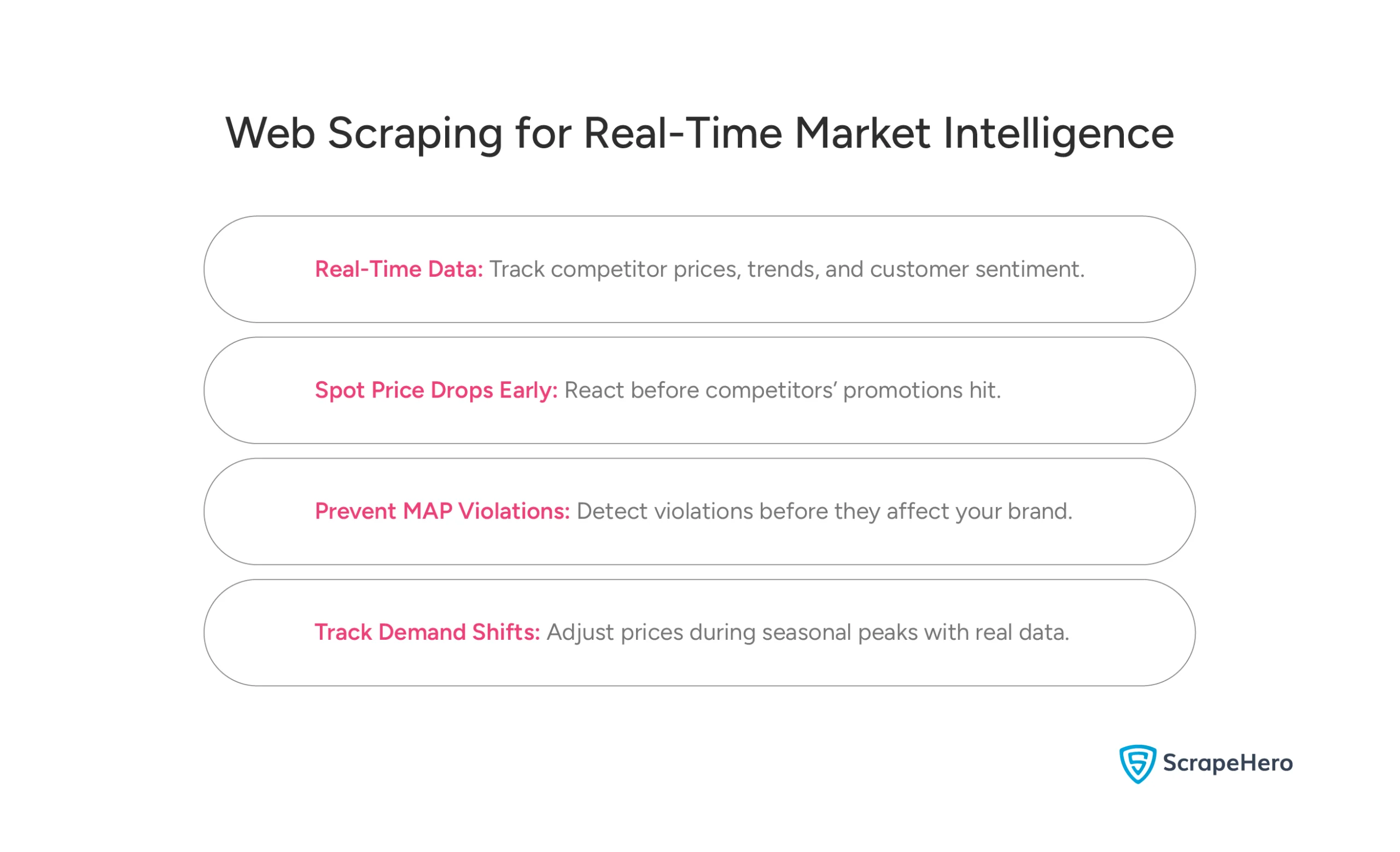
You’re not just getting a snapshot either. You’re getting a live, ongoing feed of how the market is moving. That means you can spot a competitor’s price drop before it affects your sales. You can see a shift in customer sentiment before it shows up in your numbers. You can make pricing decisions based on where the market is today, not where it was last quarter.
That’s the kind of intelligence that makes value-based pricing actually work in practice.
Did you know? Over 75% of companies set prices based on a combination of guesswork, competitors’ pricing, and production costs. If you take customer perceived value into account when discussing your pricing strategy, you’ll already be ahead of 75% of the other companies out there.
Web scraping use cases that matter for pricing
Let’s get specific. Here’s what web scraping looks like when it’s working for your pricing strategy.
- Monitoring competitor prices in real time
- Product tier & feature insights
- Catching MAP violations before they hurt you
- Reading demand and seasonal shifts
Monitoring competitor prices in real time
You don’t want to discover that a competitor dropped their price only after noticing a dip in your sales. You want to know the moment it happens. Web scraping gives you that. You can track price changes across competitors continuously, spot promotions before they pull your customers away, and decide whether to respond or hold your ground. That’s a choice. Without the data, it’s just a surprise.
Product tier & feature insights
It’s not just about price points. It’s about what competitors charge more for and why. Web scraping lets you pull apart their product tiers, see which features command a premium, and figure out where your product stacks up. If you’ve got something they don’t, that’s your justification for a higher price. You just need the data to see it clearly.
Catching MAP violations before they hurt you
Here’s the surprising part: your own retail partners might be quietly undercutting your prices right now, and you’d have no idea. MAP violations erode perceived value fast. Web scraping flags them early so you can act before the damage is done.
Reading demand and seasonal shifts
Pricing during peak seasons without demand data is guesswork. Web scraping tracks how products perform across categories during holidays, promotions, and external events. So when demand spikes, you’re not leaving money on the table with a price that hasn’t moved.
What all of this adds up to
Every one of these use cases does the same thing: it replaces assumption with evidence. You’re not pricing based on what you think the market is doing. You’re pricing based on what it’s actually doing right now, right? That’s what makes value-based pricing work in the real world, not just in theory.
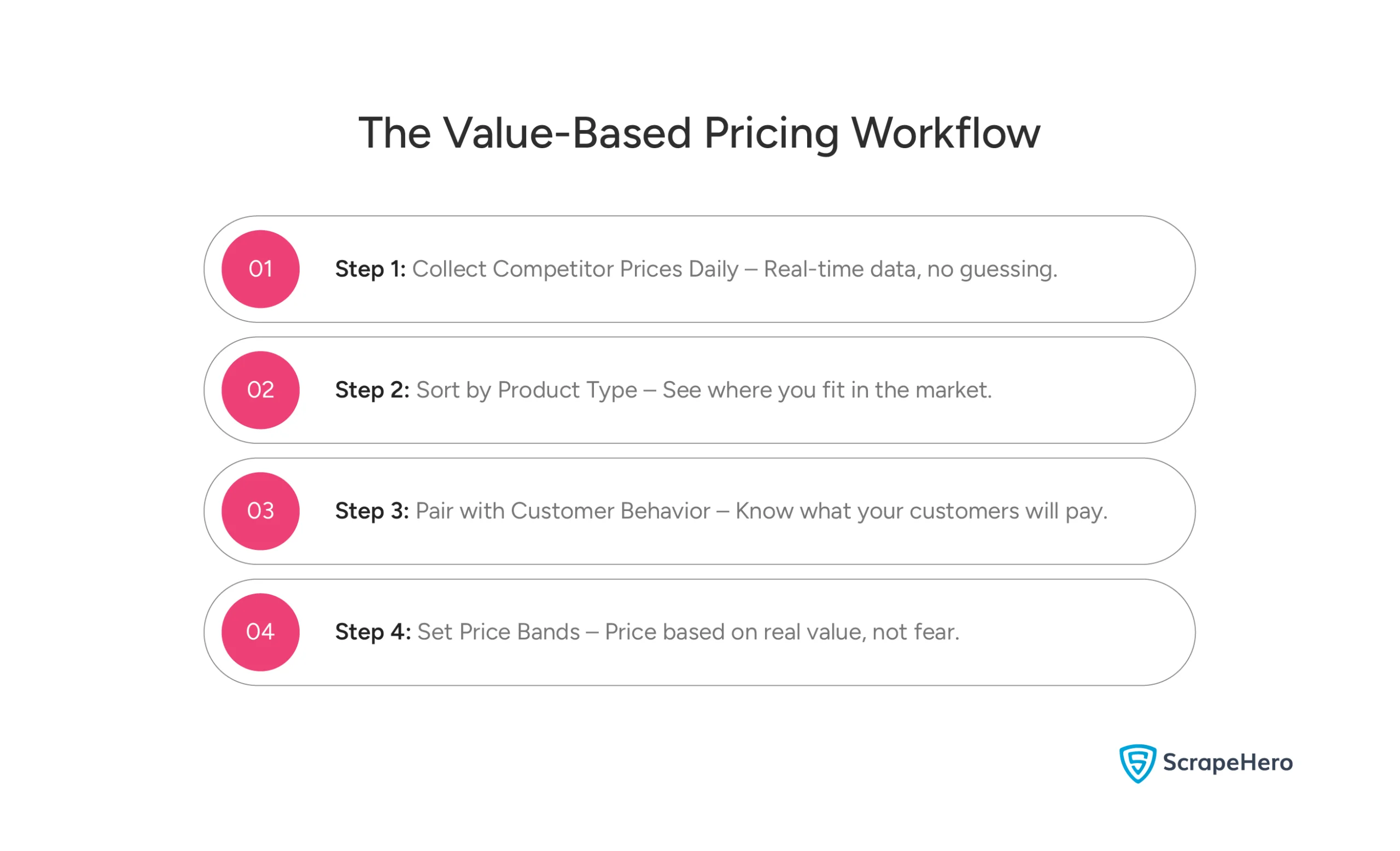
Example workflow: From data to value-based prices
This isn’t theoretical. Here’s how it actually works in practice, step by step.
Step 1: Collect competitor prices every day
Step 2: Sort it by product type and seller positioning
Step 3: Pair it with what your customers are actually doing
Step 4: Set price bands based on real value, not fear
Step 1: Collect competitor prices every day
You can’t make good pricing decisions on stale data. Web scraping pulls competitor prices across platforms daily, automatically. You wake up with a current picture of where your product stands in the market. No manual checking. No guessing. Just fresh data, every morning.
Step 2: Sort it by product type and seller positioning
Raw data isn’t useful until it’s organized. Once you’ve got the numbers, you categorize them. Who’s positioning as premium? Who’s racing to the bottom? Where do the mid-tier players sit? This step clearly shows the pricing landscape, so you can see exactly where you fit and where you could push higher. This is your competitive pricing strategy in action.
Step 3: Pair it with what your customers are actually doing
Now here’s where it gets interesting. You take that competitor data and put it next to your own customer behavior. What are people buying? At what price points are they dropping off? What’s converting? That combination tells you something neither dataset can tell you alone: what your specific customers are willing to pay for your specific product.
Step 4: Set price bands based on real value, not fear
Here’s the crucial part: most businesses set prices defensively. They price low because they’re scared of losing the sale. This workflow lets you price offensively. You’re not guessing anymore. You’ve got competitive context, customer behavior, and market positioning all in one place. Think of it as a practical price optimization strategy.
Now, your price bands reflect what the market will actually bear, and that number is almost always higher than what fear would have told you to charge.
That’s the workflow. Four steps from raw data to confident, margin-protecting prices.
Why ecommerce brands use ScrapeHero for value-based pricing
You now know what web scraping can do for your pricing strategy. The next question is who actually does it well. Here’s why serious e-commerce brands choose ScrapeHero.
- Fully managed service
- Proven results
- Scalability & customization
Fully managed service
ScrapeHero offers a fully managed web scraping service. That means you’re not hiring engineers, building scrapers, or troubleshooting data pipelines. You tell us what you need, and we deliver clean, accurate, compliant data on schedule. Your team stays focused on decisions, not infrastructure.
Proven results
Over 14,000 customers trust ScrapeHero, including Fortune 50 companies. One of our standout wins was with a major toy brand where ScrapeHero didn’t just collect competitor data; we helped the brand by providing valuable insights into how customer perceptions evolve. That’s the difference between a data vendor and a pricing intelligence partner.
Scalability & customization
Whether you’re running a focused product line or managing thousands of SKUs across multiple markets, ScrapeHero scales with you. The service adapts to your business, not the other way around. And as your market shifts, your data stays current.
The bottom line
You don’t have to choose between staying competitive and protecting your margins. Businesses that figure out how to price products competitively without racing to the bottom are the ones that build sustainable revenue. Value-based pricing strategies are how you get there.
But it only works if you’ve got the right data. Real-time data. Data that tells you what the market’s doing right now, not what it did last quarter.
That’s what web scraping gives you. And that’s what ScrapeHero delivers, fully managed, at scale, without adding to your team’s workload.
If you’re ready to stop guessing and start pricing with confidence, let’s talk.
Contact ScrapeHero today and build a pricing data strategy that actually protects your margins and grows your revenue.
FAQs
Businesses stay competitive by pricing based on customer value while tracking competitor prices and demand signals. Real-time market data helps them adjust prices strategically without sacrificing margins.
Focus on product differentiation, brand positioning, and value communication rather than matching every competitor’s discount. Monitoring competitor pricing and enforcing MAP policies also prevents unnecessary price drops.
E-commerce teams monitor competitor prices, product features, and promotions across marketplaces. They combine this with their own sales and customer behavior data to set price bands that remain competitive while protecting margins.
Companies highlight product benefits, brand strength, and customer experience to justify their pricing. Consistent pricing, strong positioning, and avoiding constant discounting help maintain perceived value.