In this article, you’ll see:
- How Fortune 500 AI hiring activity has shifted through 2026
- Which roles and companies pay the most for AI talent
- Where Fortune 500 AI jobs are concentrated
- What benefits and work arrangements come with these roles
- How data like this gets gathered at scale
Something changed in Fortune 500 AI hiring this year.
For four months straight, AI job postings barely moved. Companies added just one to three new roles a day. Then, in mid-July 2026, that pace broke.
By late August, daily postings had grown several times over. Some single days brought in more new AI listings than all of April combined.
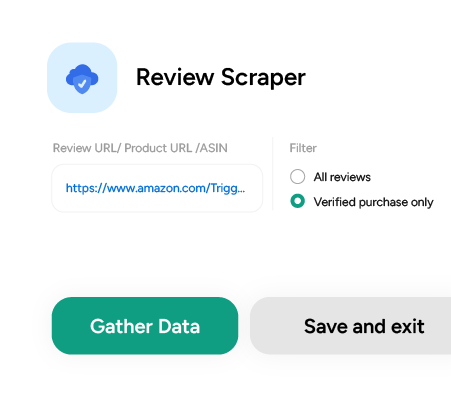
We found this pattern in a dataset of 190 distinct AI-related job postings across 32 Fortune 500 companies. The data comes from Indeed listings, gathered via ScrapeHero Cloud’s Indeed scraper.
This is a snapshot, not a full census. It covers 32 of the Fortune 500, not all 500. But the volume and time span are large enough to show a real shift.
How Has Fortune 500 AI Hiring Changed in 2026?
Fortune 500 AI hiring stayed flat for months, then spiked sharply starting in mid-July 2026.
We built this day-by-day view by pulling job listings from Indeed on a recurring schedule. Want to see how? Here’s a walkthrough on how to scrape job data for free using the ScrapeHEro Cloud.
Here’s the pattern by the numbers:
- March to June 2026: postings held steady at one to three new roles per day
- Mid-July 2026: daily postings began climbing
- Late August 2026: hiring hit its peak, with the single busiest day far outpacing anything seen earlier in the year
- Volatility widened too: daily swings grew from a tight range of about 2 postings early in the year to swings of 8 or more by August
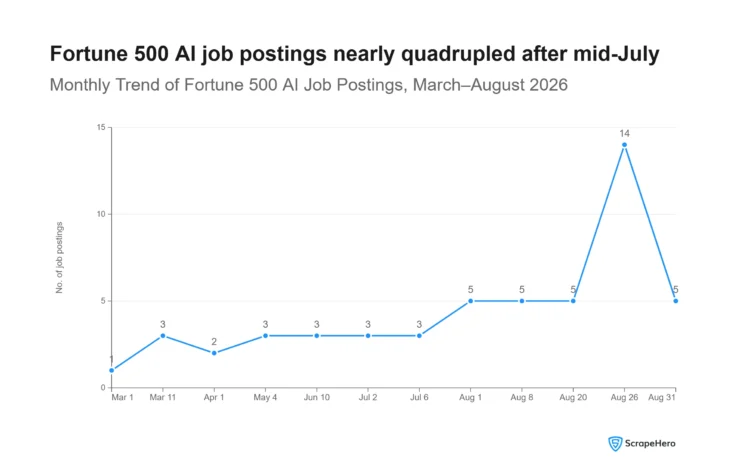
This shows one clear thing: Fortune 500 companies collectively hired more for AI roles in the second half of the year.
What’s driving that shift is worth digging into — budget cycles, new product launches, competitive pressure among peers. That’s a question worth chasing on its own.
What are the Highest-Paying AI Roles in Fortune 500 Companies?
The highest-paying AI roles at Fortune 500 companies reach $440,000 a year. Most of the top ten roles fall between $279,000 and $375,000.
Here are the ten highest-paying AI roles we found, by yearly salary:
| Role | Yearly Salary |
|---|---|
| Senior Distinguished Technologist – Pre-Sales AI & Data Center Networking | $440,000 |
| Head of AI Solutions, COO Technology (MD, C16) | $375,000 |
| Head of AI-First Development (Firmwide AI), Managing Director | $375,000 |
| Senior Staff Software Engineer, AI/ML GenAI | $313,500 |
| Principal AI Engineer – AI Builder | $307,000 |
| VP, Data & AI, Commercial Analytics | $299,400 |
| Group Product Manager, AI Hardware and Software Co-Design | $286,500 |
| Data Science Manager, Amazon Ads Identity | $283,050 |
| Senior Manager, Applied Science – Manipulation & Autonomy | $283,050 |
| Manager, Technical Solutions, Cloud Applied AI | $279,000 |
A few patterns stand out:
- Leadership roles top the list. The three highest-paying roles all carry “Head” or “Senior Distinguished” in the title, not “Engineer” or “Manager.”
- The last four roles cluster tightly. They all pay between $279,000 and $286,500. This suggests a real pay floor for senior, specialized AI roles at this level, not just a random spread.
How Much Do AI Jobs Pay at Fortune 500 Companies?
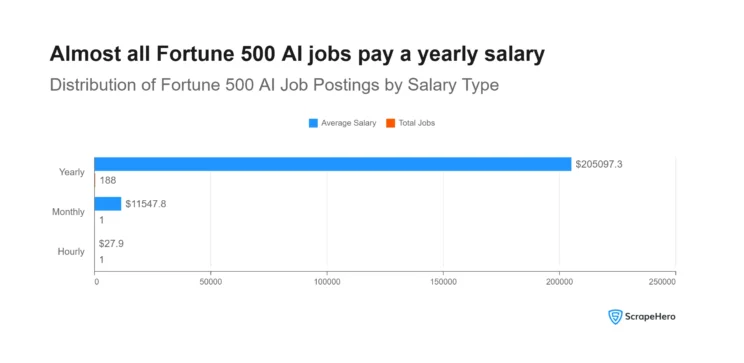
Most Fortune 500 AI jobs pay a yearly salary. Very few pay hourly or monthly.
Here’s the breakdown by pay type:
- Yearly salary: 188 of 190 postings, averaging $205,097 a year
- Hourly: 1 posting — an AI Safety Operator role at Tesla, paying $27.93 an hour
- Monthly: 1 posting, averaging $11,548 a month
The yearly figure is a genuine average across nearly the whole dataset, so it’s a reliable read on typical AI pay at these companies. The hourly and monthly numbers are single data points. They tell us these pay structures exist for AI roles, but they can’t tell us what’s typical for hourly or monthly AI work at Fortune 500 companies — one posting isn’t a pattern.
Which Fortune 500 Companies are Hiring the Most for AI Roles?
Amazon posts more AI jobs than any other Fortune 500 company in this dataset. Citi and Google follow, both with double-digit AI job counts.
Numbers like these come from tracking job postings at scale across employers, rather than checking listings one by one.
Here’s how the top ten recruiters compare, by number of AI job postings and average employee rating:
| Company | AI Job Postings | Average Rating |
|---|---|---|
| Amazon | 52 | 3.5 |
| Citi | 32 | 3.9 |
| 21 | 4.3 | |
| Morgan Stanley | 16 | 3.8 |
| Humana | 8 | 3.6 |
| JPMorgan Chase | 7 | 3.9 |
| CVS Health | 5 | 3.2 |
| Fiserv | 4 | 3.3 |
| Microsoft | 4 | 4.2 |
| S&P Global | 4 | 3.9 |
A few things stand out:
- Amazon leads by a wide margin. It posts more AI jobs than the next two companies combined.
- Volume and ratings don’t move together. Amazon posts the most jobs but has one of the lower ratings on this list. Google and Microsoft post far fewer jobs, but carry the two highest ratings.
- Three companies clear double digits. Amazon, Citi, and Morgan Stanley each post more than ten AI roles. Most other companies on the list post fewer than ten.
Which Fortune 500 Companies Pay the Highest Salaries for AI Roles?
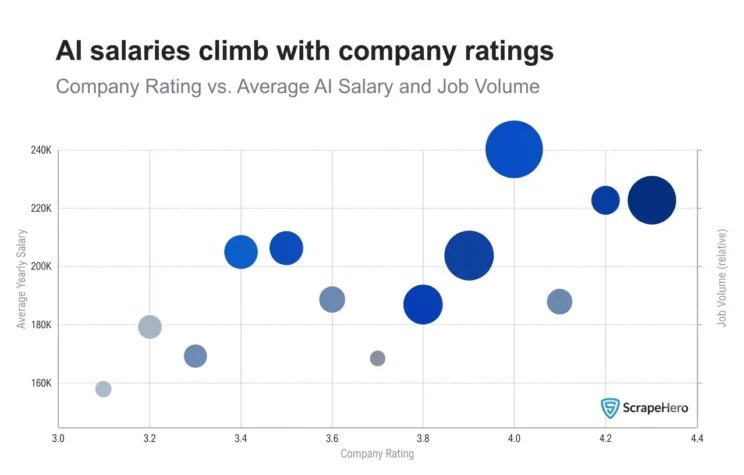
Companies with a 4.0 employee rating pay the highest average AI salary in this dataset, at close to $238,000 a year. But they also post the fewest AI jobs.
Looking across all 32 companies by rating and average AI salary, three groups emerge:
- Rating 3.0–3.3: average AI salaries mostly stay under $180,000
- Rating 3.4–3.9: average AI salaries run from about $185,000 to $207,000, with the highest job volumes in the dataset
- Rating 4.0 and above: average AI salaries reach as high as $238,000, but with very few job postings behind each figure
This looks like higher-rated companies pay more. That’s a fair read for the middle band, where salary, rating, and job volume all rise together across a decent number of postings.
The top band is different: some of those high-salary points come from just one or two job postings. A single high-paying role can pull a small group’s average up on its own.
So the connection between rating and pay is worth noting, but it’s not solid proof that a higher rating causes higher AI pay- especially at the very top.
This is the kind of pattern that’s easier to confirm with ongoing company-level job data monitoring than with a single snapshot.
Where are Fortune 500 AI Jobs Located?
This dataset shows a heavy concentration of AI job postings in the New York City area. That’s expected, and it comes with a catch: the search itself was based out of New York, so the results are naturally weighted toward listings near that location. This section shows what turned up, not a national ranking of AI hiring hubs.
With that caveat in place, here’s what the New York-area data shows:
- New York, NY: 117 job postings across 15 companies
- 1585 Broadway Avenue, New York, NY: 16 postings, 1 company
- 480 Washington Blvd, Jersey City, NJ: 8 postings, 1 company
- New York, NY 10019: 7 postings, 1 company
- Several other addresses in New York, New Jersey, and Hoboken each show 3–5 postings, mostly tied to a single company
What Benefits do Fortune 500 Companies Offer AI Employees?
Health insurance is the most common benefit for Fortune 500 AI roles, followed closely by dental and vision coverage.
Where a work setup is specified, hybrid AI jobs far outnumber remote ones — but that’s true for only a small slice of postings, so it’s a side note here, not a standalone finding.
Here’s how the top benefits break down, by number of postings that list them:
- Health insurance: 139
- Dental insurance: 127
- Vision insurance: 123
- Paid time off: 113
- Parental leave: 84
- 401(k) matching: 69
- Disability insurance: 63
- Adoption assistance: 60
- Flexible spending account: 60
- Employee assistance program: 59
A few patterns stand out:
- Core health coverage leads by a wide margin. Health, dental, and vision all appear in well over half of all postings.
- Retirement and family benefits follow, but drop off fast. 401(k) matching appears in 69 postings. Plain 401(k), without a matching detail, appears in only 47.
- Niche benefits are rare. Perks like gym memberships, childcare, and work-from-home stipends each appear in fewer than five postings.
Looking at individual companies, a few stand out for offering the broadest range of benefits:
- Walmart: 16 benefits listed
- Humana, NASDAQ, and Tesla: 15 benefits each
- Amazon and Mastercard: 13 benefits each
What This Data Shows — and What It Doesn’t
This report covers 32 of the Fortune 500, based on Indeed postings pulled over about six months. It’s a real signal, not the whole picture.
A few limits worth stating plainly:
- Sample size: 32 companies, not all 500
- One source: Indeed listings, not every job board or company career page
- Time window: roughly March through August 2026, not a full year
- Location bias: the search was based out of New York, so location findings reflect that area, not a national map
Within those limits, the signal is solid: AI hiring across these 32 companies picked up sharply in the second half of 2026. What we can’t say is how that scales across the full Fortune 500, other job boards, or other regions — this snapshot wasn’t built to answer that.
That gap is exactly what continuous monitoring closes. A one-time pull can catch a surge after it’s already underway, the way this one did. Tracking the same data continuously — across all 500 companies, not 32, and across multiple sources, not one — would catch it as it happens, not months later.
That’s the kind of data infrastructure ScrapeHero builds for companies that need to track markets like this on an ongoing basis, not just once. If hiring trends, salary benchmarks, or company-level intelligence are part of your work, ScrapeHero’s managed web scraping services can build and run that pipeline for you.
Disclaimer: The data used in this report is sourced from publicly available information. This analysis has been produced independently by ScrapeHero and is not affiliated with, endorsed by, or produced in association with any of the brands. All brand names are the property of their respective owners.
Frequently Asked Questions
In this dataset, the highest-paying role is a Senior Distinguished Technologist – Pre-Sales AI & Data Center Networking, at $440,000 a year. Most of the top ten roles pay between $279,000 and $375,000.
Almost all AI roles in this dataset pay a yearly salary, averaging $205,097. A small number pay hourly or monthly instead, but those are single postings, not a broader pattern.
Among yearly-paid roles in this dataset, the average is $205,097 a year. This reflects the 188 yearly-paid postings we found — not every AI job on the market.
This dataset can’t answer that reliably. The search behind it was based out of New York, so location results are skewed toward that area. What we can say is that within the New York metro area, postings span 15 different companies, not just one.
Our data doesn’t break out average pay by individual company — it groups companies by employee rating instead, where companies rated 4.0 and above average close to $238,000 a year, based on a small number of postings. At the individual role level, the single highest-paying posting we found was $440,000 a year, though the company isn’t named in the listing. Among roles where the company is identified, Amazon’s Data Science Manager, Amazon Ads Identity role paid $283,050.
Yes, within this dataset. Postings across these 32 companies stayed flat from March through June, then rose sharply from mid-July through August. That’s a clear increase within this sample — not a confirmed economy-wide trend.