About this Report:
This analysis is based on 660 AI job postings, tracked across 237 companies and 156 US hiring locations. We gathered this data from Indeed using the ScrapeHero Cloud Indeed Scraper. All figures come directly from this dataset. Where the data doesn’t support a conclusion, we say so.
In this report, you’ll learn:
- Whether AI hiring is increasing or slowing down in 2026
- What the average AI salary looks like, and why some job listings show hourly pay instead
- Which roles and skills command the highest pay
- Which companies and industries are hiring the most AI talent
- Whether a higher company rating means a higher AI salary
- Which US cities have the most AI job openings
- What benefits typically come with AI jobs
Is AI Increasing or Decreasing Employment in 2026?
AI hiring is increasing. Our data shows a clear, sustained climb — not a slowdown.
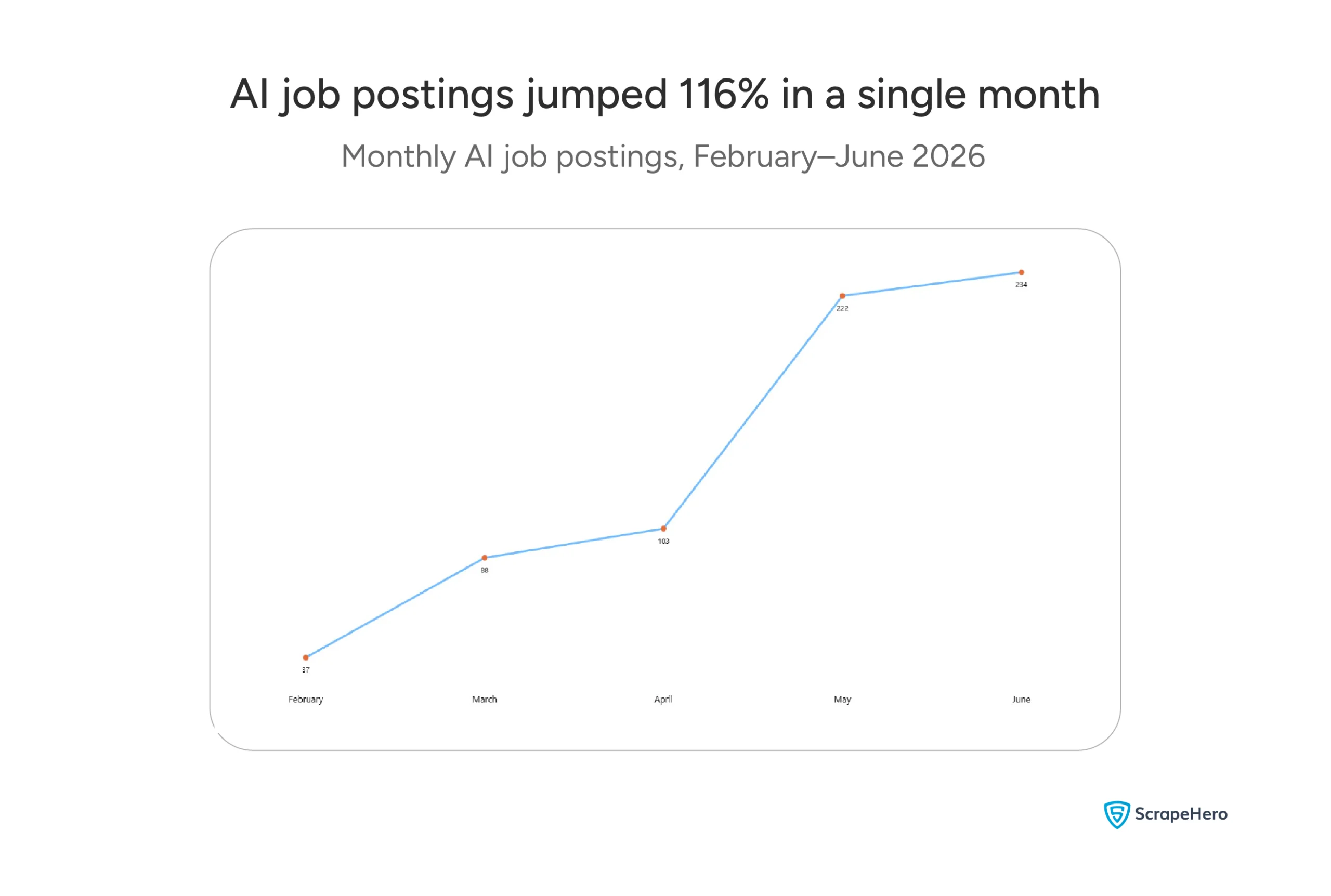
AI job postings rose from 37 in February to 234 in June. That’s more than a sixfold increase in five months. The biggest jump came in May, when postings rose by about 116% compared to April.
Here’s the month-by-month picture:
- February: 37 postings
- March: 88 postings
- April: 103 postings
- May: 222 postings
- June: 234 postings
The growth wasn’t gradual. Postings stayed under 100 for three straight months, then nearly doubled in a single month. This kind of jump suggests a specific hiring push, not just steady organic growth.
What this data can’t tell us: This dataset tracks job postings, not job losses or displacement. We can’t say whether AI is replacing other jobs, or how many people have lost work because of AI. What we can say, with confidence, is that AI-specific hiring is rising fast.
What Is the Average AI Salary in 2026?
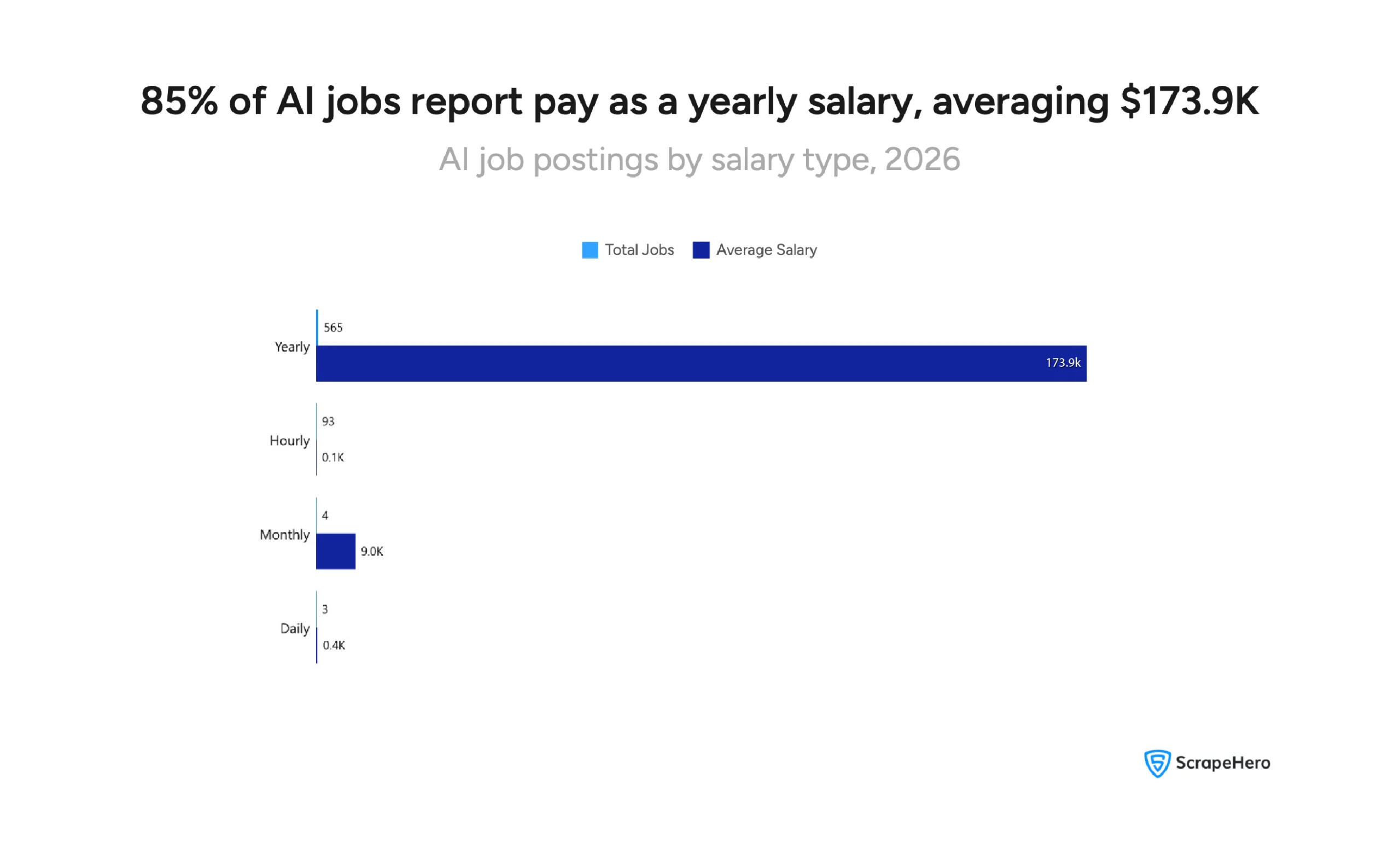
The average AI salary in 2026 is $173,900 a year. That’s based on the 85% of job postings that report pay as a yearly salary.
Not every recruiter reports pay the same way. Some list a yearly salary. Others list a monthly rate. A smaller group lists an hourly rate instead.
Here’s how postings break down by pay format:
- Yearly: 565 postings (about 85%)
- Hourly: 93 postings
- Monthly: 4 postings
- Daily: 3 postings
Most AI jobs — regardless of level or company — are priced as an annual salary. If you’re benchmarking AI compensation, the $173,900 average is the most reliable number to use, since it covers the large majority of listings.
Not all pay formats mean what they seem, though. We break this down further in the next section, using a direct example from the data.
Which AI Skills and Roles Pay the Most?
The highest-paying AI roles in our data all pay over $300,000 a year. The top role pays $390,000.
Here are the five highest-paid AI roles, based on yearly salary listings:
| Role | Yearly Salary |
|---|---|
| Member of Technical Staff – Model Training | $390,000 |
| Principal Machine Learning Engineer, Matching and Recommendations | $377,500 |
| Senior Director, Physical AI – GTM (China Market) | $363,050 |
| Principal Architect, AI Networking | $351,630 |
| Senior Managing Director – AI Strategy & Enterprise Applications | $328,000 |
A pattern stands out here. The highest-paid roles require specialized, technical skills:
- Model training
- Machine learning
- AI infrastructure
- AI networking
- Generative AI
Most of these top-paying roles also carry senior titles — Principal, Senior Director, Senior Managing Director. Companies are paying a premium for deep technical expertise.
A note on pay format: Hourly pay doesn’t mean a job is part-time, temporary, or lower-level. It just means that particular recruiter chose to display pay as an hourly rate instead of a yearly figure.
The highest-paid hourly AI role in our data is a Senior AI Software Engineer, at $170 an hour — roughly comparable to many of the yearly roles above, once you account for a full-time schedule.
Compare the two:
- $390,000/year — Member of Technical Staff, Model Training
- $170/hour — Senior AI Software Engineer
Both are senior, specialized roles. One recruiter chose to list a yearly figure. The other chose an hourly rate. This matters for anyone benchmarking AI salaries: comparing roles by pay format alone can be misleading.
AI Job Types: Full-Time, Contract, and More
Most AI jobs in our data are full-time. 425 of the 660 postings — about 64% — are full-time roles, offered by 174 different companies.
Here’s the full breakdown:
| Job Type | Postings | Companies Offering |
|---|---|---|
| Full-Time | 425 | 174 |
| Part-time | 67 | 8 |
| Contract | 15 | 13 |
| Temp-to-hire | 2 | 2 |
| Permanent | 1 | 1 |
A few things stand out:
- Full-time dominates. Nearly two-thirds of all AI job postings are full-time, and they’re spread across the widest range of companies.
- Part-time and contract roles are a small slice of the market — together, they make up less than 15% of postings.
- Only two companies offer trial-to-permanent hiring, where a role starts as temporary and can convert to permanent.
What Industries and Companies Are Hiring AI Professionals in 2026?
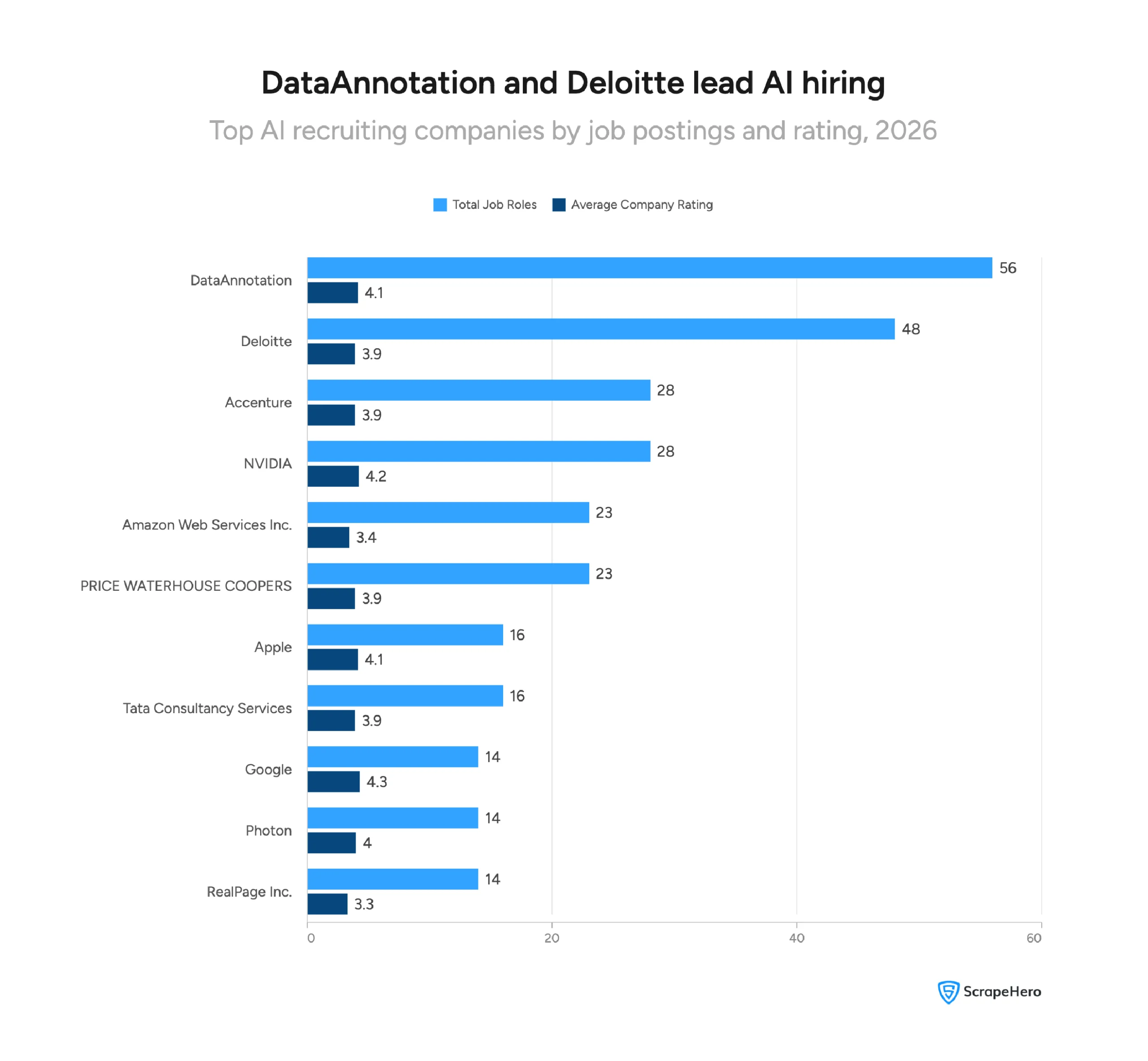
DataAnnotation and Deloitte are the top AI recruiters in our data, with 56 and 48 job postings respectively.
Here’s how the top hiring companies stack up:
| Company | AI Job Postings | Average Rating |
|---|---|---|
| DataAnnotation | 56 | 4.1 |
| Deloitte | 48 | 3.9 |
| Accenture | 28 | 3.9 |
| NVIDIA | 28 | 4.2 |
| Amazon Web Services | 23 | 3.4 |
| PwC | 23 | 3.9 |
Consulting firms show up as major AI recruiters. Deloitte, Accenture, PwC, and Tata Consultancy Services together account for a large share of AI hiring in our data. This suggests AI hiring isn’t limited to tech companies — professional services firms are competing for the same talent.
Tracking which companies are actively hiring like this, at scale, is exactly the kind of job-market monitoring more teams are turning to.
Hiring volume and company rating don’t always move together. NVIDIA (4.2) and Google (4.3) have the highest average ratings among top AI recruiters, but post fewer AI jobs than DataAnnotation or Deloitte. Meanwhile, Amazon Web Services has a lower rating (3.4) despite strong hiring volume.
What this tells us: A company hiring the most AI talent isn’t necessarily the highest-rated place to work, and vice versa. If you’re evaluating AI employers, hiring volume and employee ratings are two separate signals worth checking independently.
Does a Higher Company Rating Mean a Higher AI Salary?
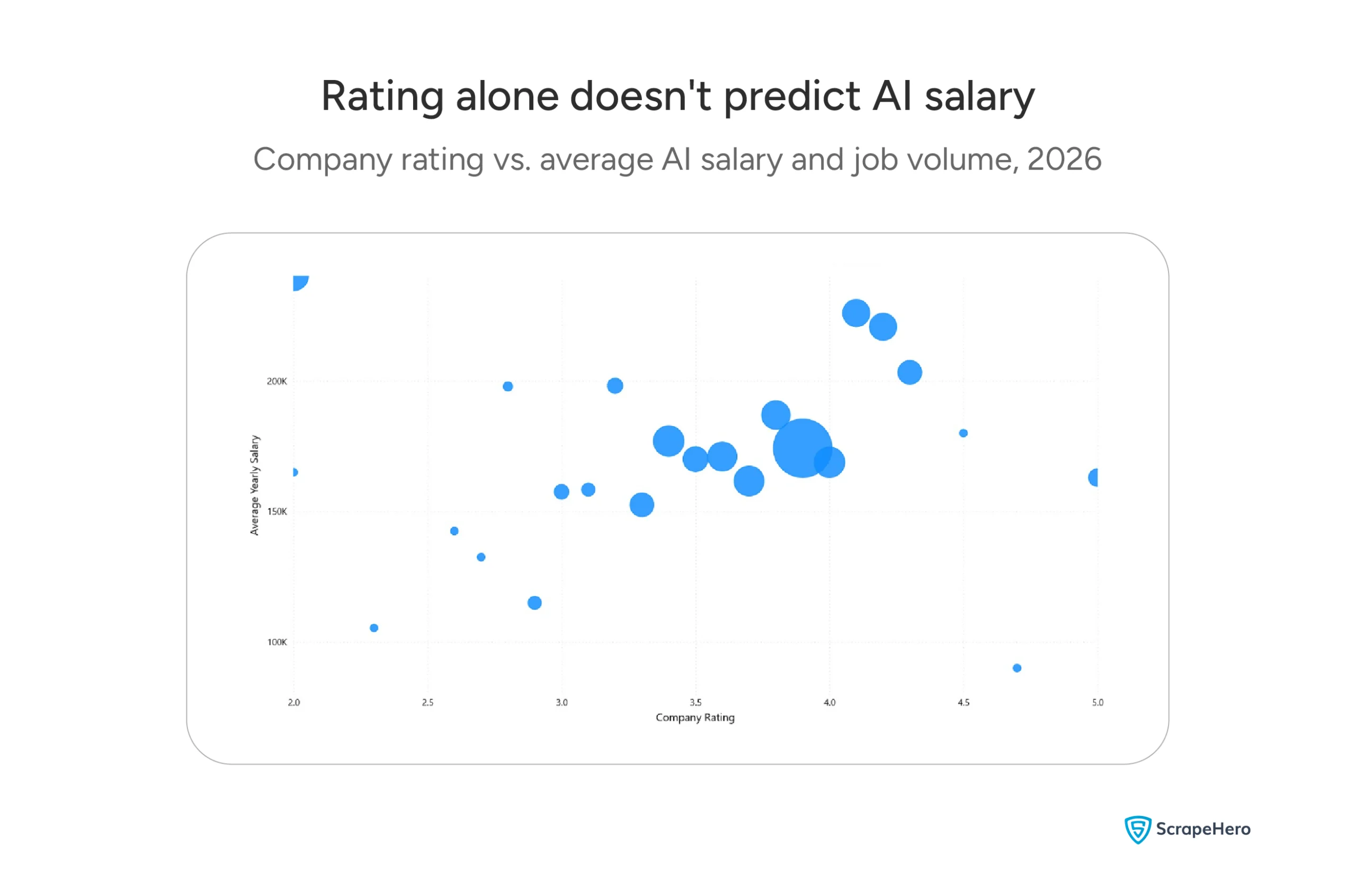
Not necessarily. A higher company rating doesn’t guarantee a higher AI salary — our data shows a more mixed picture.
Companies rated between 3.5 and 4.0 offer the strongest combination of pay and hiring volume. These companies post the most AI jobs and typically pay between $150,000 and $200,000 a year.
But rating alone doesn’t predict pay:
- One company rated 4.7 — the highest in our data — pays an average AI salary of only about $90,000 a year. This is well below the overall average.
- Companies rated below 3.0 rarely pay above $145,000 a year, regardless of how many jobs they post.
- Companies with very low ratings (below 2.0) or very high ratings (above 4.5) tend to post fewer AI jobs overall, compared to the 3.5–4.0 range.
What this means: If you’re using company ratings to estimate AI salaries, be careful. The relationship isn’t straightforward. A well-rated company doesn’t automatically mean top-tier pay, and a lower-rated company doesn’t necessarily mean lower pay either. The 3.5–4.0 rating range is the closest thing to a sweet spot in this data — but it’s a pattern, not a rule.
Which US Cities Have the Most AI Jobs?
Austin, Texas has the most AI job postings in our data — 150 postings, from 56 different companies.
Here’s how the top locations compare:
| Location | AI Job Postings | Companies |
|---|---|---|
| Austin, TX | 150 | 56 |
| Dallas, TX | 105 | 30 |
| Houston, TX | 35 | 19 |
| Irving, TX | 30 | 13 |
Dallas comes in second, with 105 postings across 30 companies. Houston and Irving follow, well behind Austin’s lead.
An important note on scope: This dataset was built by searching for AI jobs specifically within Texas. That means these results show where AI jobs are concentrated within Texas — they don’t tell us how Texas compares to other US states, or to other countries. We can’t say Austin has the most AI jobs in the entire US from this data alone. What we can say with confidence is that Austin is the clear leader in AI hiring within this Texas-focused dataset.
What Benefits Come With AI Jobs in 2026?
Health insurance is the most common benefit offered with AI jobs — it appears in 362 of the 660 job postings.
Here’s how the top benefits break down:
| Benefit | Number of Postings |
|---|---|
| Health Insurance | 362 |
| Dental Insurance | 347 |
| Vision Insurance | 328 |
| Paid Time Off | 283 |
| Paid Holidays | 199 |
| Parental Leave | 175 |
| 401 (k) | 173 |
| Disability Insurance | 149 |
| 401 (k) Matching | 141 |
Health, dental, and vision insurance lead by a wide margin. These three benefits appear far more often than any other, suggesting they’re treated as a baseline offering rather than a differentiator.
Paid time off and paid holidays also rank high. Both appear in well over half of all postings, pointing to a general focus on work-life balance across AI employers.
Retirement-focused benefits are common but less universal. 401(k) plans appear in 173 postings, and 401(k) matching in 141. That’s a meaningful share, but notably fewer than the insurance and leave-related benefits above.
Some benefits are rare. Career development plans appear in only 14 postings, and structured advancement opportunities in just 12. These extras are the exception, not the norm.
Which companies offer the most benefits? Ally Financial and K&L Gates lead, each offering around 19–20 distinct benefit types. Interestingly, the companies topping this list span a wide range of industries — financial services, legal, healthcare, telecommunications, aerospace, and manufacturing. This suggests AI hiring, and competition on benefits, isn’t confined to tech companies.
What the Data Tells Us About AI Hiring in 2026?
AI hiring in 2026 is accelerating, not slowing down. Here’s what stood out most:
- AI job postings jumped from 37 to 234 in five months — a clear, sustained climb.
- The average AI salary is $173,900 a year, though pay format varies by recruiter. Hourly listings don’t mean lower-level work.
- The highest-paid AI role in our data pays $390,000 a year, and the top skills in demand are model training, machine learning, and AI infrastructure.
- Full-time roles dominate, making up 64% of all postings.
- DataAnnotation and Deloitte lead AI hiring, and consulting firms as a group are major recruiters — not just tech companies.
- Company rating doesn’t reliably predict AI salary. The 3.5–4.0 rating range offers the best mix of pay and hiring volume, but there are clear exceptions.
- Austin, Texas leads AI hiring within our Texas-focused data, followed by Dallas and Houston.
- Health, dental, and vision insurance are standard across nearly all AI job postings.
Every finding here comes from a real, structured dataset — not estimates or projections. Where the data couldn’t support a claim, like AI’s effect on job losses elsewhere in the economy, we said so.
How we gathered this data: We pulled these 660 job postings directly from Indeed, using the ScrapeHero Cloud Indeed Scraper. This wasn’t a one-time report. It reflects live job listings, tracked and structured at scale.
That’s the kind of work we do regularly — turning live, publicly available web data into something you can actually use. Pricing, hiring trends, competitor activity, or anything else that changes by the day. If your team needs data like this, tracked reliably and delivered in a usable format, ScrapeHero can help.
Disclaimer: The data used in this report is sourced from publicly available information. This analysis has been produced independently by ScrapeHero and is not affiliated with, endorsed by, or produced in association with anyone else. All brand names are the property of their respective owners.
ScrapeHero is one of the top 3 web scraping services globally, and unlike most data services, we are a fully managed enterprise-grade web scraping service. That means real experts handle your data requirements from start to finish, no technical expertise needed on your end.
In an age where AI drives most of the process, ScrapeHero keeps a human at every point — from the first conversation about your requirements to manual QA before delivery. You get clean, structured, trustworthy data without having to chase it yourself.
Frequently Asked Questions
The average AI salary in 2026 is $173,900 a year. This figure is based on the 85% of job postings in our data that report pay as a yearly salary.
Hourly pay doesn’t mean a job is part-time, temporary, or lower-level. It simply reflects how that recruiter chose to display pay. Our data includes senior, highly specialized roles listed by the hour — including a Senior AI Software Engineer role at $170 an hour, comparable to many six-figure yearly roles.
DataAnnotation and Deloitte lead AI hiring in our data, with 56 and 48 job postings respectively. Consulting firms as a group — including Deloitte, Accenture, PwC, and Tata Consultancy Services — account for a large share of AI hiring, showing that AI recruitment isn’t limited to tech companies.
Not necessarily. Companies rated between 3.5 and 4.0 show the best combination of pay and hiring volume, typically paying $150,000–$200,000 a year. But rating alone doesn’t predict pay — one company rated 4.7, the highest in our data, pays an average AI salary of only about $90,000 a year.
Austin, Texas leads with 150 AI job postings across 56 companies, based on our Texas-focused dataset. Dallas follows with 105 postings, then Houston and Irving.