
About the Report:
The US auto parts retail industry is large, geographically spread, and more competitive than it looks from the outside. Knowing who operates where and how much ground they actually cover matters for retailers, suppliers, real estate firms, and e-commerce players alike.
This analysis draws on a store location data covering the 10 largest auto parts retailers in the US downloaded from ScrapeHero Data Store, supplemented by data from S&P Global Mobility, the Auto Care Association, and the Federal Highway Administration (FHWA).
What Does the US Auto Parts Retail Market Look Like Today?
The US auto parts retail market is big, resilient, and still growing.
The DIY and DIFM (do-it-for-me) market, which covers both consumers buying parts themselves and professional repair shops sourcing parts, is worth an estimated $175–200 billion annually, according to CreditSights. It grows at roughly 2–3% per year.
According to Technavio, the aftermarket segment alone is forecast to expand by $44.8 billion between 2025 and 2030.
Two structural forces are driving this growth.
- An aging vehicle fleet. The average age of US light vehicles reached a record 12.8 years in 2025, according to S&P Global Mobility. Passenger cars average even older — 14.5 years. Older vehicles need more maintenance, more replacement parts, and more frequent repairs.
- A dominant DIY culture. The DIY segment accounts for roughly 20% of total auto parts purchases, with DIFM making up the remaining 80%, according to the Auto Care Association and AASA. But DIY is growing fast; the DIY auto parts market hit approximately $84 billion in 2025, growing at a 5.3% CAGR since 2017, according to the Auto Care Association’s 2026 Factbook.
Both segments depend on one thing: accessible, well-stocked retail locations. That’s where store footprint data becomes critical.
According to S&P Global Mobility, 110 million US vehicles fall within the aftermarket “sweet spot” of 6–14 years old, nearly 38% of the entire fleet. It is projected to rise to 40% by 2028.
What Are the Top 10 Largest Auto Parts Retailers in the US?
The 10 largest auto parts retailers in the US operate across very different scales, specialties, and geographies.
Based on ScrapeHero’s 2026 store location data, here’s where each retailer stands:
| Retailer | Store Count | Primary Focus |
|---|---|---|
| AutoZone | 6,700+ | Car parts & accessories |
| Western Powersports | 6,500+ | Powersports vehicles & accessories |
| O’Reilly Auto Parts | 6,500+ | Car parts & accessories |
| Pronto | 6,300+ | Aftermarket parts |
| NAPA Auto Parts | 5,400+ | Car parts & accessories |
| Bendix | 4,200+ | Brake & friction parts |
| Advance Auto Parts | 4,100+ | Car parts & accessories |
| Parts Unlimited | 3,300+ | Powersports aftermarket accessories |
| Murphy USA | 1,600+ | Fuel retail & convenience |
| Auto-Wares | 1,300+ | Aftermarket parts (Midwest) |
Want to compare the locations of AutoZone with the locations of O’Reilly Auto Parts?
A few things stand out immediately.
- The top four are closer than they look. AutoZone, Western Powersports, O’Reilly Auto Parts, and Pronto all cross the 6,000-store mark. The gap between first and fourth place is fewer than 500 stores.
- They don’t all sell the same thing. Three categories emerge from this list. The first is traditional auto parts- AutoZone, O’Reilly, NAPA, Advance Auto Parts, and Auto-Wares. The second is powersports — Western Powersports and Parts Unlimited, which serve ATVs, motorcycles, and similar vehicles. The third is specialists- Pronto in aftermarket parts and Bendix in brake and friction products.
Murphy USA sits outside all three. It is primarily a fuel and convenience retailer — gas stations stocking motor oil and basic fluids — making it a structurally different business from the other nine.
- The bottom two operate at a different scale. Murphy USA (1,600 stores+) and Auto-Wares (1,300 stores+) are not national competitors in the traditional sense. Murphy USA concentrates in the South, Southwest, and Midwest, primarily near Walmart locations. Auto-Wares operates exclusively across six Midwestern states — Michigan, Ohio, Illinois, Indiana, Wisconsin, and Kentucky.
By store count, AutoZone leads with over 6,700+ locations, according to ScrapeHero’s 2026 store location data. However, by revenue, AutoZone and O’Reilly Auto Parts are the dominant players — together accounting for roughly 5% of the US investment-grade retail bond index, according to CreditSights.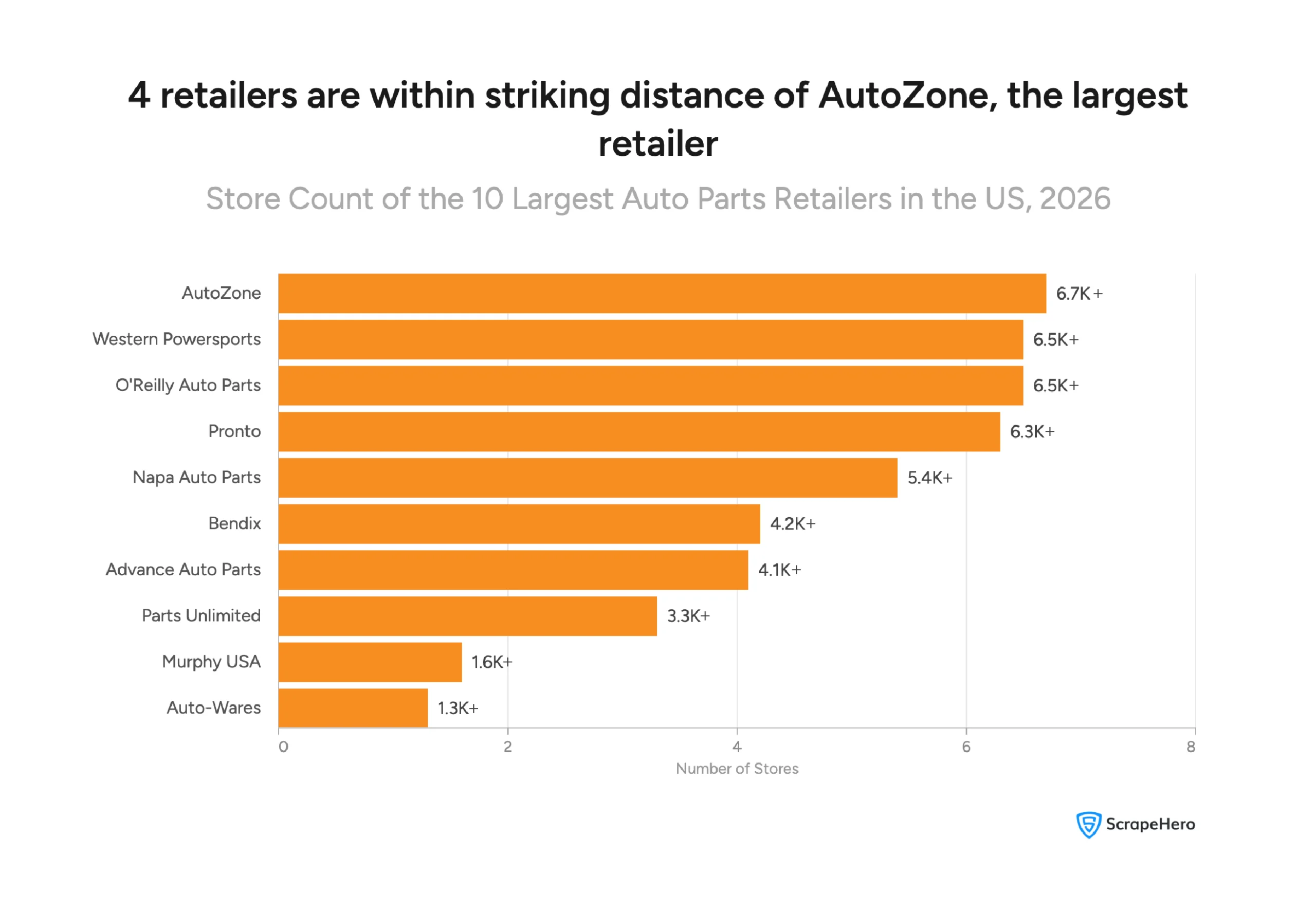
Which Auto Parts Retailer Has the Widest Geographic Coverage in the US?
Store count tells you how big a retailer is. Zip code coverage tells you how accessible it actually is.
A retailer with 6,000 stores clustered in a few metros is far less accessible than one with 4,000 stores spread across 5,000 zip codes. For customers, suppliers, and real estate planners, coverage depth matters as much as raw store count.
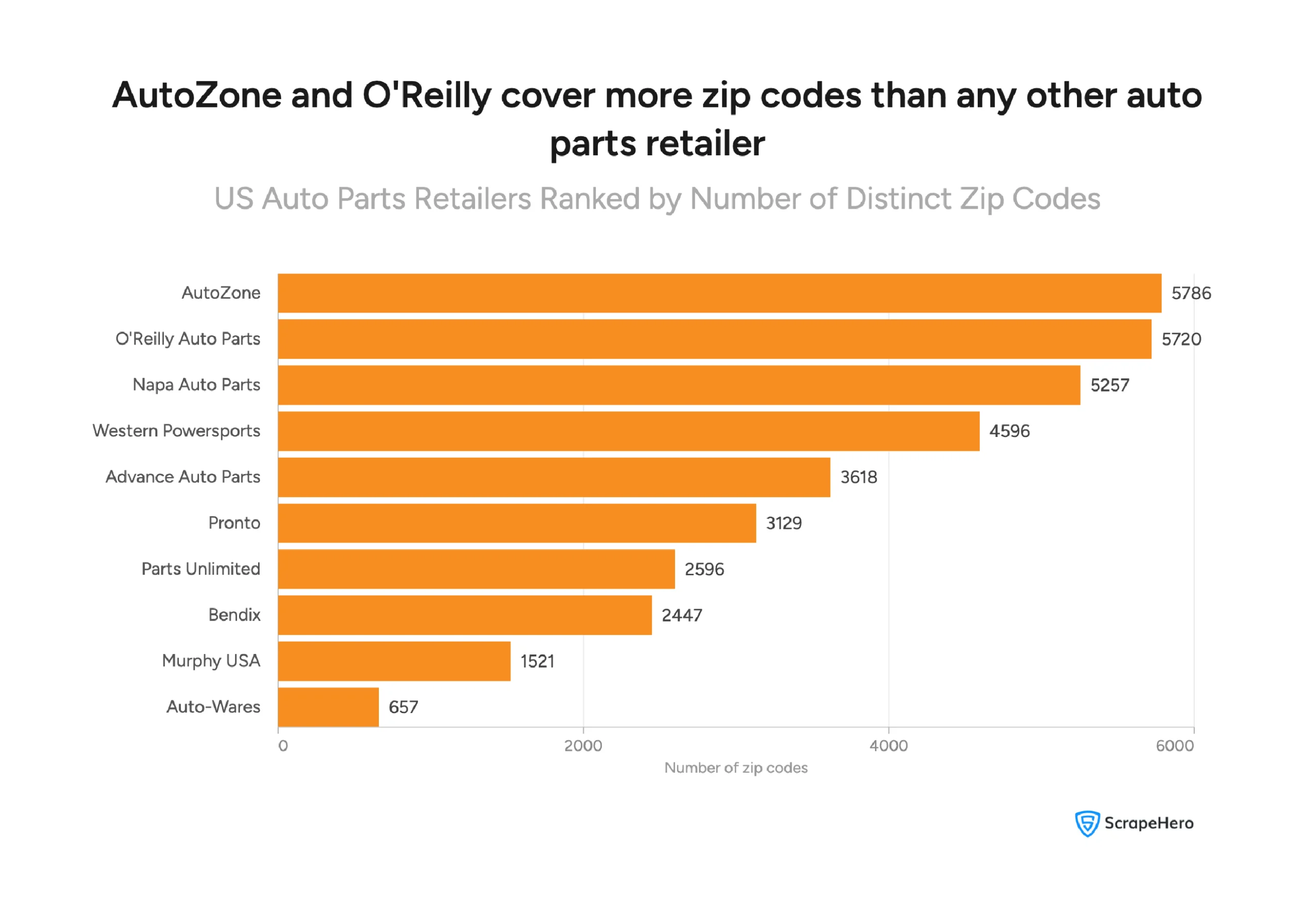
Based on ScrapeHero’s 2026 store location data, AutoZone and O’Reilly Auto Parts lead by a clear margin.
- AutoZone covers 5,786 distinct zip codes
- O’Reilly Auto Parts covers 5,720 distinct zip codes
- NAPA Auto Parts follows at 5,257 zip codes
- Western Powersports covers 4,596 zip codes
- Advance Auto Parts covers 3,618 zip codes
- Pronto covers 3,129 zip codes
- Parts Unlimited covers 2,596 zip codes
- Bendix covers 2,447 zip codes
- Murphy USA covers 1,521 zip codes
- Auto-Wares covers just 657 zip codes
The gap between the top and bottom is stark. AutoZone’s zip code reach is nearly nine times that of Auto-Wares.
Both retailers are neck and neck in geographic reach — AutoZone covers 5,786 ZIP codes, and O’Reilly covers 5,720. AutoZone leads on total store count (6,700 vs 6,500) and consumer visit share. O’Reilly leads on recent financial performance, posting 4.1% comparable store sales growth in Q2 2025. Both are investing in omnichannel — and both carry a near-identical physical footprint advantage over pure-play online competitors.
What this means in practice.
- For a customer needing a part quickly, AutoZone or O’Reilly is almost always the closest option.
- For a supplier evaluating retail distribution partners, zip code coverage directly reflects how many end customers a retailer can realistically serve.
- For a real estate firm assessing market saturation, low zip code coverage signals either opportunity or a deliberate geographic focus.
Points worth noting:
- NAPA punches above its weight. Despite ranking fifth by store count at 5,400 stores, NAPA ranks third in zip code coverage at 5,257. That’s a tighter, more distributed store network — fewer stores per zip code, spread more broadly across the country.
- Pronto’s coverage gap is significant. Pronto has 6,300+ stores, fourth by store count, but covers only 3,129 zip codes. That means its stores are heavily concentrated in fewer locations.
AutoZone leads with presence in 5,786 zip codes, followed closely by O’Reilly Auto Parts at 5,720, according to ScrapeHero’s 2026 store location data.
Where Are Auto Parts Retail Stores Most Concentrated in the US?
Store presence follows vehicle density. States with the most registered vehicles attract the most auto parts stores, and the data confirms this.
According to the Federal Highway Administration (FHWA), California leads the US with 13.1 million registered automobiles, followed by Texas at 7.4 million and Florida at 7.35 million. These three states also dominate auto parts retail store counts across nearly every retailer in ScrapeHero’s location data.
Here’s how the top five states break down by store presence across the 10 retailers:
| State | Top Retailer | Store Count | Notable Absence |
|---|---|---|---|
| Texas | Pronto | 979 | — |
| California | AutoZone | 687 | Advance Auto Parts, Auto-Wares, Murphy USA |
| Florida | Advance Auto Parts | 513 | — |
| Michigan | Auto-Wares | 755 | — |
| New York | Pronto | 814 | Auto-Wares, Murphy USA |
Where Are Auto Parts Stores Concentrated at the City Level?
State-level data shows where demand is highest. City-level data shows how retailers actually compete for it.
Not all cities are equal for auto parts retail. Cities with low public transit usage, where residents depend almost entirely on personal vehicles, are among the strongest auto parts markets in the country.
ScrapeHero’s 2026 store location data examines retailer presence across five of the most car-dependent major US cities: Houston TX, Phoenix AZ, Dallas TX, Los Angeles CA, and Atlanta GA.
| City | Top Retailer | Store Count |
|---|---|---|
| Houston, TX | Pronto | 245 |
| Phoenix, AZ | Pronto | 37 |
| Dallas, TX | Pronto | 53 |
| Los Angeles, CA | AutoZone | 38 |
| Atlanta, GA | AutoZone and Pronto | 13 (tied) |
Pronto‘s city-level dominance is the most unexpected finding in this dataset.
Nationally, it ranks fourth by store count. But at the city level, it leads or ties in four of the five car-dependent cities analyzed — Houston, Phoenix, Dallas, and Atlanta. Only in Los Angeles does AutoZone pull ahead.
According to the American Community Survey, 53 of the 63 largest US cities have fewer than 15% of residents using public transit. In cities like Houston, Phoenix, and Dallas, that figure is far lower. Where public transit is weak, personal vehicles fill the gap and auto parts retailers follow.
Pronto operates 245 stores there, nearly three times AutoZone’s 84 and more than three times O’Reilly’s 69. No other city in the dataset comes close to this level of concentration from a single retailer. The city covers over 670 square miles, has no meaningful public rail network serving its broader metro, and is home to more than 2.3 million residents. Personal vehicles aren’t a convenience in Houston; they’re a requirement.
Is Online Auto Parts Shopping on the Rise in the US?
The data suggests yes, and 2026 marks a turning point.
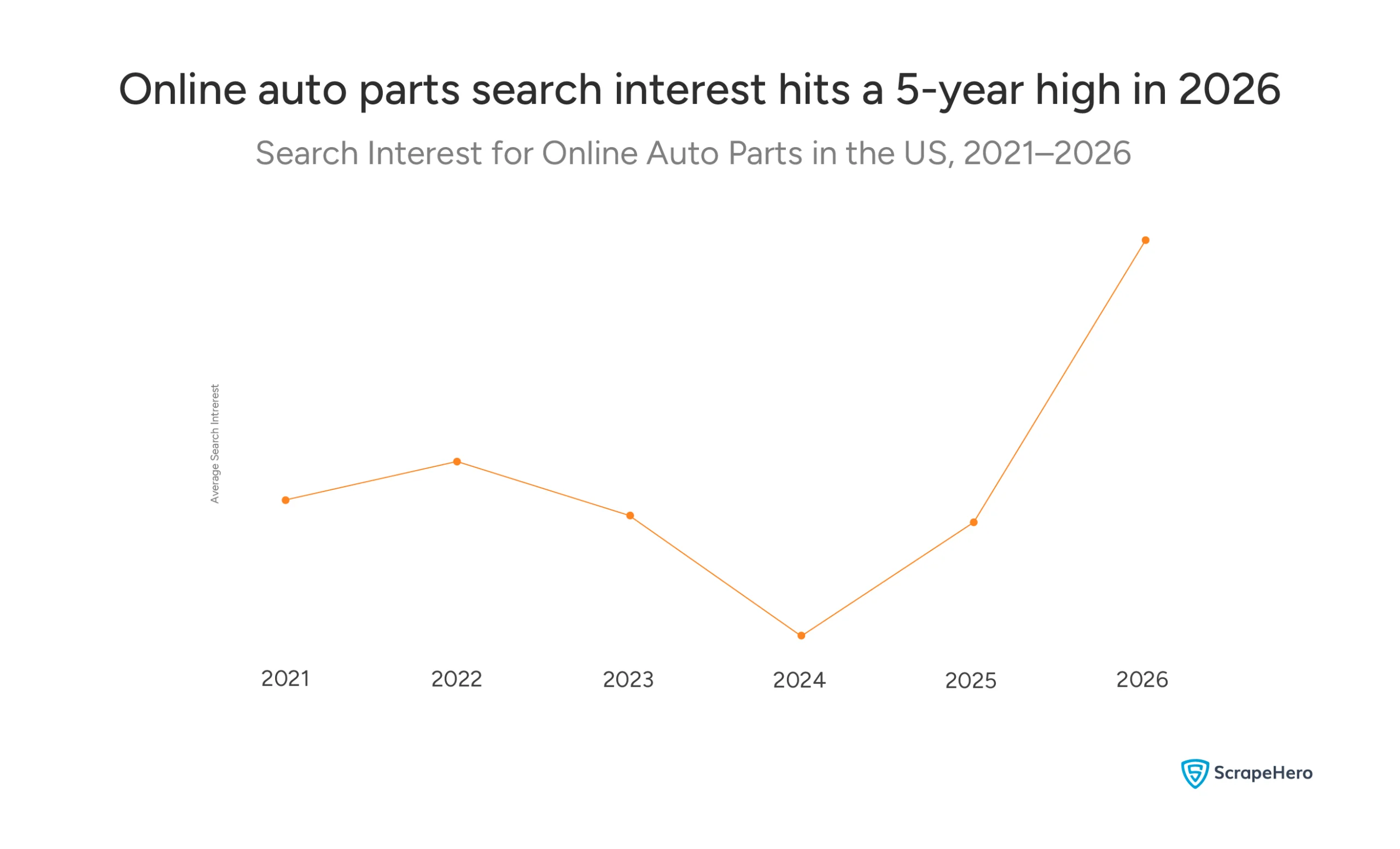
Search interest for online auto parts in the US hit a five-year high in 2026, according to ScrapeHero’s analysis of Google Trends data. Interest dipped sharply in 2024 before rebounding strongly in 2025 and peaking in 2026. Despite that mid-period dip, the overall direction is clear: more Americans are turning to online channels to research and shop for auto parts.
Several forces are sustaining this shift, some of which are:
- An aging, expensive-to-repair fleet. With the average US vehicle now 12.8 years old, repair frequency is rising. Cost-conscious owners might increasingly research and source parts online before visiting a store, or skip the store entirely.
- A growing DIY segment. Online DIY auto parts sales are growing at a 7.56% CAGR through 2031, according to the Auto Care Association. Price comparison, wider SKU availability, and next-day delivery may be making online purchasing viable for a broader range of repairs than before.
What Does This Analysis Reveal About the Auto Parts Retailers in the US?
The US auto parts retail market is large, geographically uneven, and more nuanced than headline store counts suggest.
- AutoZone leads nationally, but Pronto dominates the cities where demand is highest.
- O’Reilly matches AutoZone zip code for zip code, but trails on store count.
- California has the most registered vehicles in the country, yet three of the ten largest retailers have no presence there at all.
These are the kinds of findings that only emerge from ground-level location data — not industry reports or earnings calls.
Disclaimer: The data used in this report is sourced from publicly available information. This analysis has been produced independently by ScrapeHero and is not affiliated with, endorsed by, or produced in association with any of the auto parts retailers in the US. All brand names are the property of their respective owners.
Looking for The Right Data to Navigate the US Market?
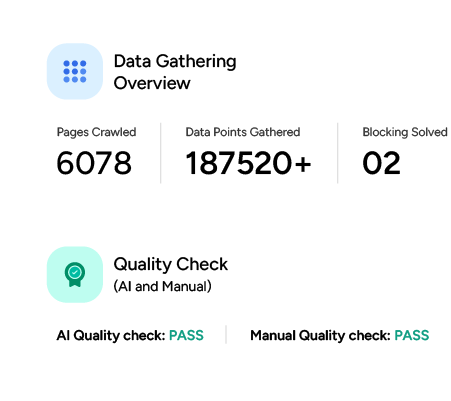
ScrapeHero is one of the top 3 web scraping services globally, and unlike most data services, we are fully managed. That means real experts handle your data requirements from start to finish, no technical expertise needed on your end.
In an age where AI drives most of the process, ScrapeHero keeps a human involved at every step, from the initial conversation about your requirements to manual QA before delivery. You get clean, structured, trustworthy data without having to chase it yourself.
Frequently Asked Questions About the Largest Auto Parts Retailers in the US
By store count, AutoZone leads with 6,700+ locations, according to ScrapeHero’s 2026 store location data. By revenue, AutoZone and O’Reilly Auto Parts are the two dominant players.
The combined DIY and DIFM market is worth an estimated $175–200 billion annually, according to CreditSights, growing at 2–3% per year. The aftermarket segment alone is forecast to expand by $44.8 billion between 2025 and 2030, according to Technavio.
AutoZone leads with 5,786 zip codes, followed by O’Reilly at 5,720 and NAPA at 5,257, according to ScrapeHero’s 2026 store location data.
AutoZone leads on store count (6,700 vs 6,500) and consumer visit share. O’Reilly leads on recent financial performance, posting 4.1% comparable store sales growth in Q2 2025. Both are nearly identical in zip code coverage.
Houston is one of the most car-dependent cities in the US, covering 670+ square miles with a less meaningful public rail network. That makes personal vehicle ownership a necessity, driving consistently high demand for auto parts.
Yes. Pronto ranks fourth nationally with 6,300+ stores. At the city level, it leads or ties in four of the five most car-dependent US cities analyzed, Houston, Phoenix, Dallas, and Atlanta, according to ScrapeHero’s 2026 store location data.