Oxylabs has a strong reputation in enterprise web scraping. Its proxy network is solid, its Web Scraper API works well, and it handles large-scale data collection with ease. For engineering teams that want to run their own infrastructure, it’s a good choice.
But not every business wants to build and manage that infrastructure. Naturally, many are looking for Oxylabs alternatives instead, one that cuts engineering work, delivers cleaner data, or manages the whole process for them.

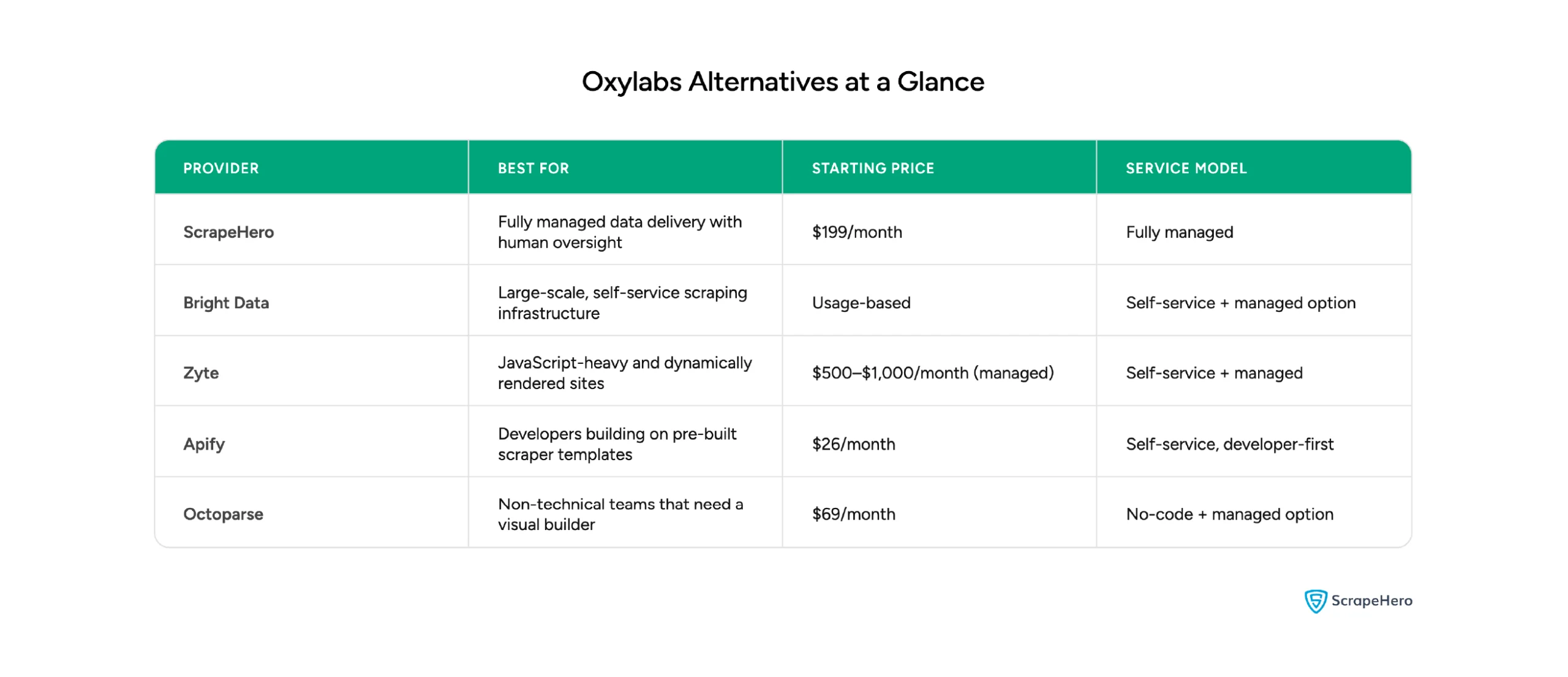
With that in mind, this guide compares five alternatives, ScrapeHero, Bright Data, Zyte, Apify, and Octoparse, on what actually matters: service model, engineering effort, data quality, scalability, support, and pricing.
Key Takeaways
Why do companies look for Oxylabs alternatives?
When you evaluate Oxylabs alternatives, it’s easy to focus on the wrong things. Proxy network size, API features, and request pricing all matter. But they don’t tell you whether you’ll actually get reliable, usable data.
Instead, the better question is: what outcome does this vendor deliver, and how much work does your team still have to do?
Here’s the part that catches people off guard: the vendor with the most features often creates the most work for your team, not the least. For that reason, a strong alternative should be judged on the full data pipeline, not just the scraping tools.
At its core, this is a web scraping service vs proxy provider decision, since a proxy alone doesn’t guarantee clean, usable data.
- Managed service vs. self-service infrastructure: Decide if your team wants to build and maintain scrapers, or hand off the whole job. This is really the managed scraping vs self-service scraping question, and it shapes almost every other decision on this list.
- Total cost of ownership: Measure ROI by counting engineering hours, scraper upkeep, proxy management, monitoring, and fixing failed extractions. Don’t just look at the subscription fee, as web scraping maintenance costs add up fast once you factor in broken scrapers and site changes.
- Data quality and normalization: Raw HTML or messy fields create extra work for your analytics, pricing, or AI teams.
- Scalability: Ensure the provider can handle millions of pages, multiple target sites, and frequent extraction runs. If you’re weighing Oxylabs alternatives for large-scale scraping specifically, this is the criterion to stress-test hardest.
- Anti-bot handling and maintenance: Know who’s responsible when a target site changes or blocks your scraper.
- Customer support and SLAs: Look for dedicated support, clear response times, and a team that fixes issues before you notice them.
- Compliance and reliability: Data sourcing practices, uptime, and delivery consistency matter as much as any feature list.
- Delivery methods: Confirm the vendor can deliver data through APIs, files, cloud storage, databases, or custom integrations, whatever fits your systems.
As a result, teams that compare vendors based solely on proxies tend to overlook the scraping infrastructure overhead that comes with running a pipeline in-house. A better evaluation considers reliability, data readiness, and the internal effort required to turn web data into something your team can actually use.
1. ScrapeHero — Best for Fully Managed Data Delivery
As one of the more established Oxylabs alternatives, ScrapeHero is a fully managed web scraping service. It’s built for businesses that want reliable web data without having to run the infrastructure themselves.
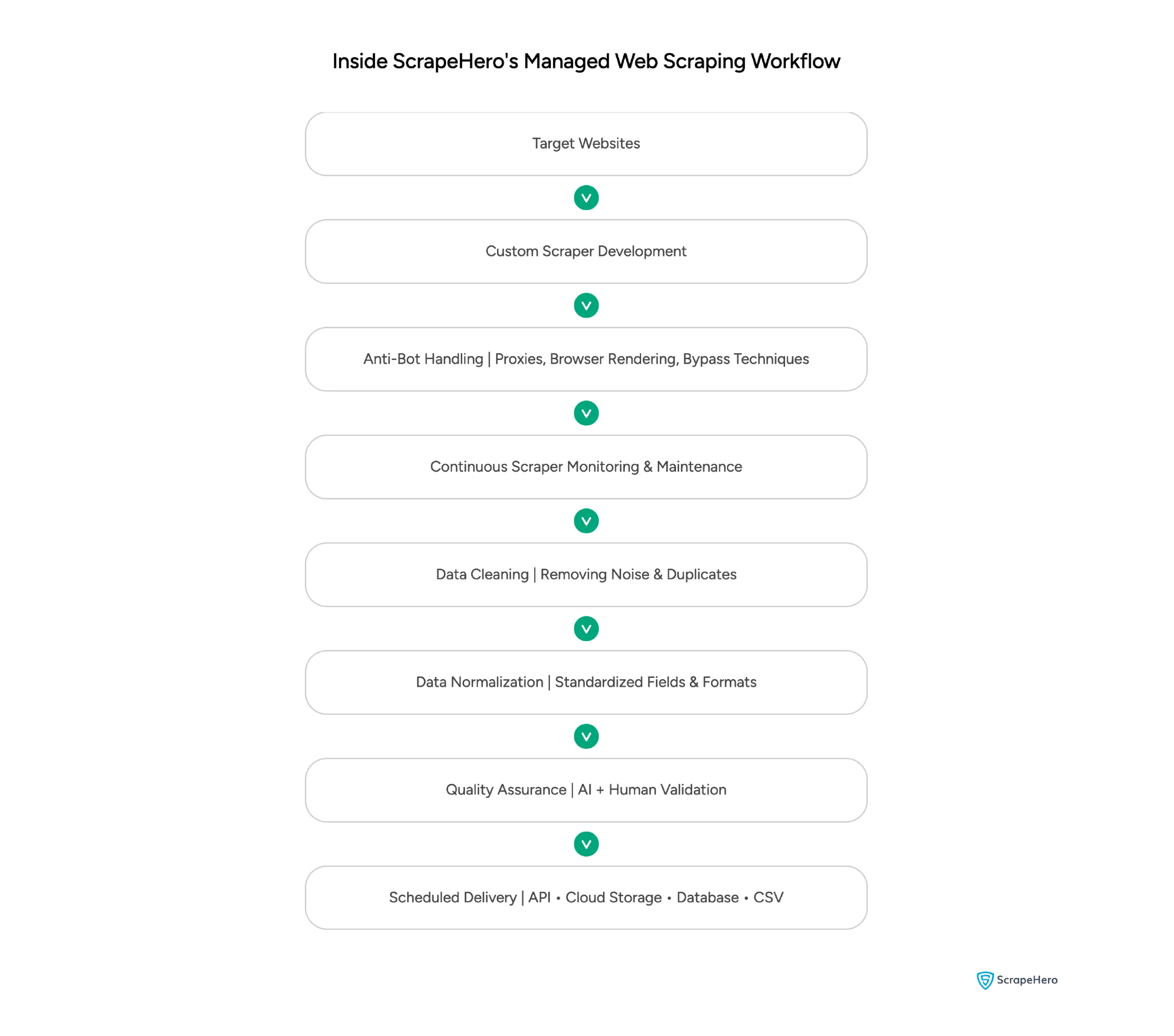
Instead of handing you a proxy network or a tool to operate, ScrapeHero owns the whole pipeline: scraper development, anti-bot handling, ongoing maintenance, data cleanup, quality checks, and scheduled delivery.
Here’s what sets it apart, and it’s not what most people expect. Many managed providers lean almost entirely on automation and AI-only checks. In contrast, ScrapeHero pairs automation with data engineers who handle onboarding, watch data quality, and step in before problems reach your systems.
For teams that don’t need a custom build, ScrapeHero Cloud offers a marketplace of ready-made, maintained scrapers for popular sites. So, you get structured data without having to handle any maintenance.
Core capabilities
- Fully managed web scraping
- Custom APIs and automated data delivery
- Data cleaning and normalization
- AI-ready datasets
- Enterprise-scale extraction
- Continuous scraper monitoring and maintenance
- ScrapeHero Cloud, with pre-built managed scrapers
Limitations
- Less suited to teams that specifically want self-service proxy infrastructure
- Less suited to teams that need smaller custom projects
Pricing
- Managed plans start at $199/month
- Enterprise plans start at $1,500/month, priced by project scope rather than infrastructure usage
Best suited for
E-commerce brands, pricing intelligence teams, digital shelf monitoring, market research, and AI/analytics teams — generally, organizations that treat web data as infrastructure rather than a one-off engineering project.
2. Bright Data — Best for Custom Enterprise Infrastructure
Bright Data is one of the largest web data platforms. Its product line is broad: proxy infrastructure, scraping APIs, browser automation, a dataset marketplace, and a managed data service.
Its biggest strength is flexibility.
Teams can build their own pipelines on Bright Data’s infrastructure, or hand off collection through its Managed Data Acquisition service.
That range makes it work for both hands-on teams and teams that want a managed option. The trade-off: if you go the self-service route, someone in-house still has to build, monitor, and maintain it.
Core capabilities
- Residential, ISP, and datacenter proxy networks
- Web Unlocker for anti-bot bypass
- Browser API for browser-based automation
- Web Scraping APIs
- Pre-collected dataset marketplace
- Managed Data Acquisition service
Limitations
- Usage-based pricing gets harder to predict as scraping volume grows
- Self-service products need dedicated engineering time to build and maintain
- Managed services run through enterprise contracts, which fits larger organizations more than smaller projects
Pricing
- Self-service infrastructure is usage-based, varying with proxy usage, bandwidth, and API requests
- Bright Data is on the expensive side; its fully managed service starts in the $1,000–$2,500-per-month range for entry-level projects, with pricing scaling upward from there.
Best suited for
Large engineering teams building custom infrastructure, organizations running high-volume global scraping, and businesses that want maximum control over proxies, browser automation, and collection workflows.
3. Zyte — Best for JavaScript-Heavy and Dynamic Sites
Zyte is one of the longest-running names in web scraping. It created the open-source Scrapy framework. Today it serves two kinds of teams: developer tools for those building custom pipelines, and Zyte Data, a fully managed service for teams that want to hand off the operational work.
Zyte’s strength is scraping JavaScript-heavy, dynamic sites.
Proxy management, browser rendering, and AI-assisted extraction work together to handle modern sites that trip up simpler crawlers. From there, you choose how much of the pipeline to keep in-house and how much to outsource.
Core capabilities
- Zyte API
- Smart Proxy Manager
- Scrapy Cloud
- Zyte Data managed service
- AI-assisted extraction
- JavaScript rendering support
Limitations
- Self-service tools need experienced developers to build, monitor, and maintain
- Data cleaning and downstream processing stay the customer’s job on the DIY side
- Managed services are positioned as premium and may not fit every budget
Pricing
- Developer tools are usage-based, scaling with request volume and rendering needs
- Managed services typically start between $500 and $1,000/month, with custom pricing by scope
Best suited for
Teams already using Scrapy, engineering teams building custom pipelines, and businesses that want the option to move between self-service and managed as needs change.
4. Apify — Best Actor Marketplace for Developers
Apify is a cloud-based scraping and automation platform built mainly for developers.
Its defining feature is the Actor marketplace: over 33,000 pre-built Actors for scraping and workflow automation. Teams can customize these instead of building scrapers from scratch.
Apify offers professional services for a more hands-off approach.
But here’s the catch: most customers still own the selection, configuration, monitoring, and maintenance of their workflows.
Also, Actors need updates as target sites change, so that ownership doesn’t go away once a workflow is running. It just moves from “building it” to “babysitting it.”
Core capabilities
- Actor marketplace with 33,000+ pre-built Actors
- Cloud-based scraper execution
- Task scheduling and automation
- Browser automation for dynamic sites
- API integrations and webhooks
- Professional managed services
Limitations
- Marketplace Actors need ongoing maintenance as target sites change
- Data quality depends on how well workflows are implemented and maintained
- Enterprise-scale deployments may need custom Actor development and added engineering time
Pricing
- Free plan available for smaller projects
- Paid plans start around $26/month, scaling with compute usage, storage, and execution time
- Custom enterprise pricing for larger deployments
Best suited for
Developers building custom scraping and automation workflows, product/engineering teams wanting flexible cloud infrastructure, and startups prototyping quickly on existing Actors.
5. Octoparse — Best No-Code Option for Non-Technical Teams
Octoparse splits into two products for two kinds of users.
One is a no-code platform for business users who build scraping workflows through a visual interface. The other is a managed enterprise service in which Octoparse handles data collection, maintenance, quality checks, and scheduled delivery.
The distinction matters. The no-code platform suits teams that want to build and run their own tasks. Meanwhile, the managed service suits teams that would rather outsource the technical work and just get structured data on a regular basis.
Core capabilities
- Visual no-code workflow builder
- Cloud-based web scraping
- Pre-built templates for common websites
- Scheduled data extraction
- Fully managed data service
- Export and integration options
Limitations
- The no-code platform is less flexible for large or highly customized enterprise projects
- Dynamic, JavaScript-heavy sites may need extra configuration or a custom solution
- Even with the managed service, you’ll likely still need to integrate delivered data into your internal systems
Pricing
- Free plan for basic use cases
- Paid plans start around $69/month, with higher tiers for advanced features
- Managed data services start around $699/project, custom-priced for enterprise needs
Best suited for
Business analysts and ops teams without dedicated developers, small and mid-sized organizations wanting no-code scraping, and businesses that need occasional data collection with minimal technical setup.
TL;DR
Which of These Oxylabs Alternatives Fits Your Business?
All five providers can collect web data, but they differ in how much work your team still has to do after scraping begins. If your priority is minimizing engineering effort while receiving cleaned, validated, business-ready datasets with predictable pricing, a fully managed service like ScrapeHero is the strongest fit.
All five options here are solid.
ScrapeHero, Bright Data, Zyte, and Apify, all well-known Oxylabs competitors, offer managed services backed by real infrastructure. If you need a set-it-and-forget-it pipeline, any of them can do the job.
But once every provider calls itself “managed,” the real question isn’t whether they handle the infrastructure. Instead, it’s what they deliver on top of it.
Most managed services focus on keeping scrapers running.
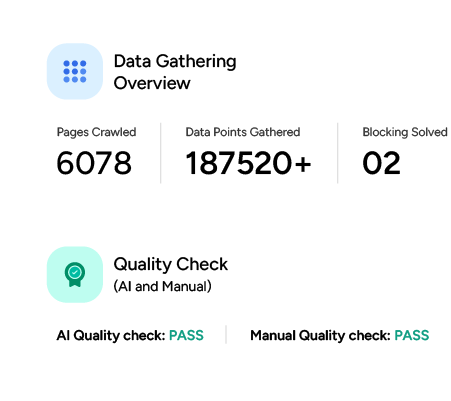
In contrast, ScrapeHero, the top web scraping company, focuses on delivering the data right. Our data engineers actively validate extracted fields and catch structural drift before a record reaches your database, not after a failed delivery alert.
The pipeline still runs at full speed; the checks just run alongside it.
Pricing works the same way. Competitors often lead with a low entry tier, then the bill grows once rendering fees, bandwidth, and overages get added. ScrapeHero’s pricing is fixed from day one, so you know what you’re paying for finished data, not every API call along the way.
We’ve also built this specifically around scraping, across e-commerce, real estate, travel, and lead generation, so we’ve run into most of the anti-bot patterns and site redesigns a new project will hit.
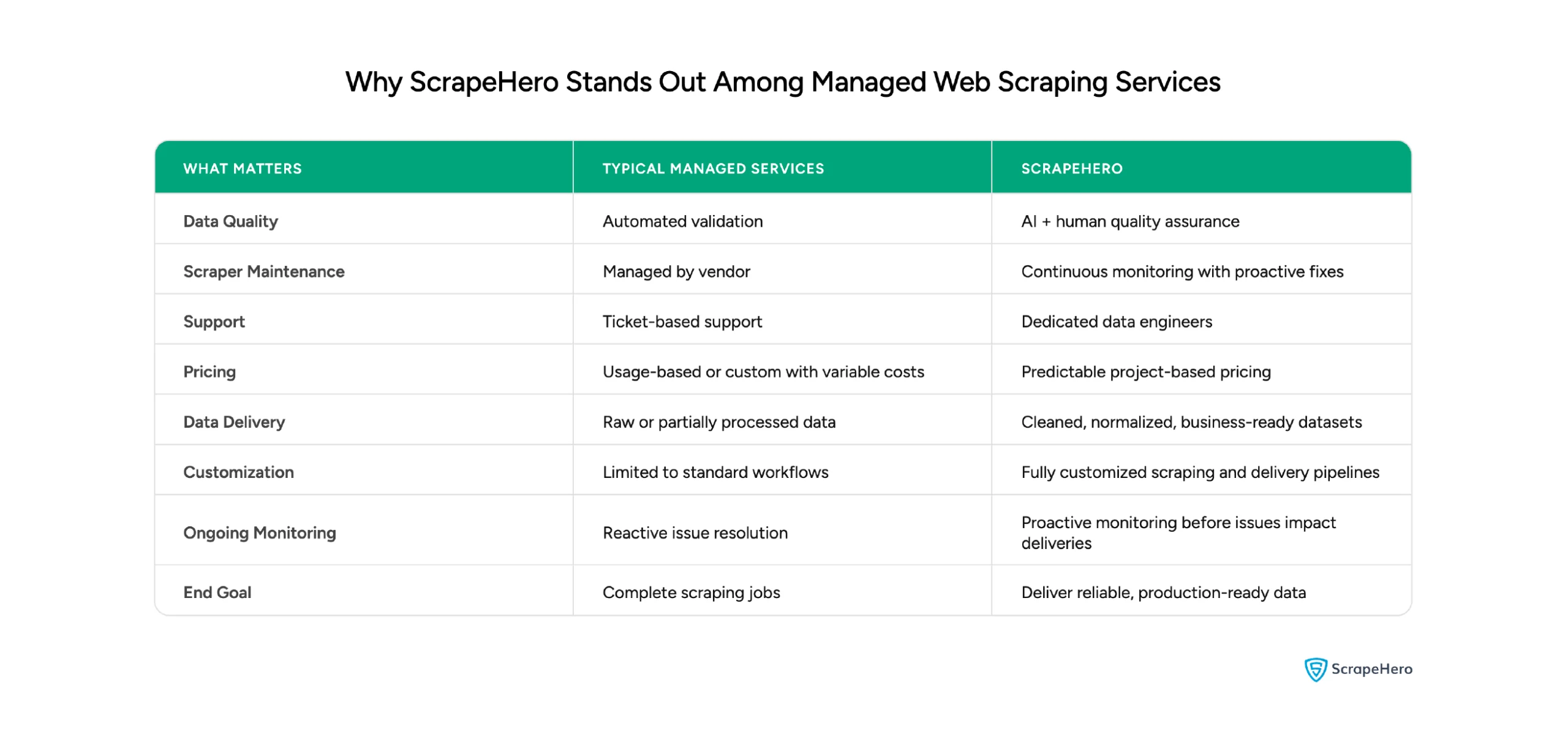
In short, if you’re comparing these five Oxylabs alternatives on features alone, they’ll look similar on paper. The difference shows up in the output: data that’s already validated, a bill that doesn’t move, and a team that’s handled your specific edge cases before.
With that in mind, if you need more guidance on this, talk to our data experts. Tell them your team’s reality, your data needs, your biggest fear about getting this wrong. They’ll tell you what actually works—even if it’s not us.
FAQs
The best web scraping service depends on your needs. Businesses that want ready-to-use data with minimal engineering effort often prefer fully managed providers like ScrapeHero, while teams needing maximum infrastructure control may choose self-service platforms.
Alternatives to Oxylabs include ScrapeHero, Bright Data, Zyte, Apify, and Octoparse. The right choice depends on whether you need proxy infrastructure, a managed scraping service, or a no-code solution.
Oxylabs pricing varies by product and usage. Its proxy and API services use usage-based pricing, while managed enterprise solutions are priced on a custom basis based on project requirements.
No, Oxylabs does not offer a free proxy service. It provides paid proxy networks and web scraping solutions, though free trials or limited testing options may be available for some products.
Companies often seek alternatives to Oxylabs when they want lower engineering overhead, more predictable pricing, cleaner data, or a fully managed service that handles the entire data collection pipeline.
No. AI can improve data extraction, cleaning, and analysis, but it still relies on web scraping to collect the underlying data. In practice, AI and web scraping are complementary technologies rather than replacements.