Zyte has become a popular option for companies that need both DIY scraping tools and managed data extraction services.
The platform combines web data collection, quality control, and delivery into a single service, helping businesses gather data from websites without having to manage the underlying infrastructure themselves.
However, Zyte is not the right fit for every organization.
Some teams need more hands-on support, affordable and predictable pricing models, industry-specific expertise, or a provider that better aligns with their business goals.
So, this guide compares five leading Zyte alternatives: ScrapeHero, Bright Data, Oxylabs, Apify, and Octoparse. You’ll learn what each provider does well, where it falls short, how it approaches data extraction, and which types of businesses it serves best.
Whether you are actively comparing Zyte competitors or just starting your evaluation, this guide covers what you need to know.
Why Do Companies Look for Zyte Alternatives?
Zyte Data is a well-established provider in the web scraping industry, and for many organizations, it delivers exactly what they need.
However, as data requirements evolve, some companies begin exploring alternatives that better align with their operational needs, budgets, or preferred ways of working.
Different Businesses Need Different Levels of Support
Not every organization approaches web data projects in the same way.
Some teams want a vendor that provides them with tools to extract data. Others prefer an end-to-end managed service model with dedicated project managers, industry specialists, or additional customization options.
Support expectations can also vary.
A global retailer monitoring thousands of products may require a different level of communication and oversight than a startup collecting data from a handful of websites.
Pricing, Onboarding, and Delivery Preferences Matter
Pricing structure is another common consideration.
Some businesses prefer affordable and highly predictable costs that make budgeting easier, while others are comfortable with usage-based pricing that scales with demand.
Companies may also evaluate alternatives based on onboarding speed, data delivery formats, or integration requirements.
Finding the Right Fit
Ultimately, choosing between Zyte alternatives and other web data providers is about finding the right fit for your business.
The best solution depends on your goals, internal resources, reporting requirements, and how much of the data collection process you want to manage yourself.
Exploring web scraping alternatives is the first step toward making that call.
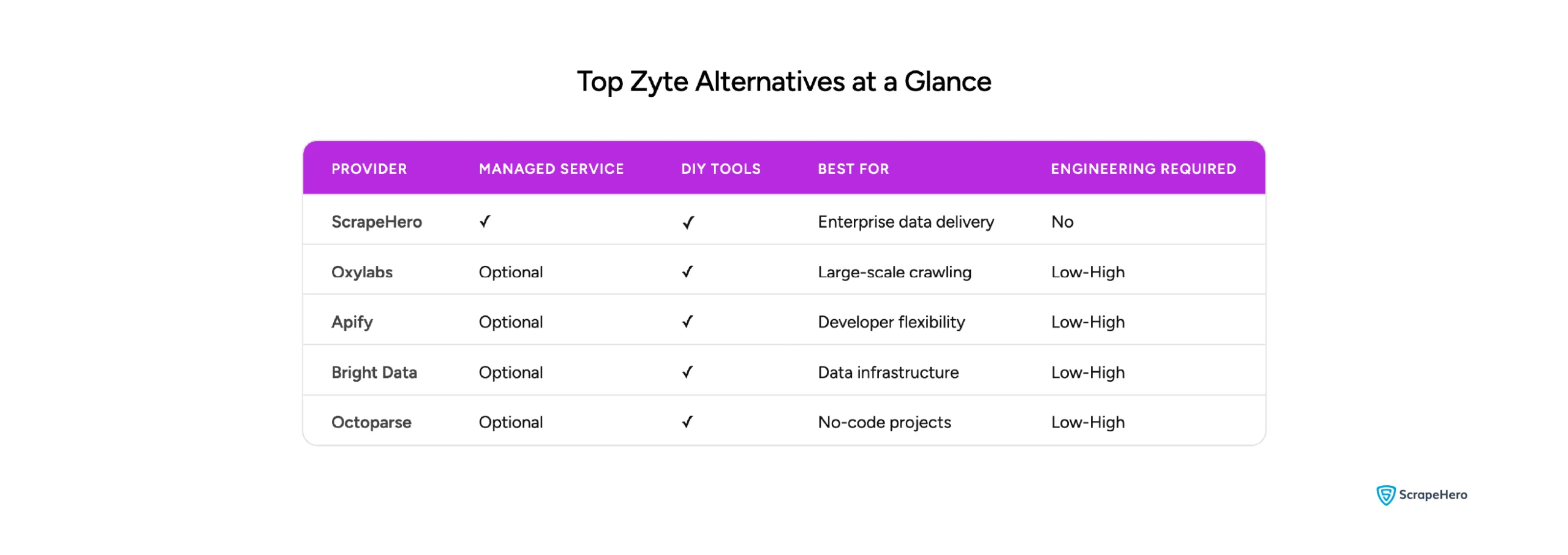
What Are the 5 Best Zyte Alternatives?
- ScrapeHero
- Oxylabs
- Apify
- Bright Data
- Octoparse
1. ScrapeHero
What is ScrapeHero?
ScrapeHero is a fully managed enterprise web scraping service. If your team doesn’t want to deal with scraping infrastructure, that’s exactly the problem it’s built to solve.
Unlike platforms centered around proxies or DIY tooling, ScrapeHero takes on the operational side entirely — scraper development, anti-block measures, monitoring, upkeep, data normalization, and delivery.
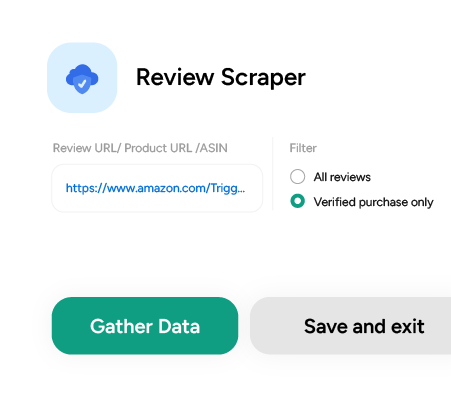
In addition to the fully managed service, ScrapeHero offers ScrapeHero Cloud, a marketplace of pre-built scrapers for hundreds of popular websites.
Most vendors in the DIY space give you self-service tools and leave setup, maintenance, and engineering to your team. ScrapeHero Cloud’s pre-built scrapers work differently. Their team manages and maintains all technical aspects. You pick the scraper you need, run it, and get the data.
Both models are a natural fit for companies where web data drives something important — pricing intelligence, digital shelf monitoring, competitor tracking, analytics, or AI pipelines.
What are ScrapeHero’s core capabilities?
Some of ScrapeHero’s core capabilities include:
- Fully managed web scraping infrastructure
- Custom APIs and automated data delivery
- Data cleaning and normalization
- AI-ready dataset preparation
- Robotic Process Automation (RPA)
- Enterprise-scale scraping support
- Ongoing monitoring and scraper maintenance
- Custom workflow development for large data operations
- ScrapeHero Cloud — a marketplace of pre-built scrapers for popular websites, fully maintained and managed by ScrapeHero.
- Data Store – A marketplace of ready-made datasets from popular websites and locations
What are the limitations of ScrapeHero?
- Less focused on self-serve proxy tooling
- Custom pricing of managed services may not suit smaller one-time projects
- May offer more operational support than smaller teams require
- However, ScrapeHero Cloud overcomes these limitations.
How much does ScrapeHero cost?
ScrapeHero offers a transparent pricing structure with no hidden costs.
Their fully managed service starts at an accessible $199/month; enterprise plans start at $1,500/month.
Who is ScrapeHero best for?
ScrapeHero is generally a strong fit for:
- E-commerce brands monitoring pricing and product data
- Market intelligence teams
- Enterprises replacing internal scraping systems
- Companies building AI and analytics pipelines
- Businesses that want fully managed data extraction with no engineering overhead
2. Oxylabs
What is Oxylabs?
Oxylabs is one of the known names in enterprise proxy infrastructure and one of the most commonly evaluated Zyte alternatives.
If high scraping concurrency, wide global coverage, and hands-on control over your operations matter to you, it’s built with that in mind.
But it’s not just a proxy service.
It includes AI web scraping tools like OxyCopilot and AI-Scraper, as well as an MCP Server that takes a meaningful chunk of the manual engineering work off your plate when setting up and running scrapers.
Also, they have a managed service that handles the full pipeline — collection, validation, cleaning, and structured delivery. You get data that’s ready to use, not raw output you still have to process.
That said, how much Oxylabs actually handles depends on which product you’re using.
Working directly with their proxy or scraper APIs? The pipeline is still your responsibility. But if the goal is to hand off that work entirely, their managed data acquisition option could be a better fit.
What are the key features Oxylabs provides?
Oxylabs provides several features designed for enterprise-scale scraping operations, including:
- Residential and datacenter proxy networks
- Web Scraper API with JavaScript rendering support
- Proxy rotation and session management
- Geographic targeting
- High concurrency support
- OxyCopilot and AI-Scraper for semi-automated workflow assistance
The platform is particularly useful for businesses that collect data across multiple regions or operate high-volume crawling systems that require stable proxy availability.
Who should use Oxylabs?
Oxylabs works well for:
- Data engineering teams with in-house crawler development capability
- Organizations running high-volume, multi-region scraping operations
- Businesses that need reliable proxy infrastructure and prefer to control extraction logic themselves
What are the limitations of Oxylabs?
- Data normalization, cleaning, and pipeline management are internal responsibilities if you’re using self-service web scraping APIs or scrapers
- Engineering overhead is real and ongoing, even with AI-assist features
- Pricing scales with bandwidth and request volume, which can grow quickly at enterprise scale
- Less suitable for non-technical stakeholders or teams without dedicated scraping engineers
How does Oxylabs price its services?
Pricing for self-service APIs and scrapers is usage-based. What you pay depends on the proxy type you use, how much bandwidth you consume, and your API usage volume.
For managed services with custom datasets, pricing starts at $800/month.
3. Apify
What is Apify?
Apify is a cloud-based scraping and automation platform built with developers in mind.
What sets it apart is the Actor marketplace, a library of over 33,000 prebuilt scrapers and automation templates spanning a wide range of websites and use cases.
The platform gives your team a cloud environment to build, deploy, schedule, and run scraping workflows. So, instead of building every crawler from the ground up, teams can start from something that already works and customize from there.
But internal ownership is still part of the deal. Someone on your team needs to pick the right actors, configure them, monitor performance, and step in when something breaks.
Also, Apify offers professional services for teams seeking a more hands-off experience.
Under that model, their team manages the end-to-end workflow — so it’s not purely self-serve if that’s not what you’re looking for.
Which path makes sense really comes down to how much your team is willing to own internally.
If you have developer resources and want flexibility, the self-serve model has a lot going for it. If you’d rather hand off the data problem entirely, the managed option is worth a closer look.
What are Apify’s key capabilities?
- Actor marketplace (33,000+ prebuilt scrapers and automation tools)
- Cloud-based scraping infrastructure
- Browser automation and JavaScript rendering
- Scheduled task execution and orchestration
- API integrations and webhook support
- Custom scraper deployment and management
- Data storage and export
Who is the target audience for Apify?
Apify suits:
- Startups and product teams that want flexible, developer-controlled scraping
- Technical teams building custom automation workflows
- Organizations that want to prototype quickly using existing marketplace actors
- Teams that are comfortable managing their own scrapers and handling output processing
- Businesses that prefer a hands-off approach, through Apify’s professional services
What are the limitations of Apify?
- Actors require ongoing maintenance as target websites change structure
- Enterprise-scale operations may eventually outgrow marketplace actors and need custom development
- Data quality and consistency depend heavily on how well the implementation is managed — whether that’s internally or through their professional services
How much does an Apify subscription cost?
Free plan and usage-based tiers are available for self-scraping tools. The paid plans start around $26/month for individuals, scaling up based on compute usage, storage, and task execution volume.
Meanwhile, their enterprise pricing starts at $2000, and you’ll need to contact their team directly for a custom quote.
4. Bright Data
What is Bright Data?
Bright Data is one of the most widely recognized names in enterprise web data infrastructure. It’s built for businesses that need data at a serious scale across hundreds of websites and multiple geographies, backed by the technical muscle to make it happen.
The platform covers a lot of ground.
Proxy infrastructure, scraper APIs, pre-built datasets, a browser API, and an MCP server — it’s a full stack of tools designed to give technical teams significant control over how they collect data.
If you have engineers who want to own the data pipeline, Bright Data hands them a robust toolkit to do exactly that.
But it’s not purely a self-serve platform.
Their Managed Data Acquisition service handles the full workflow — collection, validation, enrichment, and structured delivery, along with custom dashboards, reports, and expert recommendations. So if your goal is to hand off the data problem entirely, that option exists, too.
That said, how hands-off your experience actually is depends heavily on which product you’re using.
Working with their proxy or scraper APIs directly means your team is still responsible for setup, maintenance, and pipeline management.
For businesses evaluating Zyte alternatives, Bright Data is worth a serious look, especially if scale, global coverage, and formal compliance certifications such as GDPR, CCPA, and ISO standards matter to your procurement process.
What features does Bright Data offer?
- Proxy Infrastructure (Residential, ISP, and Datacenter — 400M+ IPs across 195 countries)
- Web Unlocker API (automated CAPTCHA and anti-bot handling)
- Web scraping APIs — including Scraper APIs for real-time data from 250+ websites, pre-built
- Scraper Studio (build custom scrapers without managing infrastructure)
- Browser API (cloud-based remote browsers with built-in stealth)
- Datasets Marketplace (pre-collected, ready-to-download datasets)
- Retail Intelligence / Bright Insights (AI web scraping tools with AI-powered dashboards, price tracking, and product matching)
- MCP Server (for AI agent and LLM integration)
- Managed Data Acquisition (fully managed service — zero engineering involvement)
Which user profiles fit Bright Data best?
Bright Data works well for two distinct user profiles:
DIY path: Engineering teams that want direct control over proxy rotation, rendering, and scraping infrastructure. If your developers are comfortable working with APIs and want the flexibility to build custom pipelines at scale, Bright Data provides them with a robust toolkit to do so.
Managed path (Managed Data Acquisition): Business teams or decision-makers with no internal scraping resources who need clean, structured data delivered on a schedule — with dashboards, reports, and expert recommendations included. This is an enterprise-grade service priced to match.
How does Bright Data structure its pricing?
The self-service tools run on usage-based pricing. Costs scale with proxy bandwidth, request volume, and rendering requirements — making it flexible but harder to forecast month-to-month.
However, Bright Data’s fully managed service runs on a contractual or subscription-based commitment rather than micro-billing.
Fully managed project costs typically range from $1,000 to $2,500 per month, depending on scope and complexity. Custom scrapers carry a one-time setup fee of around $500, and there’s a minimum monthly spend requirement, which may not be the right fit for small and medium businesses.
5. Octoparse
What is Octoparse?
Octoparse isn’t one-size-fits-all. They serve completely different kinds of teams.
The first is a no-code desktop tool built around a visual workflow builder. No engineers required. Your ops team, analysts, or business users can get scraping tasks running without touching a line of code. For teams without dedicated technical resources, that’s a great choice.
The second is a fully managed enterprise service. Octoparse takes on the entire operation — anti-bot handling, data cleaning, quality checks, and scheduled delivery. You hand over the target URLs, and they handle everything else.
The no-code tool is well-suited to lighter workloads and teams that want to move fast without a steep learning curve. However, their managed service is a different beast — one that puts Octoparse in the same conversation as enterprise-level Zyte alternatives like ScrapeHero and Bright Data.
Before you decide whether Octoparse belongs on your shortlist, figure out which of these two offerings actually matches what you need. That single decision shapes everything else.
What are the core features of Octoparse?
Octoparse includes several features aimed at simplifying web scraping workflows, including:
- Visual no-code workflow builder
- Cloud-based scraping
- Scheduled scraping tasks
- Prebuilt templates for common websites
- Export integrations
- Automated task execution
- Browser-based extraction support
- Dedicated support via Slack channel
- Free sample data delivered in 1-2 business days
What are the limitations of Octoparse?
- DIY tool has limited flexibility for enterprise-scale projects
- DIY tool is less suitable for highly dynamic or complex websites
- DIY tool may struggle with advanced anti-bot protections (relies on manual proxy setup, cookie clearing, user-agent rotation, and CAPTCHA solving)
- DIY tool’s custom workflow capabilities are more limited than those of developer-focused platforms
- Managed service is significantly more expensive (starting at $699/project)
- Managed service offers less control over the technical details of the scraping process
- Both offerings may still require internal work for final data integration, depending on your use case
What are the pricing options for Octoparse?
DIY no-code tool: Subscription-based. Free plan available. Paid plans start at approximately $69–83$ per month for the Standard plan, going up to $249–$299 per month for the Professional plan. Enterprise custom pricing is also available.
Fully managed Data Service: Project-based or monthly pricing. Starts at
$699/project. Custom quotes are available for larger volumes.
Which Web Scraping Service Actually Fits Your Business?
If you choose the wrong vendor, you’re not just wasting money. You’re slowing down the data pipeline that your pricing, analytics, or AI initiatives depend on. So let’s cut to it.
Which service gives developers the most control?
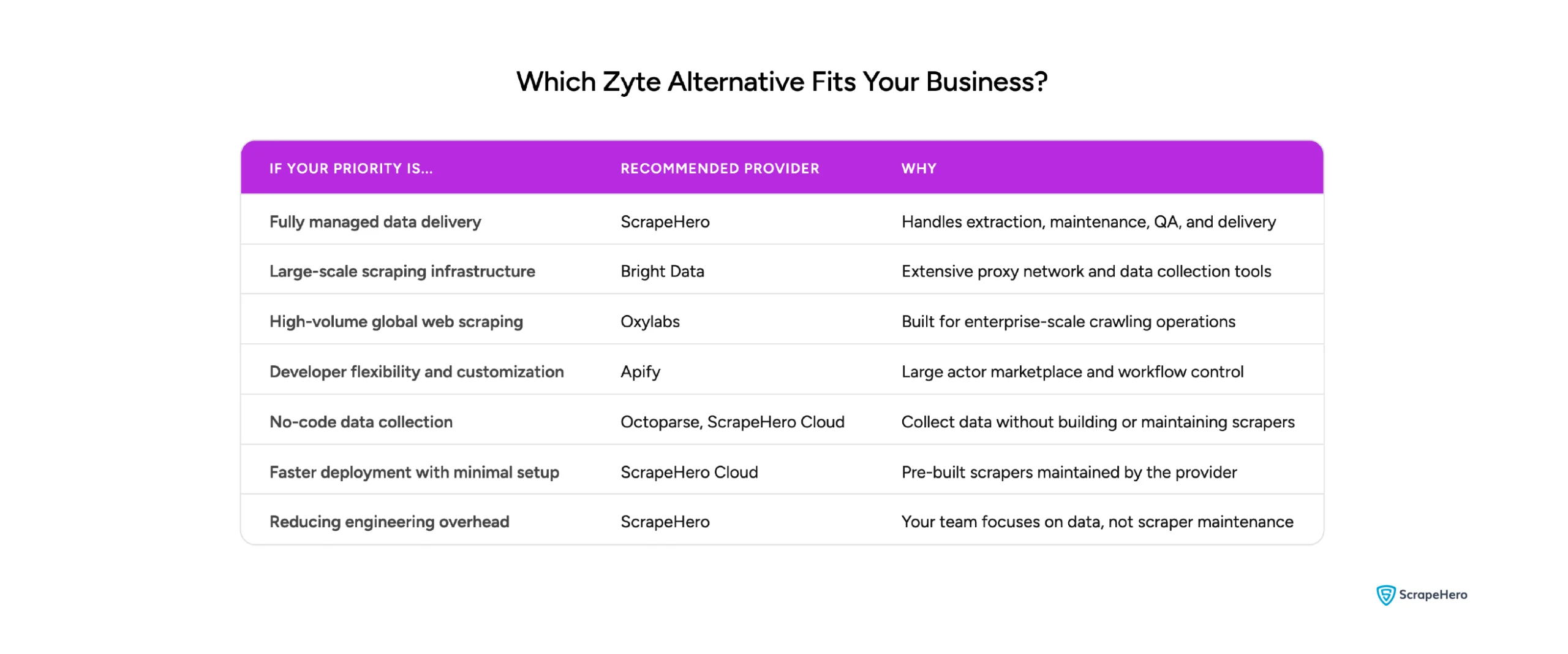
If your team wants to own the infrastructure, Apify, Oxylabs, and Bright Data all give developers meaningful flexibility.
Apify’s Actor marketplace speeds up prototyping. Oxylabs handles high-concurrency crawls at a serious scale. Bright Data gives you granular control over proxy rotation and rendering.
But if what you actually want is clean, structured data without the engineering overhead, ScrapeHero Cloud’s pre-built scraper marketplace gets you there faster. Pick the scraper, run it, get the data. No setup. No maintenance. No surprises.
What works best for startups?
Speed matters more than anything when you’re a startup. Apify lets small technical teams spin up scrapers quickly. Octoparse’s no-code tool works for lighter-structured scraping without dedicated engineers.
The catch with both? Someone still has to own configuration, upkeep, and fixes when things break.
For startups that can’t afford that overhead, ScrapeHero Cloud’s managed scrapers for popular sources such as Amazon, Walmart, and Google Maps handle all of that for you. Your team uses the data, and someone else manages the technical side.
Which is the best Zyte alternative for enterprises?
For teams that need reliable web data without internal scraping engineering, the shortlist includes ScrapeHero, Bright Data, and Octoparse’s managed services. All three handle extraction, anti-bot evasion, cleaning, and delivery.
But what sets ScrapeHero apart isn’t a feature. It’s people.
Most providers lean on automation and AI interfaces to run the show. But ScrapeHero puts experienced humans at every layer — QA, project management, support, and execution. AI handles the efficiency, and people handle the judgment calls.
When your data feeds business-critical decisions, that difference is worth paying for.
The Bottom Line: How Should You Choose Your Scraping Provider?
It comes down to one honest question: how much of this do you actually want to own?
If the answer is all of it — the infrastructure, the pipelines, the maintenance- then these Zyte web scraping alternatives give you the control you’re looking for: Oxylabs, Apify, and Bright Data. Just go in knowing that control comes with ongoing engineering commitment.
And if the answer is none of it, and you just want accurate, structured data to show up on schedule without your team ever touching a crawler, that’s exactly what ScrapeHero, the web scraping company, is built for. You’ll get managed execution, human-augmented QA, and clean data on time. Every time.
If you need more guidance on this, talk to our data experts. Tell them your team’s reality, your data needs, and your biggest fear about getting this wrong. They’ll tell you what actually works—even if it’s not us.
FAQs
Some of the top web scraping tools for data extraction include ScrapeHero, Bright Data, Oxylabs, Apify, and Octoparse — each catering to different needs, from fully managed services to developer-focused DIY platforms.
Zyte is not fully open source, though it is built on Scrapy, which is an open-source Python framework. The core Zyte platform and its managed services are proprietary.
Zyte is generally considered a reliable service, with a well-established track record in web data extraction and a platform that handles anti-bot measures, JavaScript rendering, and data delivery at scale. That said, reliability for your specific use case depends on the complexity of your targets and the level of support your team needs.
Zyte sits somewhere in the middle — it offers both DIY scraping tools and managed data services, but competitors like ScrapeHero go further on the managed side, while platforms like Bright Data and Oxylabs offer more robust proxy infrastructure and developer controls. The right choice depends on how much of the pipeline your team wants to own.
It depends on your use case — web scraping APIs tend to cost more per request but save you the engineering overhead of managing proxy rotation, rendering, and parsing yourself. Proxies are cheaper at the infrastructure level but require your team to build and maintain the rest of the stack.