You already know data matters. You’ve heard it a hundred times. But knowing it and actually building a system around it are two very different things.
Most e-commerce competitive intelligence efforts fall somewhere in the middle. They’re collecting some data, running some reports, and making decisions that are part informed, part instinct. But it’s not enough anymore.
The brands pulling ahead right now aren’t doing something radically different. They’re just more deliberate about what they track, how often they check it, and how quickly they act on it. This article breaks down exactly how they do it.

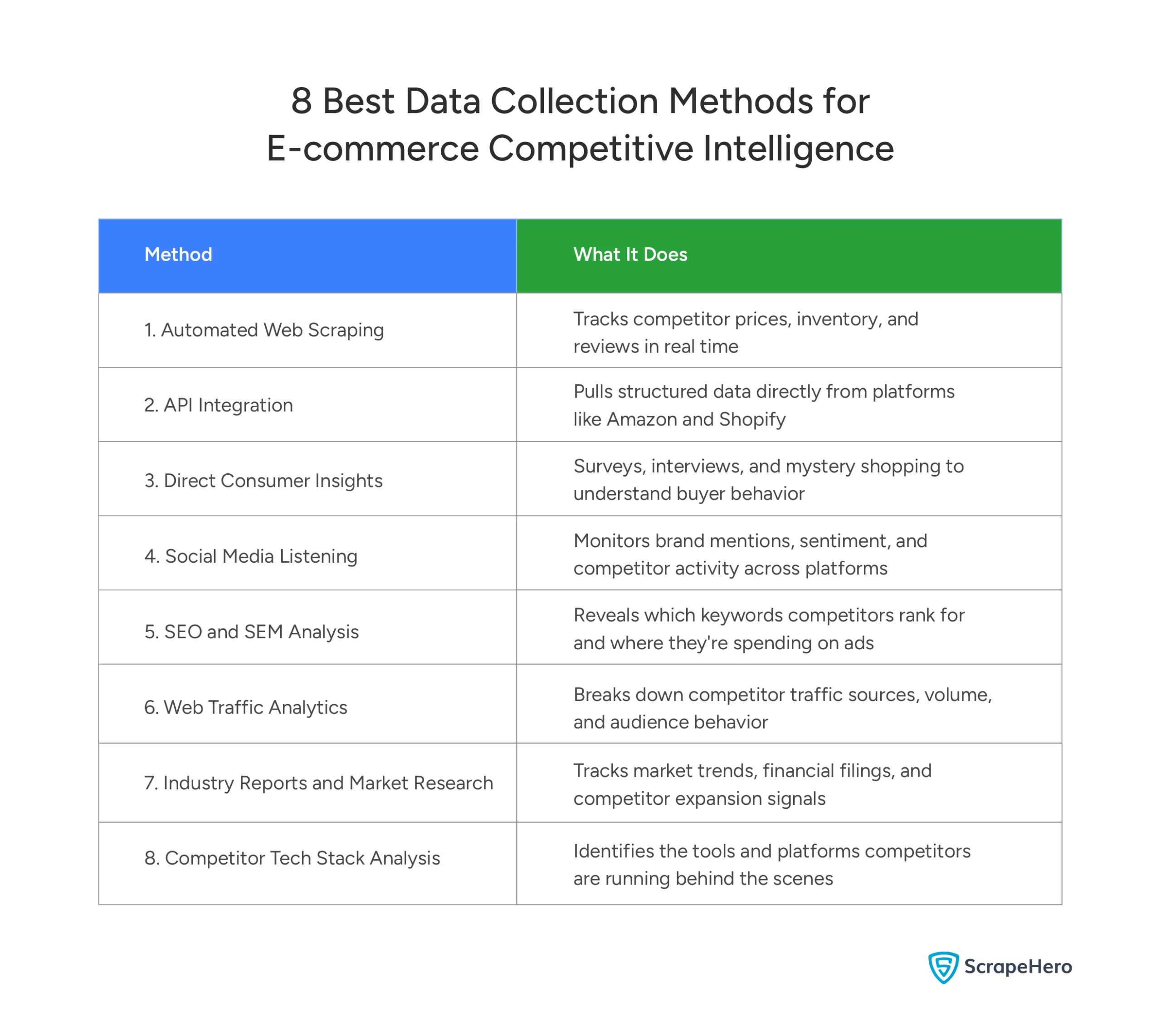
Here are the best data collection methods e-commerce leaders are using today.
What Are the Best E-commerce Data Collection Methods?
- Automated Web Scraping
- API Integration
- Direct Consumer Insights
- Social Media Listening
- SEO and SEM Analysis
- Web Traffic Analytics
- Industry Reports and Market Research
- Analyzing Competitor Tech Stacks
Method 1: Automated Web Scraping
If you’re serious about staying competitive, web scraping isn’t optional. It’s how you stop guessing and start knowing what’s actually happening in your market.
What is web scraping? Web Scraping, web harvesting, screen scraping, or web data extraction is the process of extracting data from websites. The process saves data to a local file or to a database in spreadsheet format. Collecting data from multiple websites, which could be quite tedious if done manually, is automated through web scraping so as improve the efficiency and volume of data extraction.
Here’s what it can do for you.
Dynamic Price Monitoring
Prices change constantly in e-commerce. Tracking them manually? That’s a full-time job nobody has time for. With automated competitor pricing and promotion tracking, you can monitor competitor prices, discounts, and flash sales the moment they go live. If a competitor drops their price, you know immediately. You adjust. You don’t lose the sale.
Inventory & Product Listings Monitoring
This one’s underrated. When a competitor’s best-seller goes out of stock, that’s your window. You can increase ad spend, capture that traffic, and convert buyers who can’t find what they need elsewhere. Scraping gives you that visibility before the opportunity disappears.
Review & Rating Analysis
Your competitor’s negative reviews are your product roadmap. If customers keep complaining about the same flaw, that’s a gap you can fill. Position your product as the fix. Let their shortcomings do your marketing for you.
Together, these methods give you a real-time picture of your competitive landscape. Right now, as it’s happening. Not a weekly snapshot or last month’s data.
That’s the difference between reacting and leading.
Method 2: API Integration
Not every data collection method works the same way. APIs are a solid option for businesses that want direct, structured access to data directly from the platform. Amazon, eBay, Shopify — these platforms offer APIs that let you pull real-time pricing, stock levels, product listings, promotions, and even customer behavior metrics directly into your system.
No scraping needed. The platform hands you the data.
So why doesn’t everyone just use APIs?
Here’s the catch. Not every website offers one. Most don’t. And the ones that do often limit what you can access, how frequently you can pull data, and what you’re allowed to do with it.
That’s exactly why web scraping remains the go-to method for competitive intelligence for e-commerce. APIs work well when the door’s open. Scraping gets you in when it isn’t.
Where APIs genuinely shine
If you’re selling on or monitoring major platforms, API integration is worth setting up. You get clean, structured, real-time data. Pricing changes, stock updates, new listings — it flows into your system automatically.
But for the rest of the web? You’ll need other tools. And that’s where scraping, social listening, and other methods pick up where APIs leave off.
Method 3: Direct Consumer Insights
Automated tools are great. But sometimes the most valuable data comes from simply talking to people.
Primary research puts you in direct contact with your customers and, in some cases, your competitors’ customers. No algorithm does this for you. You ask, they answer, and what you learn can shift how you position your entire brand.
Customer Surveys and Interviews
Want to know why someone chose a competitor over you? Ask them. Surveys and interviews help you understand what’s driving purchasing decisions, what customers actually value, and what would make them switch. That’s not data you can scrape from a website.
Win/Loss Analysis
This one stings a little, but it’s worth it. Talk to customers who recently left for a competitor. Was it pricing? Product quality? Customer service? Whatever the reason, knowing it gives you something to fix. And fixing the right things is how you stop losing customers to the same problem twice.
Mystery Shopping
Go through your competitor’s buying experience yourself. Browse their product pages. Go through checkout. Reach out to their support team. You’ll spot things no tool will flag. A smoother checkout flow, better product photography, and faster response times. These are the small advantages that quietly cost you sales.
First-party data
This is everything you’re already capturing from your own channels. Website visits, purchase histories, customer support interactions, and browsing patterns. Your customers are constantly telling you what’s working and what isn’t. The data’s already there.
The question is whether you’re actually reading it.
Compare your conversion rates, retention numbers, and purchase frequency against industry benchmarks. If the gap is wide, that’s not just a metric. That’s a signal that something in your business needs fixing.
Method 4: Social Media Listening
Here’s something most brands overlook: your competitors’ customers are publicly telling you exactly what they love and hate about them, every day, for free.
Social media isn’t just a marketing channel. It’s a live focus group you never have to pay for.
What you’re actually looking for
Tools like Vista Social, Brandwatch and Hootsuite let you track brand mentions, hashtags, and sentiment across platforms like Twitter, Instagram, LinkedIn, and Facebook. You can see how customers are responding to a competitor’s campaign, like whether their AI video content is driving stronger engagement than static posts.
That’s real intelligence. Not guesswork.
The part most people miss
Pay attention to how competitors handle criticism publicly. Are they responding to complaints? Ignoring them? Working with influencers to shape perception? How a brand behaves under pressure tells you a lot about where they’re strong and where they’re not.
If their customers are consistently frustrated about something, that’s your opening. Position your brand as the one that actually gets it right.
Method 5: SEO and SEM Analysis
Look at their search engine results
You can tell a lot about a competitor’s strategy just by looking at what they’re ranking for. You don’t need insider access. The data’s already out there.
Tools like Semrush, Ahrefs, and SE Ranking show you exactly which keywords your competitors are targeting, how they’re ranking organically, and what kind of content is driving their traffic. That’s your starting point. Find the gaps, go after the keywords they’re missing, and build content that outranks them.
Don’t ignore their paid search either
Paid ads tell a different story. When you look at a competitor’s SEM campaigns, you can see which keywords they’re bidding on, what their ad copy looks like, and where they’re putting their budget. That’s not just advertising data. That’s a window into how they’re positioning their brand and which products they’re pushing hardest.
If they’re spending heavily on a specific keyword, there’s a reason. Either it converts well, or they’re trying to own that space. Either way, you want to know about it.
Put both together
SEO shows you where they’re winning without you having to pay for it. SEM shows you where they’re willing to spend. Together, they give you a complete picture of their digital strategy and a clear map of where you can compete, undercut, or outperform them.
Method 6: Web Traffic Analytics
Not all traffic is good.
Tools like Similarweb break down a competitor’s entire online presence. Total traffic volume, audience demographics, and traffic sources, whether that’s organic search, paid ads, social media, or referrals. You can see which channels are actually working for them and which they rely on most.
What the numbers are really telling you
High traffic doesn’t always mean high performance. A competitor might be pulling in a lot of visitors but losing most of them immediately. A high bounce rate often points to weak landing pages or content that doesn’t match what people came to find. Low engagement suggests their user experience isn’t doing the job.
These aren’t just their problems. They’re your opportunities.
Look at how their site actually feels to use
Visit their pages. Go through their product listings. Notice how fast things load, how easy it is to find what you’re looking for, and how smoothly the checkout flows. A better user experience quietly drives more conversions than most brands realize.
If their site is frustrating to use and yours isn’t, that alone can be the reason a customer picks you.
Method 7: Industry Reports and Market Research
Sometimes, the best e-commerce competitive intelligence methods aren’t about your competitors directly. It’s about understanding the market they’re operating in, and where it’s heading.
Reports from firms like Gartner, Nielsen, and McKinsey give you that macro view. Consumer behavior shifts, emerging technologies, and market growth patterns. This is the kind of context that helps you make bigger, longer-term decisions with more confidence.
Public data tells you more than you’d expect
Financial filings, SEC reports, earnings calls. Most people scroll past these. But if a competitor is publicly traded, their financials are sitting right there, telling you exactly where they’re investing, where they’re pulling back, and what they’re prioritizing next quarter.
That’s not guesswork. That’s their strategy, written down and filed publicly.
Watch the signals most brands ignore
A competitor quietly posting ten new engineering roles? That’s a product build. An acquisition announcement in a category adjacent to yours? That’s an expansion signal. A press release about a new partnership? That’s a distribution play.
Job boards, M&A announcements, and press releases aren’t glamorous sources of data. But they’ll tell you what a competitor is planning before they tell anyone else.
Method 8: Analyzing Competitor Tech Stacks
Most businesses have no idea what technology their competitors are running. And that’s a bigger blind spot than they realize.
Tools like BuiltWith let you look under the hood of any website and see exactly what they’re using. Their e-commerce platform, payment systems, CRM tools, marketing automation software, and personalization engines. All of it.
Why does this matter?
Because technology shapes the customer experience. If a competitor is running a faster platform, a smarter recommendation engine, or a more seamless checkout system, that’s a direct advantage. Customers feel it, even if they can’t name it. And it quietly influences whether they buy from them or from you.
Use it to benchmark your own stack
Once you know what they’re using, compare it to what you’ve got. Are there tools they’re using that you’re not? Are there gaps in your infrastructure that could be slowing you down or costing you conversions?
This isn’t about copying what competitors do. It’s about making sure you’re not falling behind without knowing it.
Ethical and Legal Considerations in the Data Collection Landscape
Collecting competitor data is fair game. But how you do it matters more than most people think.
Laws like GDPR and CCPA exist for a reason. They set clear boundaries around how customer and competitor data can be collected and used. Staying within those boundaries isn’t just about avoiding legal trouble. It’s about running a business you don’t have to defend in court someday.
Know what’s off limits
Scraping proprietary content, such as product descriptions and images, or copyrighted material, isn’t just unethical; it’s illegal. It’s a liability. The kind that can quietly turn into an expensive legal problem before you even see it coming.
Stick to what’s publicly available. Pricing, stock levels, customer reviews, and sentiment data. That’s more than enough to build a strong intelligence operation without crossing any lines.
Why does this also affect your reputation?
Customers and stakeholders pay attention to how brands operate. Being transparent about your data practices builds trust. Trust, in e-commerce, directly affects whether people buy from you or someone else.
A simpler way to stay compliant
If navigating compliance feels like too much to manage internally, outsourcing to a professional web scraping service is worth considering. Providers like ScrapeHero are built around ethical, compliant data collection. They know where the lines are, operate within them, and handle the legal complexity on your behalf. So you get the data you need without the risk that comes with doing it yourself.
Doing this the right way is a competitive advantage.
Turning Data into Actionable Insights
Collecting data is the easy part. Knowing what to do with it is where most businesses fall short.
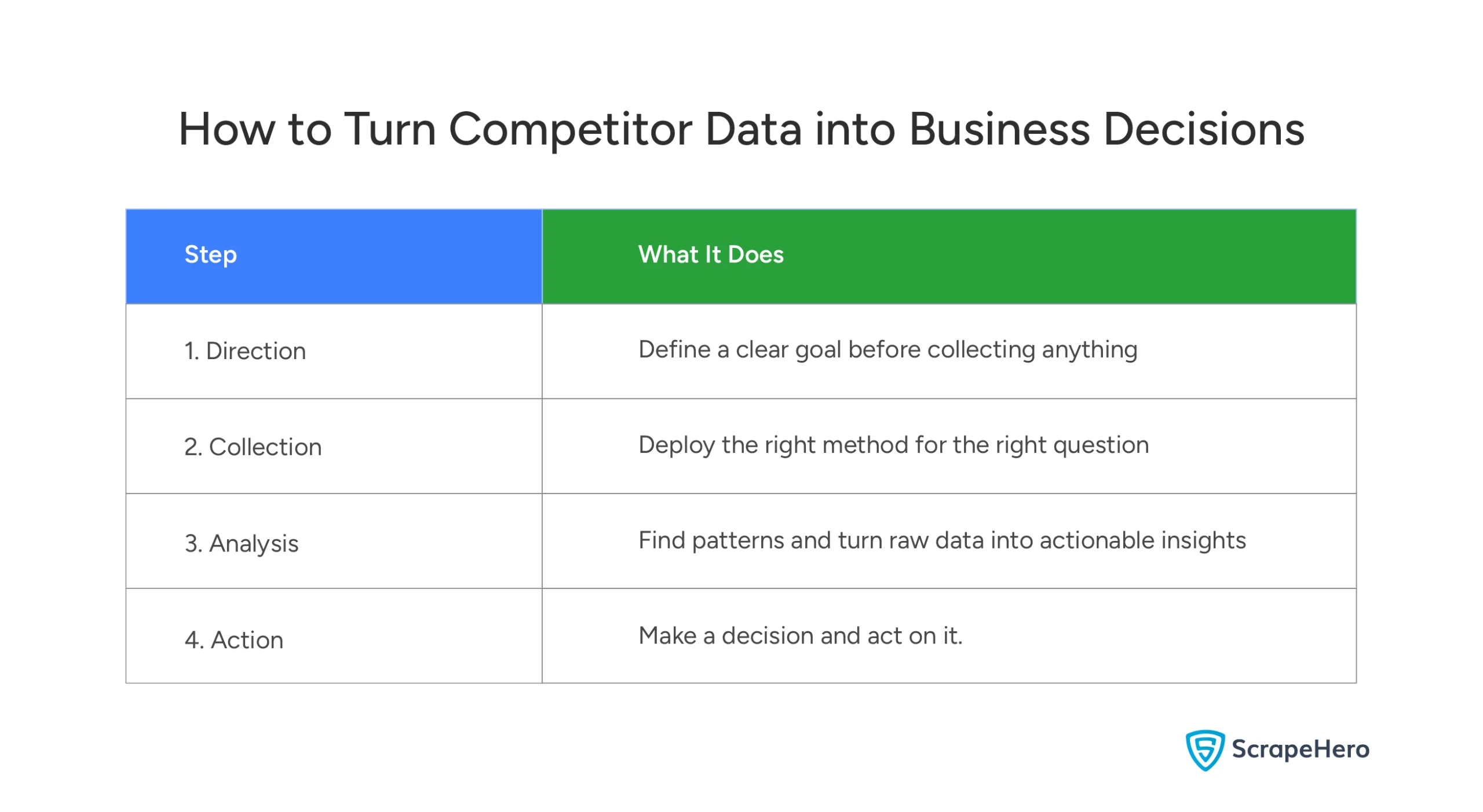
The Intelligence Cycle is a simple framework that takes you from raw data to real decisions. Four steps. No fluff.
Direction
Start with a clear goal. What are you actually trying to find out? Are you looking at pricing gaps, product opportunities, or customer experience weaknesses? Without a defined objective, you’ll collect a lot of data and act on almost none of it.
Collection
This is where the methods covered in this article come in. Web scraping, social listening, surveys, SEO analysis, and financial reports. The method you choose depends entirely on what you’re trying to learn. Use the right tool for the right question.
Analysis
Raw data doesn’t tell you anything on its own. Business Intelligence tools help you find the patterns, spot the trends, and surface the insights that actually mean something. This is where data stops being numbers and starts being knowledge.
Action
Here’s where most businesses drop the ball. They collect the data, run the analysis, and then let the report sit in a folder somewhere. The entire point of e-commerce competitive intelligence is to make a decision. Adjust your pricing. Fix your funnel. Double down on a product category. Something has to change, or the whole process was just an exercise.
Data without action isn’t intelligence. It’s just noise.
Wrapping Up: Building a Sustainable Competitive Advantage
You’ve made it through every method. Now here’s the honest truth: you don’t need to use all of them at once.
Start with what’s most relevant to the decisions you’re making right now.
Brands that win in e-commerce aren’t the ones with the biggest budgets. They’re the ones who know what’s happening in their market before everyone else does, and move on it faster. That’s what a solid e-commerce competitive intelligence strategy gives you.
If you’re ready to put this into practice, ScrapeHero’s web scraping service can help you automate data collection, monitor competitors in real time, and surface the insights that matter most to your business. Pricing, inventory, customer sentiment. All of it, without the manual effort.
The e-commerce market’s not slowing down. But with the right data behind you, you won’t need it to.
Check out how ScrapeHero can give your e-commerce brand a competitive edge.
FAQs
Brands use automated web scraping tools to track competitor prices, discounts, and promotions in real time. This allows them to adjust their own pricing instantly without manually checking competitor websites.
Web scraping automatically collects publicly available data from competitors’ websites, including pricing, stock levels, and customer reviews, at scale. This gives e-commerce brands a real-time view of the competitive landscape without manual effort.
Services and tools like ScrapeHero, Semrush, Similarweb, Brandwatch, and BuiltWith are commonly used to monitor competitors across pricing, search rankings, web traffic, and technology. The right tool depends on what data you’re trying to collect and where it lives.