Amazon is one of the most scraped websites in the world. Retailers monitor competitor pricing, brands track unauthorized sellers, researchers analyze reviews, and e-commerce companies collect catalog intelligence at scale.
But one question appears repeatedly:
Is scraping Amazon legal?
The short answer is: scraping publicly accessible Amazon data is not automatically illegal, but it can violate Amazon’s Terms of Service and create legal, technical, and compliance risks depending on how the data is collected and used.
However, Amazon actively discourages unauthorized automated access through anti-bot systems, rate limiting, CAPTCHAs, and legal enforcement mechanisms.
This guide examines the Amazon scraping policy, legal precedents, data risk levels, and safe collection methods, including the use of APIs and managed services.
Does Amazon Allow Web Scraping?
Amazon generally prohibits unauthorized automated scraping in its Terms of Service.
Like most major platforms, Amazon uses technical and contractual restrictions to limit automated access to its marketplace data. This includes:
- Rate limiting
- Bot detection systems
- CAPTCHA challenges
- IP blocking
- Access restrictions
- Legal notices in severe cases
Amazon’s policies are designed to protect infrastructure stability, marketplace integrity, intellectual property, consumer privacy, and seller ecosystem fairness.
However, there is an important distinction between what Amazon permits contractually, what is technically accessible, and what courts may consider illegal.
These are not always the same thing.
For instance, publicly accessible product listings may still be reachable without authentication, even if Amazon discourages automated extraction through its Terms of Service.
This creates a legal gray area that has been heavily debated in courts over the past decade.
Businesses that need Amazon marketplace intelligence often rely on an enterprise-grade web scraping company to reduce this operational and compliance risk.
Is Scraping Amazon Legal?
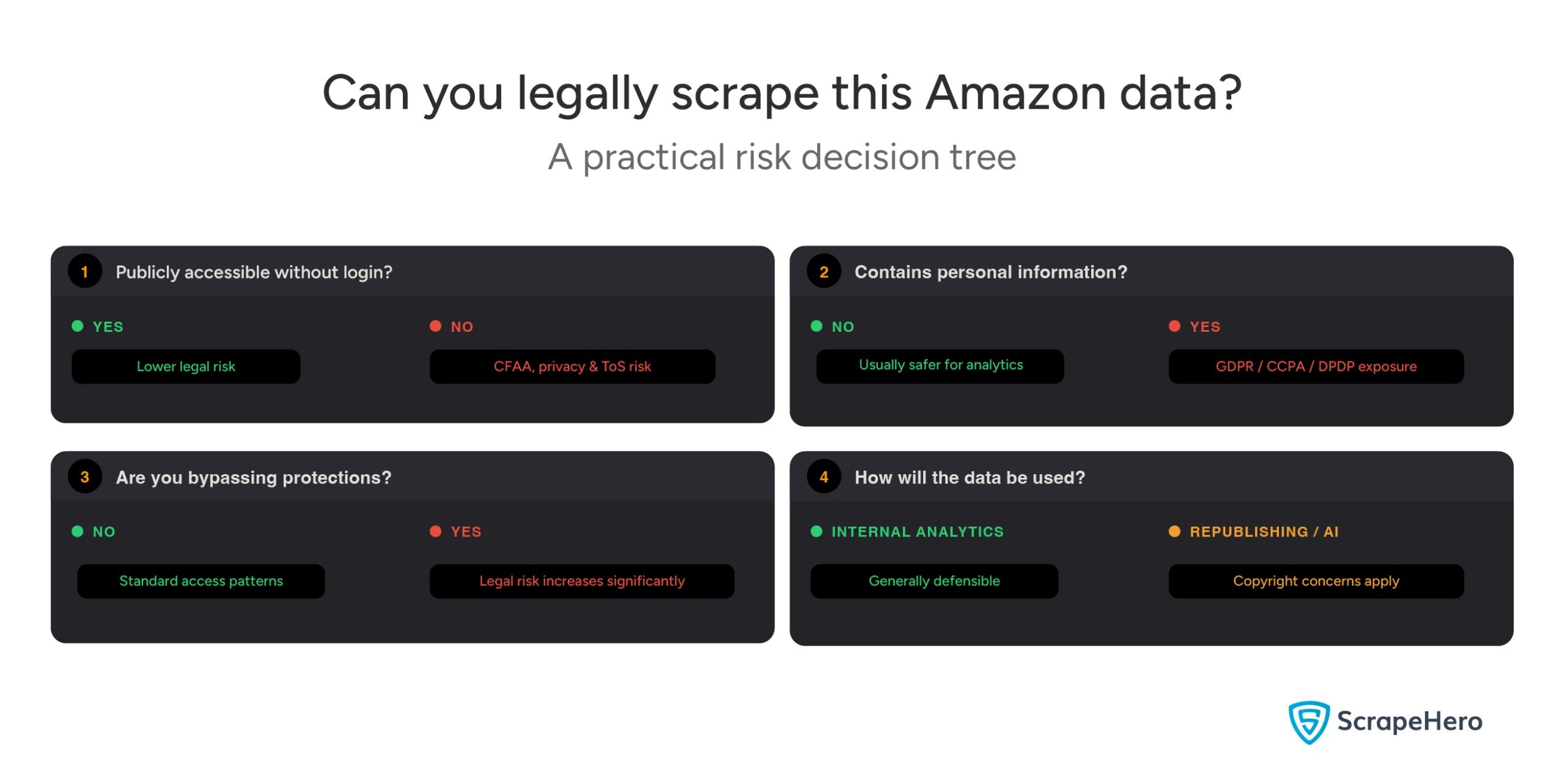
Web scraping Amazon itself is not inherently illegal.
The legality depends on:
- What data is collected
- Whether restrictions are bypassed
- How the data is used
- Applicable privacy and cybersecurity laws
- How the data is accessed
Public vs Private Data
Scraping publicly accessible product listings is generally considered lower risk than scraping login-protected pages, customer accounts, hidden APIs, and internal seller dashboards.
Public availability matters significantly in many legal disputes involving scraping.
Personal Data Collection
Collecting personally identifiable information creates much higher compliance exposure under GDPR, CCPA, DPDP Act, and other privacy laws.
Examples of such data—including customer names, addresses, phone numbers, and personal profiles—are legally riskier to collect than product titles or prices.
Copyright and Content Reuse
Facts like pricing are generally treated differently from creative content, and the latter may carry additional copyright considerations, including review text, images, enhanced product descriptions, and branded content.
Server Abuse and Operational Harm
Scraping at extreme volume can create legal and technical issues if it: degrades infrastructure, causes service disruption, and ignores repeated blocking attempts.
Responsible crawling behavior matters.
What Courts Have Said About Web Scraping
Several landmark cases shaped modern web scraping law.
While none are Amazon-specific, they strongly influence how courts interpret scraping disputes.
hiQ Labs v. LinkedIn
The Ninth Circuit ruled that scraping publicly accessible LinkedIn profiles was unlikely to violate the Computer Fraud and Abuse Act (CFAA).
This case became one of the most cited precedents in public-data scraping discussions.
Key Takeaway: Publicly accessible data may be treated differently from protected systems requiring authorization.
Van Buren v. United States
The U.S. Supreme Court narrowed interpretations of “unauthorized access” under the CFAA.
Key Takeaway: Accessing information improperly is not always the same as accessing systems without authorization.
Craigslist v. 3Taps
Craigslist aggressively pursued a scraping-related case involving continued access after blocks and cease-and-desist notices.
Key Takeaway: Ignoring explicit restrictions and continuing access after warnings can significantly increase legal risk.
What These Cases Mean for Amazon Scraping
The legalities are still evolving.
However, courts increasingly distinguish between:
- Scraping public information
- Bypassing protected systems
- Violating contracts
- Violating cybersecurity laws
This distinction matters for businesses conducting e-commerce intelligence and competitive analysis.
What Data Can You Legally Scrape?
Not all Amazon data carries the same legal or compliance risk.
The table below provides a practical overview.
| Data Type | Risk Level | Notes |
| Public product listings | Low-Medium | Commonly scraped for e-commerce intelligence |
| Pricing data | Low-Medium | Frequently used for price monitoring |
| Product availability | Low-Medium | Standard competitive analysis use case |
| Seller information | Medium | Depends on usage and jurisdiction |
| Customer reviews | Medium | Potential copyright and privacy considerations |
| Images and branded assets | Medium-High | Intellectual property considerations apply |
| Login-protected data | High | Greater CFAA and ToS exposure |
| Personal customer data | Very High | GDPR, CCPA, DPDP implications |
| Payment/account information | Illegal/Extreme Risk | Serious legal and regulatory exposure |
The safest categories involve:
- public product metadata
- catalog attributes
- pricing intelligence
- stock monitoring
Risk rises significantly when scraping involves:
- personal information
- authentication bypassing
- private systems
- copyrighted user content at scale
Amazon Web Scraping Policy Explained
Amazon actively discourages automated scraping through both technical and contractual measures.
One important signal is Amazon’s robots.txt configuration.
What is robots.txt?
A robots.txt file tells automated crawlers which areas of a site are restricted or discouraged from crawling.
It is not a law by itself, but it represents a website owner’s stated crawl preferences.
Amazon’s robots.txt contains multiple disallowed paths that indicate areas where automated access is discouraged.
Why robots.txt Matters
Ignoring robots.txt does not automatically make scraping illegal.
However, courts might consider repeated disregard for technical restrictions as part of broader unauthorized-access arguments.
It also signals whether a scraper is behaving responsibly.
Is It Legal to Scrape Amazon Data for Different Use Cases?
The intended use of scraped data significantly affects risk.
Price Monitoring
Risk Level: Low-Medium
Retailers commonly scrape:
- prices
- discounts
- stock availability
- Buy Box changes
Price monitoring is one of the most common e-commerce intelligence use cases.
Competitor Research
Risk Level: Medium
Brands monitor:
- competitor assortments
- category rankings
- seller activity
- keyword visibility
Legal risk increases if collection becomes aggressive or bypasses restrictions.
Review Analysis
Risk Level: Medium-High
Businesses scrape reviews for:
- Sentiment analysis
- Product feedback
- Feature extraction
However, review content may involve:
- Copyright concerns
- User-generated content issues
- Privacy considerations
Note: Amazon has recently updated its review access policies and now requires authentication to view full review data. To stay compliant and ensure a smooth experience for our users, ScrapeHero has stopped scraping Amazon reviews.
Academic Research
Risk Level: Lower
Research institutions often analyze marketplace behavior using publicly accessible data.
Risk is lower when:
- Data is anonymized
- Usage is non-commercial
- Privacy safeguards exist
AI Training and LLM Datasets
Risk Level: Emerging/Medium-High
Using scraped e-commerce data for AI training is receiving increasing legal scrutiny globally.
Questions around:
- Licensing
- Copyrighted material
- Fair use
- Model training rights
are still evolving.
GDPR and CCPA: What Scrapers Need to Know
Privacy regulations increasingly affect web scraping operations worldwide.
Even if scraping itself is technically possible, privacy laws may restrict how collected data is processed and stored.
GDPR (European Union)
GDPR applies when personal data from EU residents is processed. Key principles include lawful basis for processing, data minimization, transparency, and storage limitation. Scraping personal information without clear justification can create compliance exposure.
CCPA (California)
The California Consumer Privacy Act grants consumers rights related to data access, deletion, disclosure, and data sales.
Practical Compliance Principles
Businesses scraping Amazon data should:
- Avoid unnecessary personal data collection
- Document collection purposes
- Maintain retention policies
- Respect deletion requirements
- Audit third-party data vendors
Compliance is increasingly becoming both a legal and reputational issue.
What Happens If Amazon Detects Scraping?
Amazon uses layered enforcement mechanisms.
The escalation path often follows a predictable sequence.
- Rate Limiting: Requests begin slowing or failing.
- CAPTCHA Challenges: Automated traffic is challenged with verification systems.
- IP Blocking: Specific IP ranges may be restricted temporarily or permanently.
- Account Restrictions: Associated Amazon accounts may face limitations.
- Cease-and-Desist Notices: Legal warnings may be issued in serious cases.
- Litigation Risk: High-scale or abusive scraping operations can face lawsuits or regulatory scrutiny.
At this stage, many companies realize that managing scraping infrastructure, compliance, proxy systems, and legal safeguards internally becomes expensive and risky.
Working with an experienced web scraping company can help businesses collect marketplace intelligence more responsibly while reducing operational overhead.
Amazon API vs Web Scraping vs Managed Scraping Platforms
| Feature | Amazon APIs | DIY Scraping | Managed Platforms |
| Compliance clarity | Stronger | Varies | Managed support |
| Data coverage | Limited | Flexible | Extensive |
| Maintenance burden | Low | Very High | Low |
| Anti-bot handling | N/A | Complex | Managed |
| Infrastructure scaling | Moderate | Difficult | Easier |
| Reliability | Moderate | Variable | Higher |
| Setup complexity | Moderate | High | Lower |
| Real-time flexibility | Limited | High | High |
Businesses evaluating Amazon data collection usually compare three approaches:
- Official APIs
- DIY scraping
- Managed scraping platforms
Official APIs are useful but often limited in:
- Coverage
- Freshness
- Flexibility
- Marketplace visibility
DIY scraping provides flexibility but introduces:
- Infrastructure costs
- Maintenance burden
- Compliance management
- Anti-bot challenges
Managed providers help businesses scale e-commerce intelligence more efficiently.
How to Scrape Amazon Legally & Safely
No scraping strategy is completely risk-free.
However, businesses can reduce legal and operational exposure significantly by following responsible practices.
Use Official Amazon APIs or Managed Amazon APIs Whenever Possible
One of the safest and most sustainable ways to collect Amazon marketplace data is to use official APIs whenever they can support your use case.
Amazon’s official APIs can provide structured access to product details, pricing information, availability, and catalog metadata without requiring businesses to build and maintain large-scale scraping infrastructure. For many organizations, APIs offer a cleaner and more stable alternative to direct web scraping.
However, Amazon’s official APIs may also come with limitations such as strict rate limits, approval requirements, delayed updates, and restricted marketplace coverage. Businesses that need broader e-commerce intelligence often require additional data access beyond what official APIs provide.
In such cases, managed solutions like ScrapeHero Amazon APIs can help businesses access structured marketplace data at scale while reducing operational complexity.
ScrapeHero provides APIs for multiple Amazon data use cases, including:
- product details and pricing
- search results
- offer listings
- best seller rankings
Using APIs where appropriate can reduce parsing instability, maintenance overhead, and operational challenges compared to maintaining large-scale scraping systems internally.
Scrape Publicly Accessible Data
One of the most important principles of responsible web scraping is limiting collection to publicly accessible information. Most e-commerce intelligence workflows only require data that is already visible to normal users, such as product listings, pricing information, rankings, availability, and catalog metadata.
Attempting to scrape login-protected systems or customer-specific information introduces significantly higher legal and compliance risk. Courts often distinguish between collecting public marketplace data and bypassing authentication or access restrictions.
Focus primarily on:
- Product listings
- Pricing data
- Inventory availability
- Rankings and catalog metadata
- Public seller information
Avoid scraping:
- Customer accounts
- Payment information
- Login-protected systems
- Restricted internal pages
Example: Accessing Public Web Pages
import requests
from lxml import html
response = requests.get("https://scrapehero.com")
print(response.status_code)
parser = html.fromstring(response.text)
heading = parser.xpath("//h1/text()")
print(heading)
This example demonstrates how publicly accessible HTML content can be retrieved and parsed without bypassing authentication systems.
Respect Reasonable Crawl Behavior
Responsible scraping is not only about what data is collected, but also how the collection process interacts with a website’s infrastructure. Sending large volumes of automated requests in short periods of time can overload servers, trigger anti-bot systems, and disrupt normal platform operations.
Amazon actively monitors traffic patterns and automated browsing behavior. Aggressive crawling may result in:
- Rate limiting
- CAPTCHA challenges
- IP blocking
- Automated bot detection
- Temporary access restrictions
Using throttling and pacing requests responsibly helps reduce operational strain while supporting more stable long-term data collection practices.
Example: Adding Request Delays
import time
import requests
urls = [
"https://example.com/page1",
"https://example.com/page2"
]
for url in urls:
response = requests.get(url)
print(response.status_code)
time.sleep(5)
Introducing delays between requests helps lower the likelihood of triggering automated detection systems.
Avoid Collecting Personal Data Unnecessarily
Most e-commerce intelligence projects do not require sensitive customer information. In many cases, businesses only need operational marketplace data such as pricing, availability, rankings, and catalog attributes.
Collecting personal or login-protected information creates substantially higher legal and compliance exposure under regulations such as GDPR and CCPA.
A safer approach is to keep collection narrowly focused on business intelligence rather than customer identity data.
This generally includes:
- Product metadata
- Seller information
- Rankings
- Availability data
- Pricing intelligence
Rather than:
- Customer identities
- Addresses
- Payment details
- Personal accounts
- Non-public user information
Review Privacy Regulations Carefully
Privacy and data protection laws are becoming increasingly important in large-scale web scraping operations. Businesses collecting marketplace data across multiple regions should understand how regulations affect the storage, processing, and usage of scraped information.
Even when scraping publicly accessible pages, compliance obligations may still apply if datasets contain personally identifiable information or user-generated content tied to individuals.
Businesses should periodically review:
- GDPR requirements
- CCPA obligations
- Retention policies
- Lawful processing requirements
Reviewing governance policies early helps reduce long-term compliance risk as regulations evolve globally.
Monitor Amazon Policy and Enforcement Changes
Amazon’s approach to automated access evolves continuously. Changes to robots.txt directives, anti-bot systems, API policies, or Terms of Service can affect both the technical reliability and compliance posture of a scraping workflow.
A process that works safely today may require adjustments later as marketplace policies and enforcement mechanisms change.
Businesses conducting long-term scraping operations should regularly review:
- Crawl behavior
- Infrastructure stability
- Request patterns
- Policy changes
- Compliance safeguards
Compliance is rarely a one-time setup. It is an ongoing operational process.
Use Official Amazon APIs or Managed Amazon APIs Whenever Possible
One of the safest and most sustainable ways to collect Amazon marketplace data is to use official APIs whenever they can support the required use case.
Amazon’s official APIs can provide structured access to:
- Product details
- Pricing information
- Catalog metadata
- Inventory availability
Using official APIs may reduce:
- Maintenance overhead
- Parsing instability
- Operational complexity
- Certain compliance concerns
However, Amazon’s APIs may also involve limitations such as strict rate limits, approval requirements, delayed updates, and restricted marketplace coverage.
For businesses that require broader e-commerce intelligence, managed solutions like ScrapeHero Amazon APIs can provide additional flexibility and larger-scale marketplace coverage.
ScrapeHero offers APIs for:
- Product details and pricing
- Reviews and ratings
- Search results
- Offer listings
- Best seller rankings
These APIs help businesses access structured marketplace data without maintaining large-scale scraping infrastructure internally.
Maintain Internal Documentation and Governance
As scraping operations grow, internal governance becomes increasingly important. Businesses should maintain clear documentation around what data is collected, why it is being collected, how long it is retained, and which safeguards are in place.
Well-documented processes make it easier to audit scraping activities, review legal exposure, and maintain operational consistency across teams.
This becomes especially important for:
- Enterprise analytics systems
- e-commerce intelligence workflows
- AI training pipelines
- Cross-border data operations
- Large-scale automation projects
Strong governance helps transform scraping from an ad hoc technical activity into a scalable operational process.
Consult Legal Counsel for Large-Scale Scraping Projects
Small-scale public data collection may involve relatively limited legal exposure, but enterprise-scale scraping initiatives often require deeper legal review.
This is particularly important for businesses:
- Operating internationally
- Aggregating large datasets
- Processing user-generated content
- Supporting commercial intelligence systems
- Building AI or analytics products
Legal guidance can help organizations evaluate compliance obligations, assess operational risk, and establish internal governance policies before scaling data collection efforts.
Use Managed Infrastructure for Stability and Compliance
Maintaining large-scale scraping infrastructure internally can become operationally expensive and technically complex over time. Businesses often need to manage throttling systems, infrastructure scaling, proxy reliability, anti-bot detection, data normalization, and compliance monitoring simultaneously.
Managed infrastructure helps reduce:
- Operational instability
- Blocking frequency
- Crawler maintenance overhead
- Scaling complexity
- Infrastructure management burden
For this reason, many organizations work with ScrapeHero’s managed services to manage marketplace data collection more efficiently while internal teams focus on analytics and business intelligence.
Wrapping Up
The question “Is scraping Amazon legal?” does not have a simple yes-or-no answer. Amazon scraping exists within a complex intersection of platform policies, privacy regulations, technical access controls, and evolving legal interpretations. Scraping publicly accessible product data is not automatically illegal, but the way data is collected, processed, and used can significantly affect legal and operational risk.
For most businesses, the safest approach is to focus on publicly accessible marketplace information while maintaining responsible crawling behavior and clear internal governance practices.
This typically includes:
- Collecting public marketplace data
- Avoiding unnecessary personal information
- Respecting reasonable crawl behavior
- Reviewing compliance obligations regularly
- Using APIs where appropriate
As e-commerce intelligence becomes increasingly important, companies are balancing the need for large-scale marketplace visibility with growing expectations around privacy, infrastructure responsibility, and data governance.
For organizations that need reliable Amazon marketplace intelligence without maintaining large-scale scraping infrastructure internally, working with a web scraping service such as ScrapeHero can simplify both data collection and operational management.
ScrapeHero is the #1 fully managed web scraping service for businesses that want reliable data without the overhead of building and maintaining scraping infrastructure internally. Free your development team from maintaining fragile scrapers and let them focus on building products, analytics, and business-critical systems.
Contact us today to discuss your Amazon data requirements.
FAQs
Yes. Amazon uses rate limiting, CAPTCHA systems, behavioral analysis, and IP reputation monitoring to detect automated traffic. Excessive or aggressive scraping activity may lead to temporary or permanent IP blocks.
Not necessarily. A robots.txt file is not a law, but it communicates a website’s crawl preferences. Ignoring robots.txt may still increase operational and legal risk depending on the circumstances.
Academic and non-commercial research projects generally face lower legal scrutiny, especially when using publicly accessible and anonymized data. However, privacy and copyright obligations may still apply.