Pizza Hut and Papa John’s follow, but the gap between the three chains is wide and growing.
About This Report
This report compares Domino’s, Pizza Hut, and Papa John’s across store count, revenue, state and city presence, web traffic, etc in the US market.
The location, state, city, and county data comes from the ScrapeHero Data Store, where these datasets are available for instant download. We supplemented this with third-party industry data on revenue, market share, and recent ownership changes, all cited inline.
The goal is simple: show what public data can reveal about the US pizza industry, and how a data-driven view differs from headlines and gut assumptions.

Slice of It: Quick Takeaways
Here’s what the data shows, at a glance:
- Domino’s leads on every major metric. It has the most US stores (7,233), the highest US revenue ($9.5 billion in 2024), and the widest city-level presence (3,707 cities).
- Papa John’s breaks the pattern in one state. Florida, not Texas, is Papa John’s top market — the only one of the three chains where this is true.
- Pizza Hut changed hands in 2026. Yum! Brands sold Pizza Hut for $2.7 billion in June 2026, splitting the deal between LongRange Capital and Yum China.
- More stores doesn’t always mean more revenue per store. Domino’s franchisees average $1.3 million in annual sales per location — well ahead of Pizza Hut (~$1 million) and Papa John’s (~$1.1 million).
- All three chains cover almost the entire US. Domino’s and Pizza Hut operate in 52 states and territories. Papa John’s operates in 50.
- The US market dwarfs Canada’s. All three chains have far more US locations than Canadian ones, and the gap is largest for Papa John’s.
Source note: store count, state, city, and county figures are pulled from the ScrapeHero Data Store. Revenue and AUV figures are cited to PMQ Pizza and Restaurant Dive respectively (full citations appear in the relevant sections below). The Pizza Hut sale is sourced to Yum! Brands’ official press release.
Which Pizza Chains Dominate the US Market?
Three chains dominate the US pizza market: Domino’s, Pizza Hut, and Papa John’s. Together, they operate more than 17,000 stores across the country. Combined, their reported 2024 US revenue adds up to roughly $18.5 billion (Source: PMQ Pizza, 2026 report).
Each brand has taken a different path to its current position.
- Domino’s operates the most locations and generates the most revenue of the three, by a wide margin.
- Pizza Hut, owned by Yum! Brands until its 2026 sale, has shifted from a dine-in-first model toward delivery and carryout in recent years (Source: Restroworks industry report).
- Papa John’s markets itself around premium ingredients and quality positioning, with a smaller store footprint than its two rivals (Source: Matrixbcg competitive analysis).
The US itself is fertile ground for this competition.
Americans eat around 9.6 kg of pizza per person every year, one of the highest rates in the world (Source: World Population Review). Only Norway consumes more.
For a broader view of the US pizza landscape, including Little Caesars and other major players, see our US Pizza Chain Analysis.
That scale is exactly why store count, revenue, and market share matter so much here. A few percentage points of market share in the US pizza industry translate into hundreds of millions of dollars.
The next sections break down exactly how these three chains stack up, market by market, metric by metric.
US Pizza Chains by Store Count and Market Share
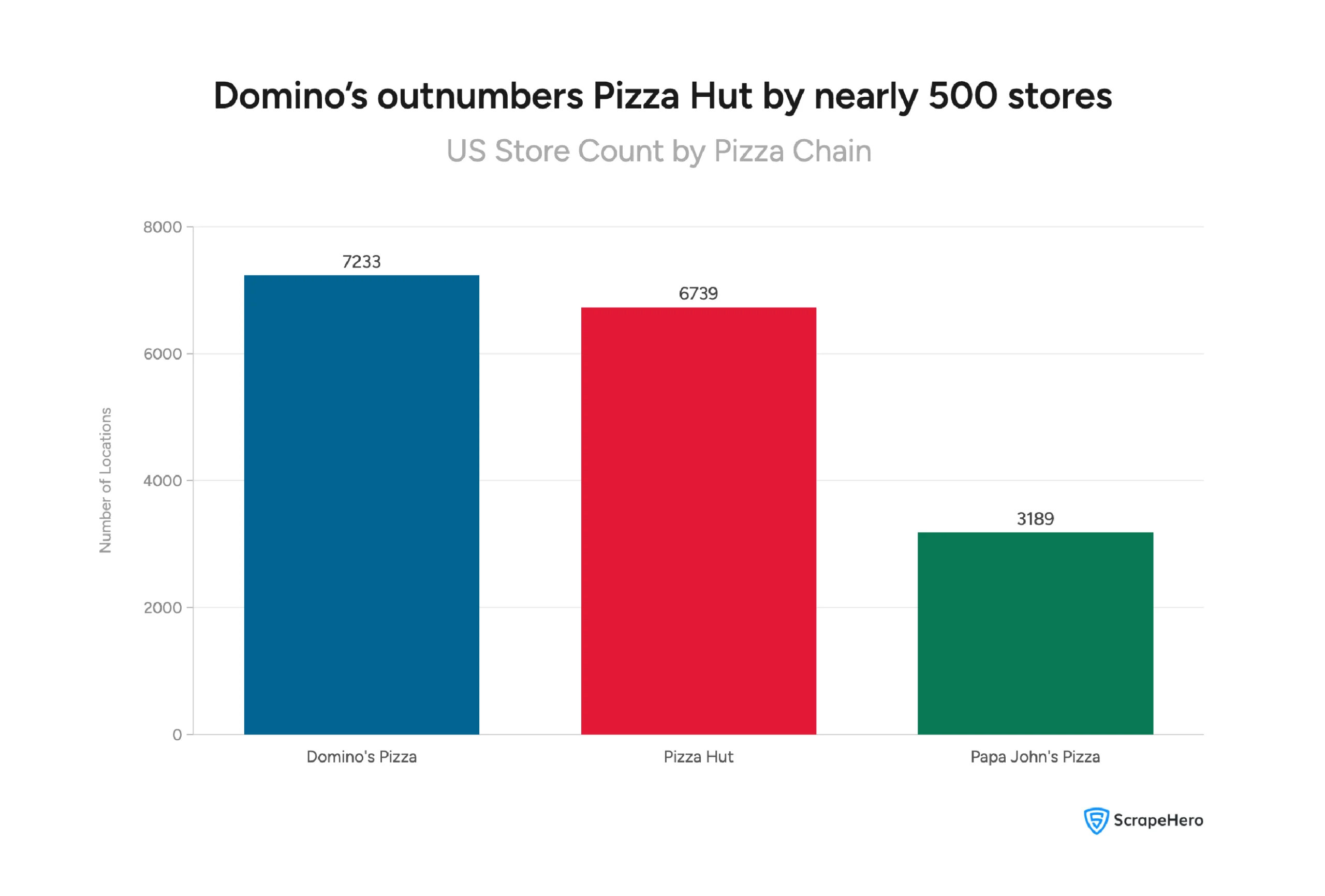
Domino’s leads the US pizza market by store count. It operates 7,233 locations, ahead of Pizza Hut’s 6,739 and Papa John’s 3,189 (Source: ScrapeHero Data Store).
That’s a real gap. Domino’s has nearly 500 more stores than Pizza Hut and more than double Papa John’s count.
But store count alone doesn’t tell the whole story. A chain with more stores may not automatically be the bigger business.
Want to download the complete list of all Domino’s Pizza locations in the US?
How is Market Dominance Measured in the Pizza Industry?
Market dominance in the pizza industry comes down to three numbers: store count, total revenue, and revenue per store.
Each one tells a different part of the story.
Store count shows reach. Revenue shows scale. Revenue per store shows how well each individual location performs.
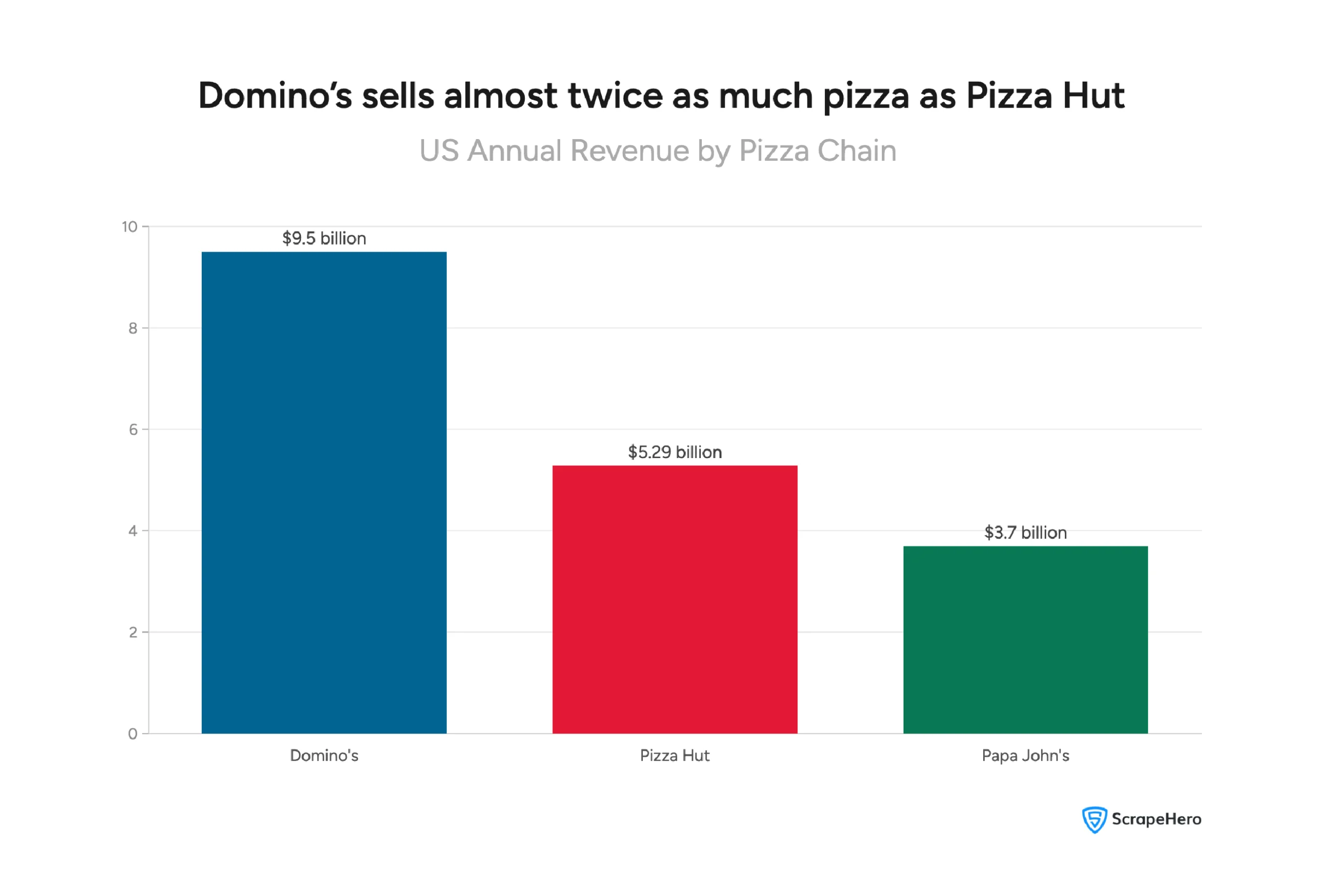
On revenue, Domino’s leads by an even wider margin than its store count suggests:
- Domino’s: $9.5 billion in 2024 US sales, up from $9.02 billion in 2023
- Pizza Hut: $5.29 billion in 2024, down slightly from $5.37 billion in 2023
- Papa John’s: $3.7 billion in 2024, down from $3.86 billion in 2023
Revenue Per Store: The Number That Actually Matters
Store count and total revenue only go so far. Average unit volume (AUV), how much a single store earns per year, shows which chain runs the strongest individual locations.
| Chain | Average Unit Volume |
|---|---|
| Domino’s | ~$1.3 million (from $26,247 average weekly sales) |
| Papa John’s | ~$1.1 million |
| Pizza Hut | ~$1 million |
Domino’s doesn’t just have more stores. Each of its stores also earns more, on average, than a Pizza Hut or Papa John’s location.
That combination, more stores and higher revenue per store, could be the reason why Domino’s controls roughly 23% of the US QSR pizza market, with plans to grow that share further (Source: Restaurant Dive).
Domino’s vs Pizza Hut vs Papa John’s: Full Comparison
Domino’s beats both Pizza Hut and Papa John’s on every core metric: store count, revenue, and revenue per store.
Pizza Hut holds the number two spot, and Papa John’s trails both in scale, though it competes differently on positioning.
Here’s the side-by-side:
| Metric | Domino’s | Pizza Hut | Papa John’s |
|---|---|---|---|
| US Stores | 7,233 | 6,739 | 3,189 |
| US Revenue | $9.5 billion | $5.29 billion | $3.7 billion |
| Average Unit Volume | ~$1.3 million | ~$1 million | ~$1.1 million |
| States/Territories Covered | 52 | 52 | 50 |
| Cities Covered | 3,707 | 3,188 | 1,860 |
Is Domino’s Bigger Than Pizza Hut?
Yes. Domino’s is bigger than Pizza Hut by every measure in this report.
It has 494 more stores, generates $4.2 billion more in annual US revenue, and earns roughly $300,000 more per store on average.
How Many Domino’s Stores Are There in the US?
Domino’s operates 7,233 stores across the United States. That makes it the largest pizza chain in the country by store count, ahead of Pizza Hut’s 6,739 and Papa John’s 3,189.
Domino’s stores also reach more places. The chain operates in 3,707 US cities, more than either competitor, giving it the widest delivery footprint of the three.
Where Papa John’s Actually Competes?
Papa John’s doesn’t try to out-build Domino’s or Pizza Hut. It runs fewer than half as many stores as Domino’s. Instead, it competes on premium positioning — marketing itself around ingredient quality rather than store count.
Download the list of all Papa John’s locations in the US, here.
State and City Presence Across the US
All three chains have a near-national footprint, but they don’t compete for the same ground. Domino’s and Pizza Hut operate in 52 states and territories. Papa John’s operates in 50.
That two-state gap is small. It doesn’t change the bigger picture: all three chains are present almost everywhere in the country. The real differences show up at the state, city, and county level.
Which States Have the Most Pizza Restaurants in the US?
Texas has the most combined pizza chain locations in the US. Across Domino’s, Pizza Hut, and Papa John’s, Texas hosts 1,982 stores, well ahead of California (1,321) and Florida (1,259).
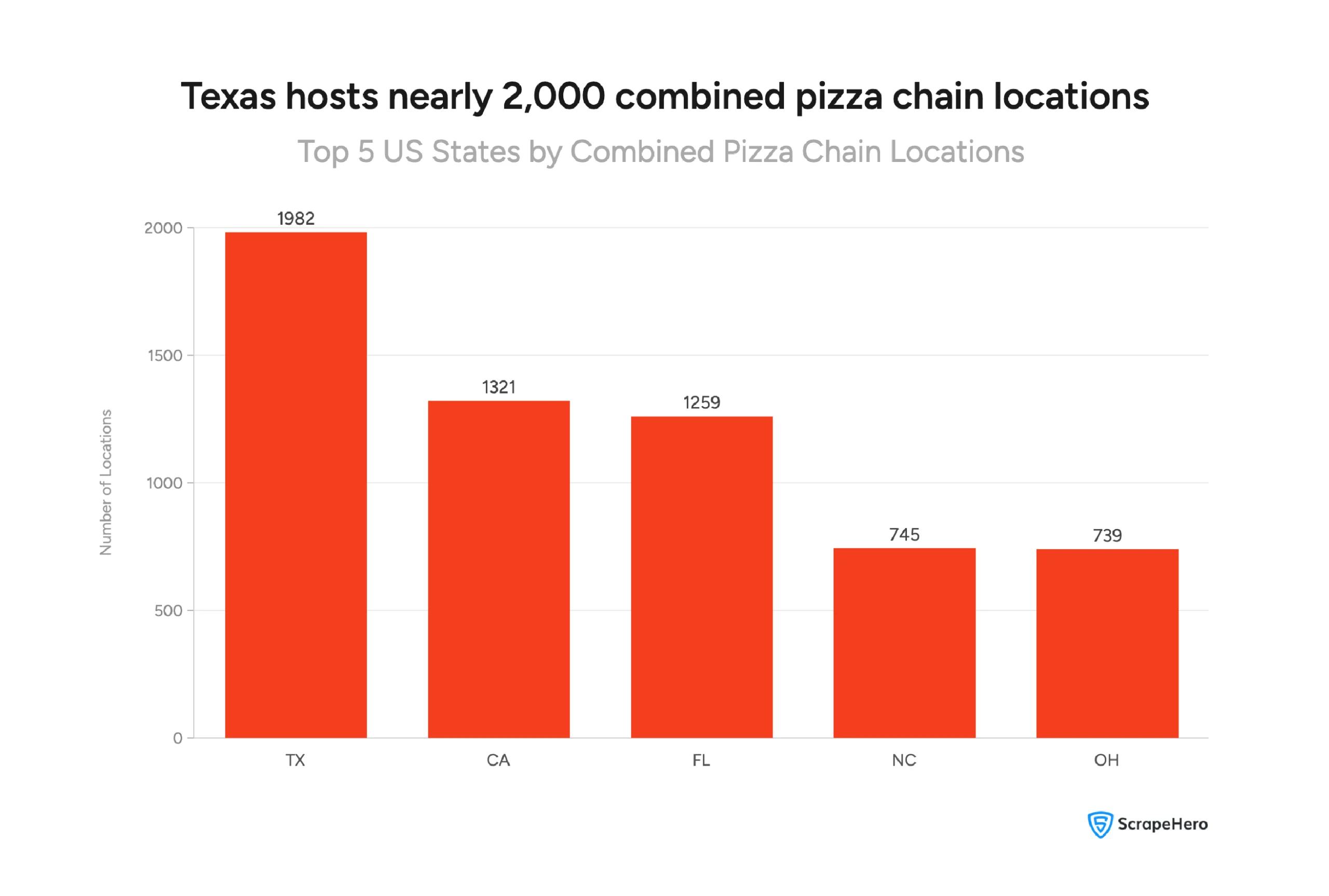
Texas leads the combined ranking, but not every chain agrees on where its top market is.
- Domino’s: Texas (781) → California (603) → Florida (495)
- Pizza Hut: Texas (918) → California (553) → Florida (461)
- Papa John’s: Florida (303) → Texas (283) → Georgia (195)
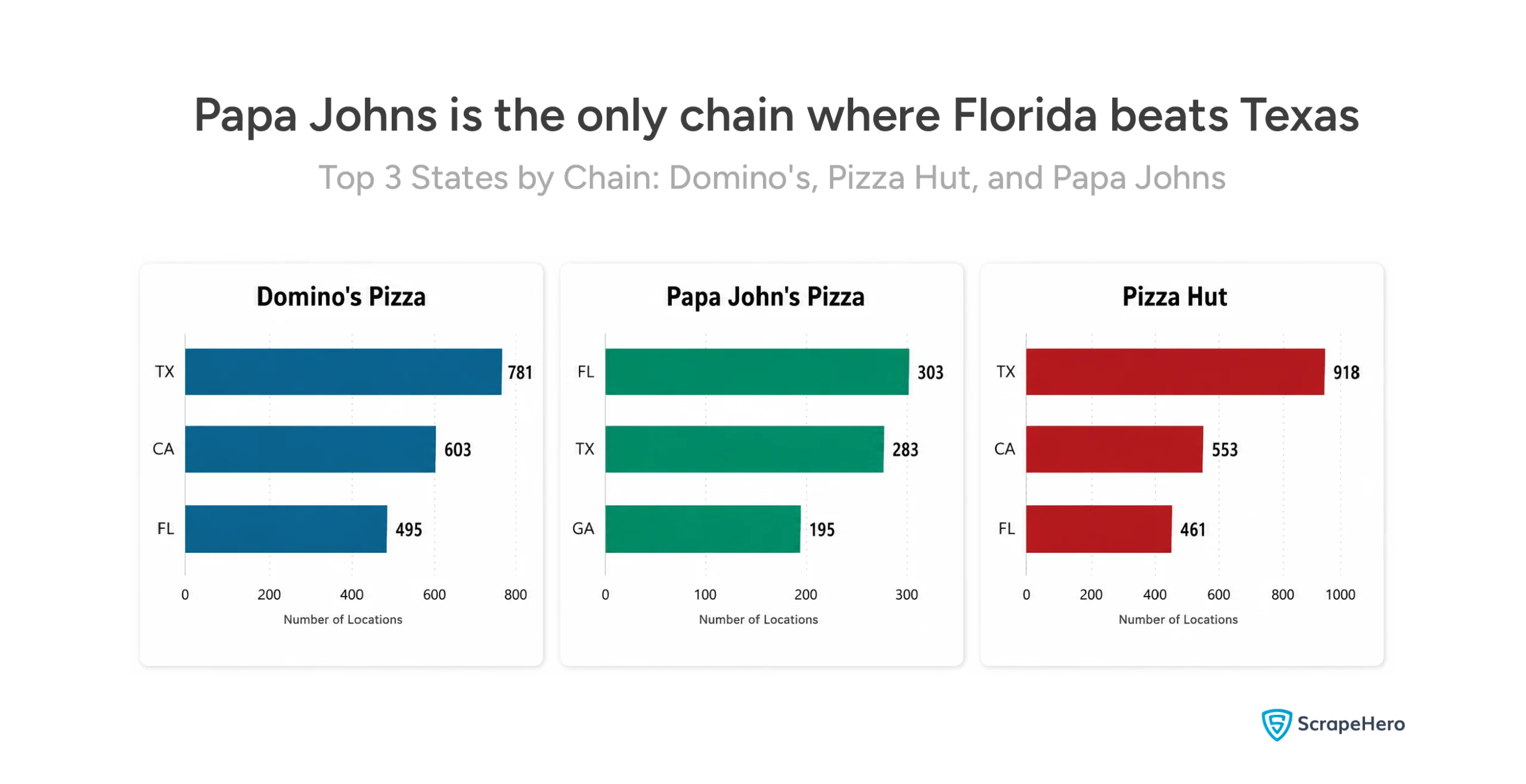
Domino’s and Pizza Hut both build around Texas first. Papa John’s doesn’t. That’s a real strategic difference; it suggests Papa John’s targets its expansion differently than its two larger rivals.
City-Level Reach
Domino’s covers more US cities than either competitor. It operates in 3,707 cities, ahead of Pizza Hut’s 3,188 and Papa John’s 1,860.
| Chain | Cities Covered |
|---|---|
| Domino’s | 3,707 |
| Pizza Hut | 3,188 |
| Papa John’s | 1,860 |
This tracks with the store count numbers from earlier; Domino’s reaches more places, in more granular detail, than its rivals.
How Does the US Pizza Market Compare to Canada?
The US pizza market is far larger than Canada’s for all three chains.
Domino’s, Pizza Hut, and Papa John’s each operate many more US locations than Canadian ones, but the size of that gap depends on the brand.
| Chain | US Locations | Canada Locations | US-to-Canada Ratio |
|---|---|---|---|
| Domino’s | 7,233 | 648 | ~11:1 |
| Pizza Hut | 6,739 | 620 | ~11:1 |
| Papa John’s | 3,189 | 219 | ~15:1 |
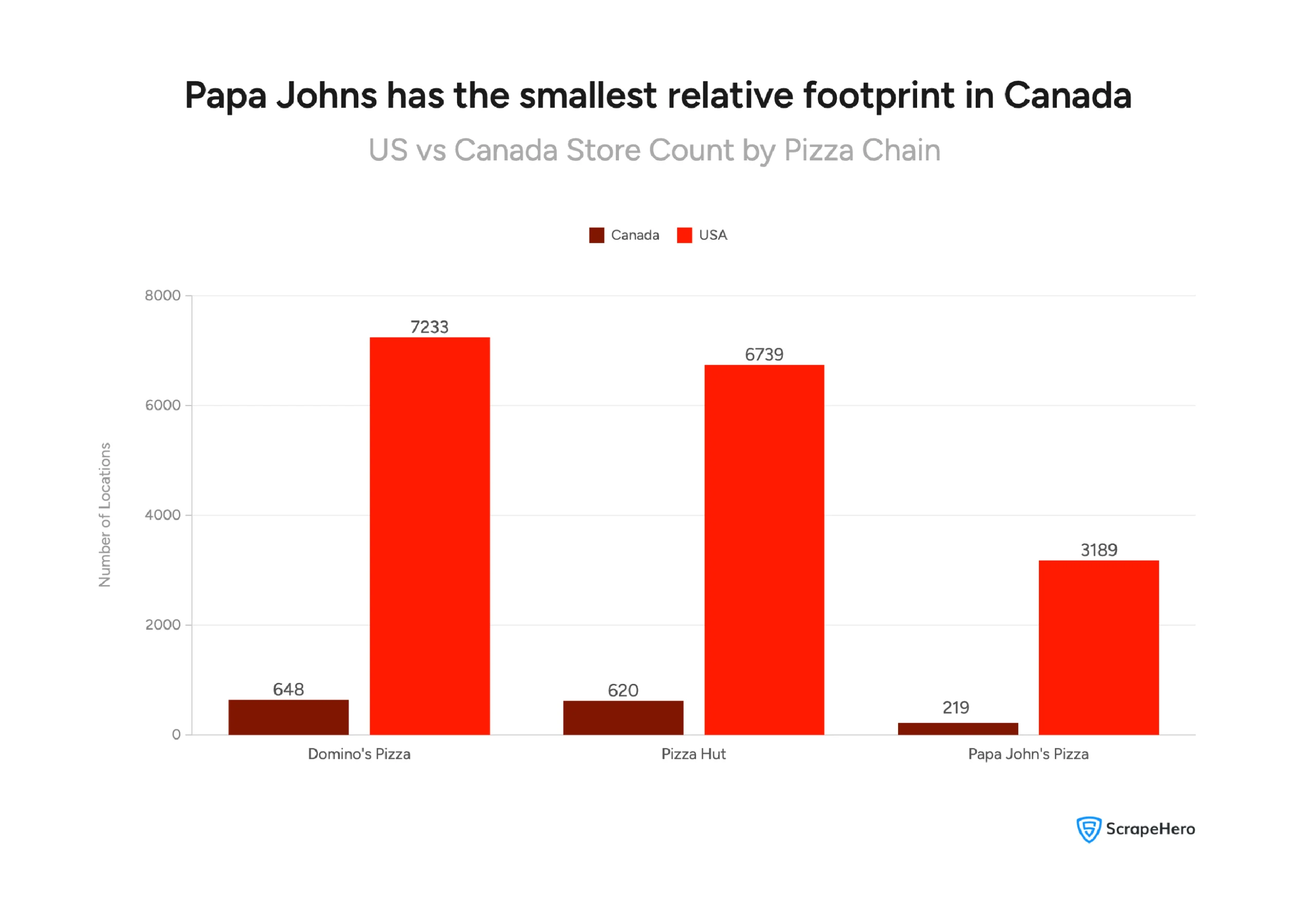
Domino’s and Pizza Hut scale down at almost the same rate when you move from the US to Canada — both sit close to an 11-to-1 ratio.
Papa John’s doesn’t follow that pattern. Its US-to-Canada ratio is closer to 15-to-1, meaning its Canadian presence is proportionally smaller than its two rivals.
This lines up with what we already know about Papa John’s US strategy.
It runs a smaller, more selective store count overall, built around premium positioning rather than raw scale. That same selectiveness appears to carry over into how the chain expanded — or didn’t — into Canada.
Digital Presence and Online Engagement
Domino’s has the highest online engagement of the three chains, based on web traffic data. Its site captures 97.54% web traffic, just ahead of Pizza Hut’s 96.33% and Papa John’s 91.59% (Source: SimilarWeb, via ScrapeHero analysis).
Which Pizza Chain Has the Highest Online Engagement?
Domino’s leads, but the gap between all three chains is narrow.
Less than 6 percentage points separate the highest and lowest score. That tells you something important: all three brands have built strong digital habits among their customers. None of them is falling behind online, even if one edges out the others.
High web traffic signals active digital ordering. Customers browsing a pizza chain’s site are usually checking menus, prices, or placing an order — a step that increasingly replaces phone calls or walk-ins. This tracks with digital order data across the industry. More than 85% of Domino’s US retail sales now come through digital channels, according to the company’s 2025 annual report. Papa John’s runs lower, with about 70% of its US sales flowing through digital platforms as of late 2025 (Source: QSR Magazine, November 2025). Put together, pizza ordering in the US has moved online, and all three major chains have adapted to it.
2026 Industry Shakeup: Pizza Hut’s Ownership Change
Pizza Hut is no longer owned by Yum! Brands.
On June 16, 2026, Yum! Brands announced it had signed definitive agreements to sell Pizza Hut for $2.7 billion, ending nearly five decades of ownership (Source: Yum! Brands, SEC Form 8-K, June 16, 2026).
The deal splits Pizza Hut into two parts. LongRange Capital, a private equity firm, is acquiring Pizza Hut’s business outside mainland China for about $1.5 billion. Yum China Holdings is separately acquiring Pizza Hut’s mainland China operations for about $1.2 billion (Source: Yum! Brands press release, June 2026).
Deal at a glance:
- Total sale price: $2.7 billion
- Buyers: LongRange Capital (Pizza Hut ex-China) + Yum China Holdings (Pizza Hut China)
- Announced: June 16, 2026
- Expected close: Q3 2026, pending regulatory approval
- Strategic review began: November 2025
Pizza Hut’s US systemwide sales fell approximately 8% in fiscal 2025, and the chain closed roughly 250 US locations in the first half of 2026 (Source: L’Express Franchise, June 2026). That decline lines up with the revenue numbers earlier in this report — Pizza Hut’s US revenue dropped slightly from 2023 to 2024, while Domino’s kept growing.
So, Who Dominates the US Pizza Market?
Domino’s dominates the US pizza market.
It leads in store count, revenue, revenue per store, city coverage, and online engagement. No other chain in this report beats it on a single major metric.
The data across this report tells a consistent story:
- Domino’s wins on scale and efficiency. It has more stores (7,233), more revenue ($9.5 billion), and higher revenue per store (~$1.3 million) than either rival. That combination is why Domino’s holds roughly 23% of the US QSR pizza market, with room to grow further.
- Pizza Hut held the number two spot, but lost ground. Its US revenue declined from 2023 to 2024, and its systemwide sales fell about 8% in fiscal 2025. That decline led directly to Yum! Brands selling the chain for $2.7 billion in June 2026.
- Papa John’s competes on a different plan entirely. It doesn’t try to out-build the other two. It runs fewer stores, stays open longer per day on average, and leads in Florida instead of Texas — the one state where the usual pattern breaks.
Store count alone doesn’t decide who wins the US pizza market. Revenue per store, digital adoption, and how fast a brand adapts to delivery all matter just as much. Domino’s leads because it wins on all of these at once.
Disclaimer: The data used in this report is sourced from publicly available information. This analysis has been produced independently by ScrapeHero and is not affiliated with, endorsed by, or produced in association with any of the pizza chain brands. All brand names are the property of their respective owners.
ScrapeHero is one of the top 3 web scraping services globally, and unlike most data services, we are fully managed. That means real experts handle your data requirements from start to finish, no technical expertise needed on your end.
In an age where AI drives most of the process, ScrapeHero keeps a human at every point — from the first conversation about your requirements to manual QA before delivery. You get clean, structured, trustworthy data without having to chase it yourself.
FAQ
Domino’s is the largest pizza chain in the US, both by store count (7,233 locations) and by revenue ($9.5 billion in 2024).
Domino’s dominates the US pizza market. It leads in store count, revenue, revenue per store, city coverage, and online engagement.
Domino’s operates 7,233 stores across the United States, more than Pizza Hut (6,739) or Papa John’s (3,189).
Yes. Domino’s has 494 more US stores, generates $4.2 billion more in annual revenue, and earns roughly $300,000 more per store on average than Pizza Hut.
Texas has the most combined pizza chain locations in the US, with 1,982 stores across Domino’s, Pizza Hut, and Papa John’s, followed by California and Florida.
Pizza Hut operates 6,739 US locations, the second-most of the three major chains.
No. Papa John’s runs 3,189 US stores and generates $3.7 billion in annual revenue, both well below Pizza Hut’s 6,739 stores and $5.29 billion in revenue.
As of June 2026, Pizza Hut is no longer owned by Yum! Brands. LongRange Capital acquired Pizza Hut’s business outside mainland China, and Yum China Holdings acquired Pizza Hut’s mainland China operations, in a combined $2.7 billion deal.
Florida, with 303 stores. This makes Papa John’s the only one of the three major chains where Texas isn’t the top state.
All three chains have far more US locations than Canadian ones. Domino’s and Pizza Hut each have roughly 11 US stores for every 1 in Canada, while Papa John’s ratio is closer to 15-to-1.