This analysis is powered by structured store location data downloaded from the ScrapeHero Data Store, giving you a ground-level view of Kroger’s US presence, straight from the source.
Introduction
Kroger was founded by Bernard Kroger in 1883 in Cincinnati, Ohio, with a life savings of $372 and a single grocery store. Today, it’s a retail giant.
Kroger is the largest supermarket chain in the United States, according to Statista.
But Kroger isn’t just one store. It’s a network of 21 regional banners, thousands of ZIP codes, and decades of strategic expansion, operating under different names in different markets.
For business analysts, retail strategists, and data teams, that complexity is exactly what makes Kroger’s location footprint worth studying. Here’s why it matters:
- Market entry decisions depend on knowing where Kroger already dominates
- Competitor benchmarking requires understanding banner-level density, not just total store count
- Site selection and whitespace analysis need ZIP-code-level store concentration data
- Retail trend forecasting is sharper when footfall and location data are combined
Kroger’s $148B in annual sales (krogerfeedbacks.com) and its presence in 1,247 US cities make it a reliable proxy for grocery market health nationwide.
Key Highlights (Kroger Locations US)
- Kroger operates 4,120+ stores across 36 states and 1,247 cities under 21 banners, making it the largest pure-play grocery chain in the US
- Texas (408) and Ohio (404) lead in total store count; Ohio is Kroger’s home state
- In high-GDP states like California and Washington, Kroger operates entirely under regional banners — the “Kroger” name doesn’t appear on a single storefront
- 4 of the top 12 states by store count have zero stores under the core Kroger banner
- 14 states have no Kroger presence at all
- Houston, TX is the most store-dense city with 52+ Kroger-format stores in high-concentration ZIP codes
- King Soopers and Smith’s are the fastest-growing banners by year-over-year foot traffic (May–Oct 2025)
- Kroger holds 10.3% grocery market share — second only to Walmart (24.2%), with Costco (9.5%) close behind
- Sales have grown consistently from $122.3B (2019) to $148B (2024)
How Many Kroger Stores Are in the US?
As of 2026, Kroger operates 4,120+ stores across 36 states and 1,247 cities in the US. It runs these stores under 21 different banners, regional grocery brands that Kroger has acquired and maintained over decades of expansion.
| Metric | Count |
| Total Stores | 4,120+ |
| Total Banners | 21 |
| Total States | 36 |
| Total Cities | 1,247 |
These numbers reflect a deliberate expansion strategy. Kroger doesn’t just open more stores; it acquires regional grocery chains and keeps them running under their original names. That’s how one company ends up with 21 banners across 36 states.
Want a complete list of all stores operating under the core Kroger banner in the US?
The biggest merger in their history came in 1999, when they merged with Fred Meyer, Inc. (owner of Smith’s Ralphs, Food 4 Less and QFC). That year, they also merged with JayC, Owens Market and Pay Less.
Kroger’s sales figures reinforce that scale. Revenue has grown every single year from 2019 to 2024:
- 2019: $122.3B
- 2020: $132.5B
- 2021: $137.9B
- 2022: $144.1B
- 2023: $146.5B
- 2024: $148B
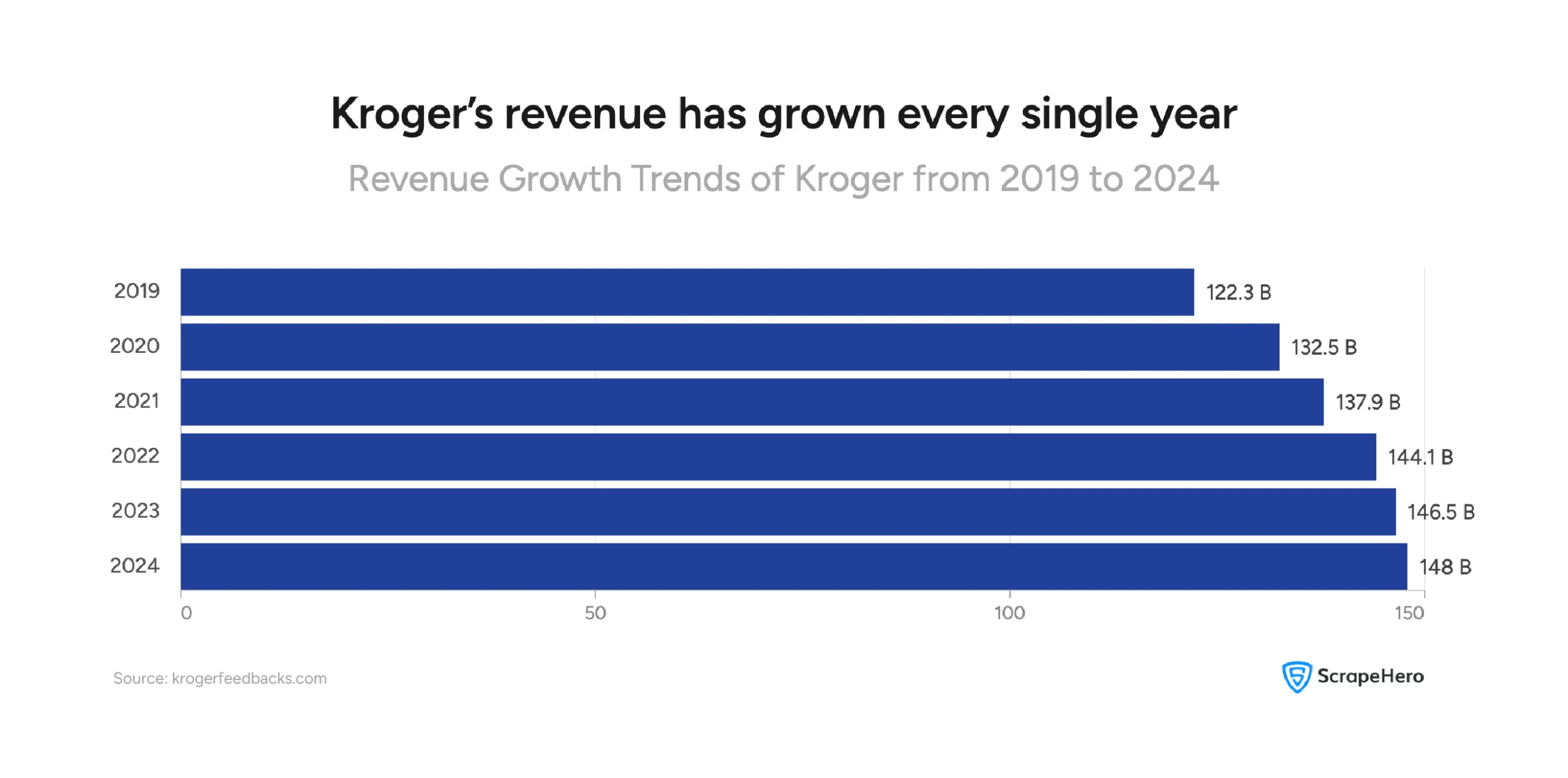
The biggest single-year jump came between 2019 and 2020. Since then, growth has been steady, reflecting a maturing market rather than a slowdown.
Kroger Store Location Analysis Across the US — A State-by-State Breakdown
Kroger’s 4,120+ stores are spread across 36 states — but that coverage is far from uniform. Some states have hundreds of stores. Others have fewer than 5. And 14 states have no Kroger presence at all.
Which State Has the Most Kroger Stores?
Texas and Ohio have the most Kroger stores, and it’s closer than you’d expect.
| State | Store Count |
| Texas | 408 |
| Ohio | 408 |
| Georgia | 329 |
| California | 297 |
| Indiana | 248 |
| Michigan | 246 |
| Tennesse | 240 |
| Kentucky | 225 |
| Virginia | 190 |
| North Carolina | 157 |
| Washington | 157 |
| Colorado | 157 |
Ohio is Kroger’s home state, and it shows. The core Kroger banner alone accounts for 404 stores in Ohio, with Ruler Foods adding another 4.
Texas leads in raw store count, but operates very differently; all 408 stores run under the core Kroger banner, making it the largest single-banner market outside Ohio.
Here’s what makes the top 12 states particularly interesting: 4 of them have zero stores under the core Kroger banner: California, North Carolina, Washington, and Virginia.
In those states, Kroger operates entirely through regional brands. Shoppers in those markets may never encounter a store called “Kroger” — yet they’re shopping at a Kroger-owned business.
Where Are Kroger Stores Concentrated? A City-Level Look
State-level numbers tell you where Kroger operates. City-level numbers tell you where Kroger dominates.
This section looks at cities with more than 2 Kroger-format stores in a single ZIP code, a reliable indicator of true market concentration.
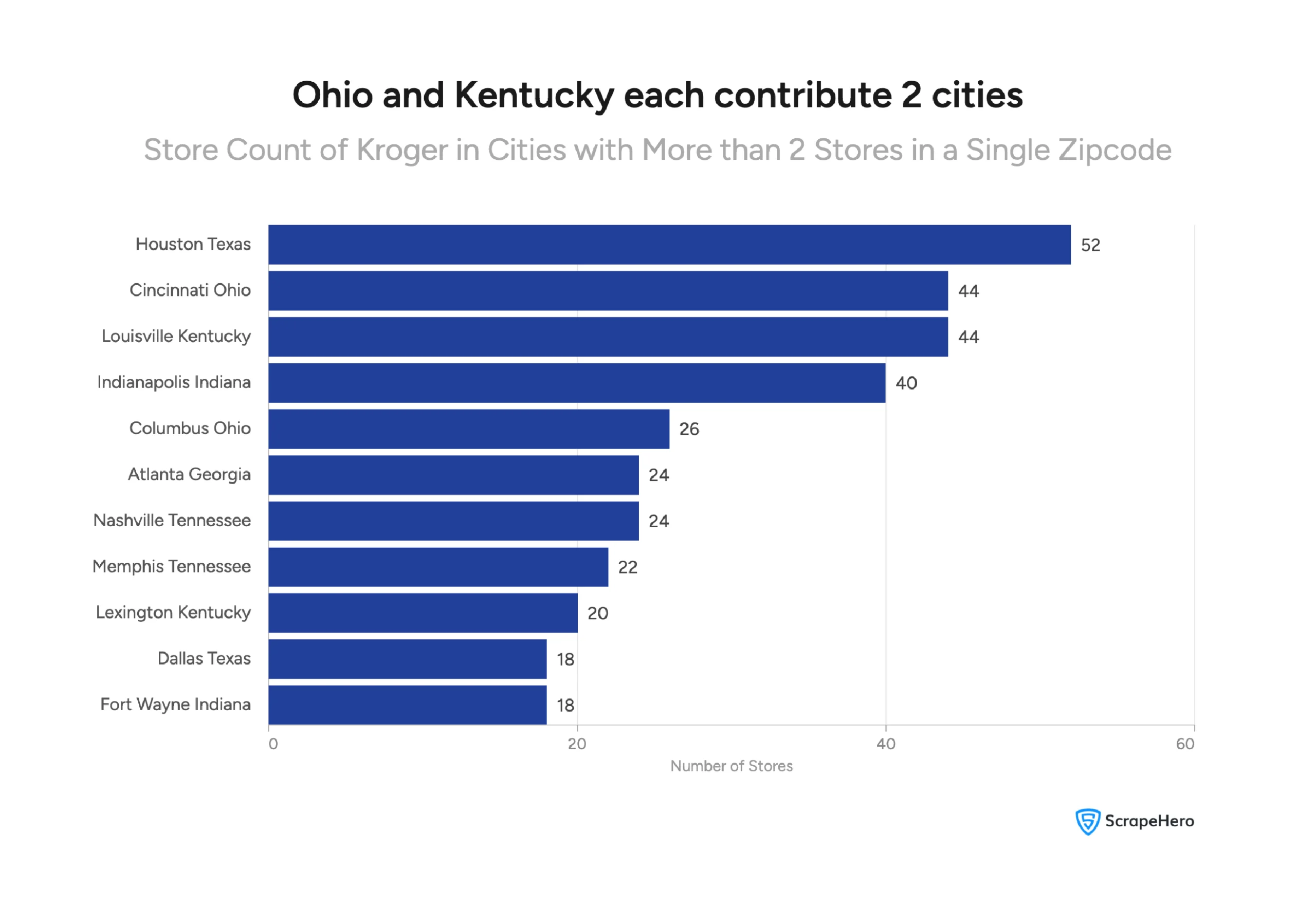
Houston leads by a significant margin, with 52 stores concentrated in high-density ZIP codes.
A few patterns worth noting for analysts:
- Ohio and Kentucky each contribute 2 cities to the top tier — Cincinnati + Columbus, Louisville + Lexington
- Texas dominates at both ends — Houston at the top, Dallas further down, reflecting Kroger’s strong statewide penetration
- Indiana and Tennessee each place 2 cities in the top 11 — Indianapolis + Fort Wayne, Nashville + Memphis
For site selection teams and retail strategists, this concentration data reveals where Kroger has already saturated the market — and by extension, where competitive pressure is highest.
Kroger’s Multi-Banner Strategy — More Than Just “Kroger”
Walk into a Ralphs in Los Angeles, a Fred Meyer in Seattle, or a King Soopers in Denver, and you’re shopping at a Kroger store. You just wouldn’t know it from the sign above the door.
This is Kroger’s multi-banner strategy. Instead of rebranding every acquisition under the Kroger name, the company lets regional brands retain their identity.
Here’s how the banner landscape breaks down across key states:
How Does Kroger’s Banner Strategy Vary by Region?
California
- Ralphs — 187 stores
- Food 4 Less — 90 stores
- Foods Co — 20 stores
- No stores under the core Kroger banner
Washington
- Fred Meyer — 57 stores
- QFC — 54 stores
- Fred Meyer Jewelers- 46
- No stores under the core Kroger banner
Illinois
- Marianos — 40 stores
- Ruler Foods — 11 stores
- Kroger — 60 stores
What Do Kroger’s Banner Operating Hours Tell Us?
Beyond store count, operating hours reveal how each banner serves its market.
- Most banners average ~16 hours/day, consistent across all days of the week
- QFC has the highest average at 20 hours/day
- Fred Meyer Jewelers operates the fewest hours at 12 hours/day, dropping to just 7 hours on Sundays
For data teams building retail intelligence layers, banner-level operating hours are a critical — and often overlooked — data point. They signal how a store is positioned in its local market and when foot traffic is likely to peak.
Are Kroger Stores Growing? Visit Trends by Banner
Store count tells you where Kroger is. Foot traffic tells you where Kroger is winning.
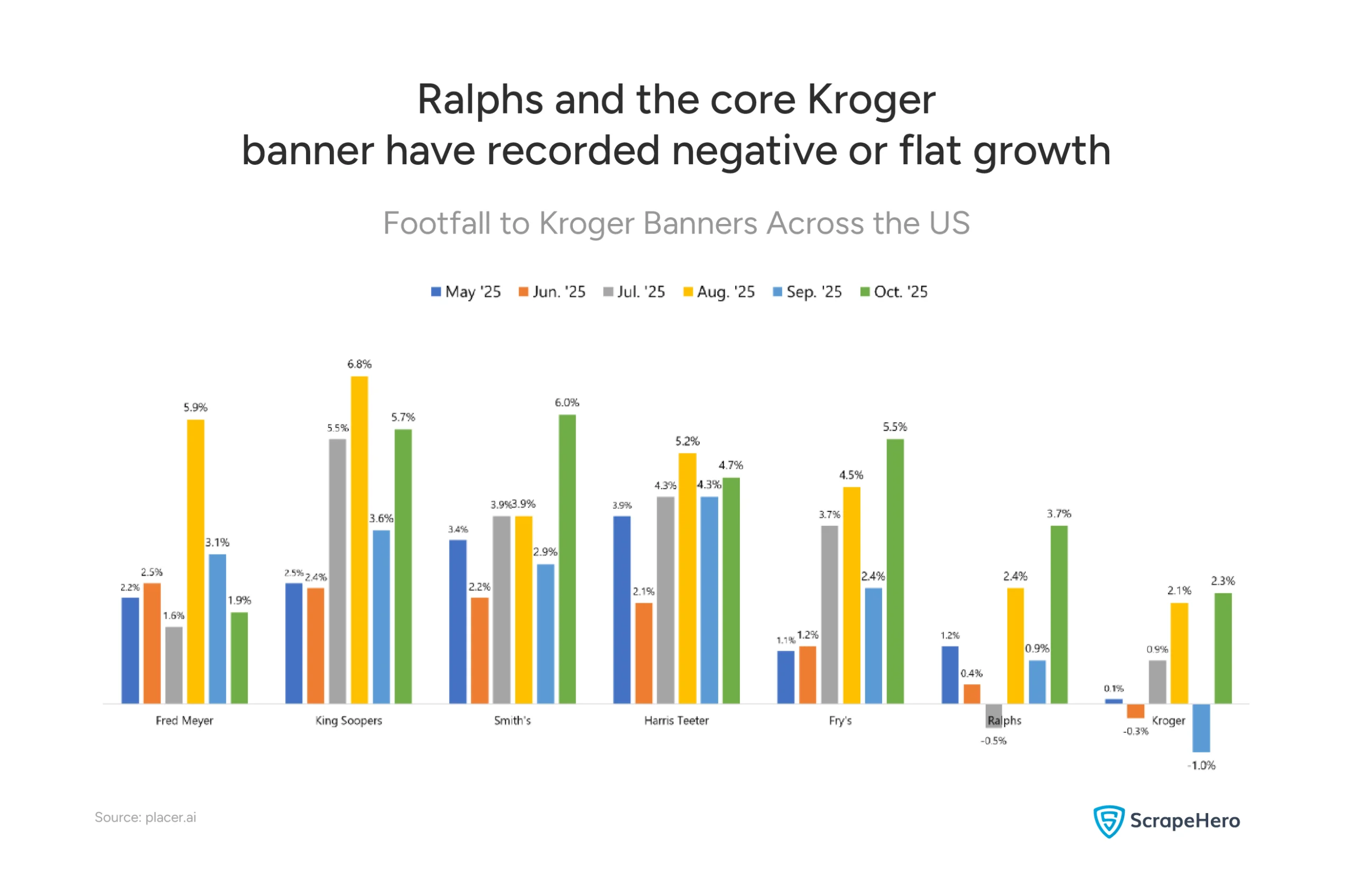
Using year-over-year visit data from May to October 2025, here’s how each Kroger banner performed against the previous year:
Which Kroger Banners are Growing the Fastest?
Strongest Performers
- King Soopers peaked at 6.8% YoY growth — the highest of any banner in the period
- Smith’s peaked at 6.0% YoY growth — the second strongest performer
- Harris Teeter and Fry’s showed steady improvement, particularly through August–October 2025
Moderate Growth
- Fred Meyer recorded a strong spike in August at 5.9% before moderating in subsequent months
Weakest Performers
- Ralphs and the core Kroger banner recorded negative or flat growth in some months before recovering later in the period
For teams building retail forecasting models, banner-level visit trends layered on top of location data gives you a significantly sharper picture than store count alone.
How Does Kroger Compare to Its Competitors?
Store count and foot traffic paint a picture of Kroger’s internal performance. But how does Kroger stack up against the broader US grocery market?
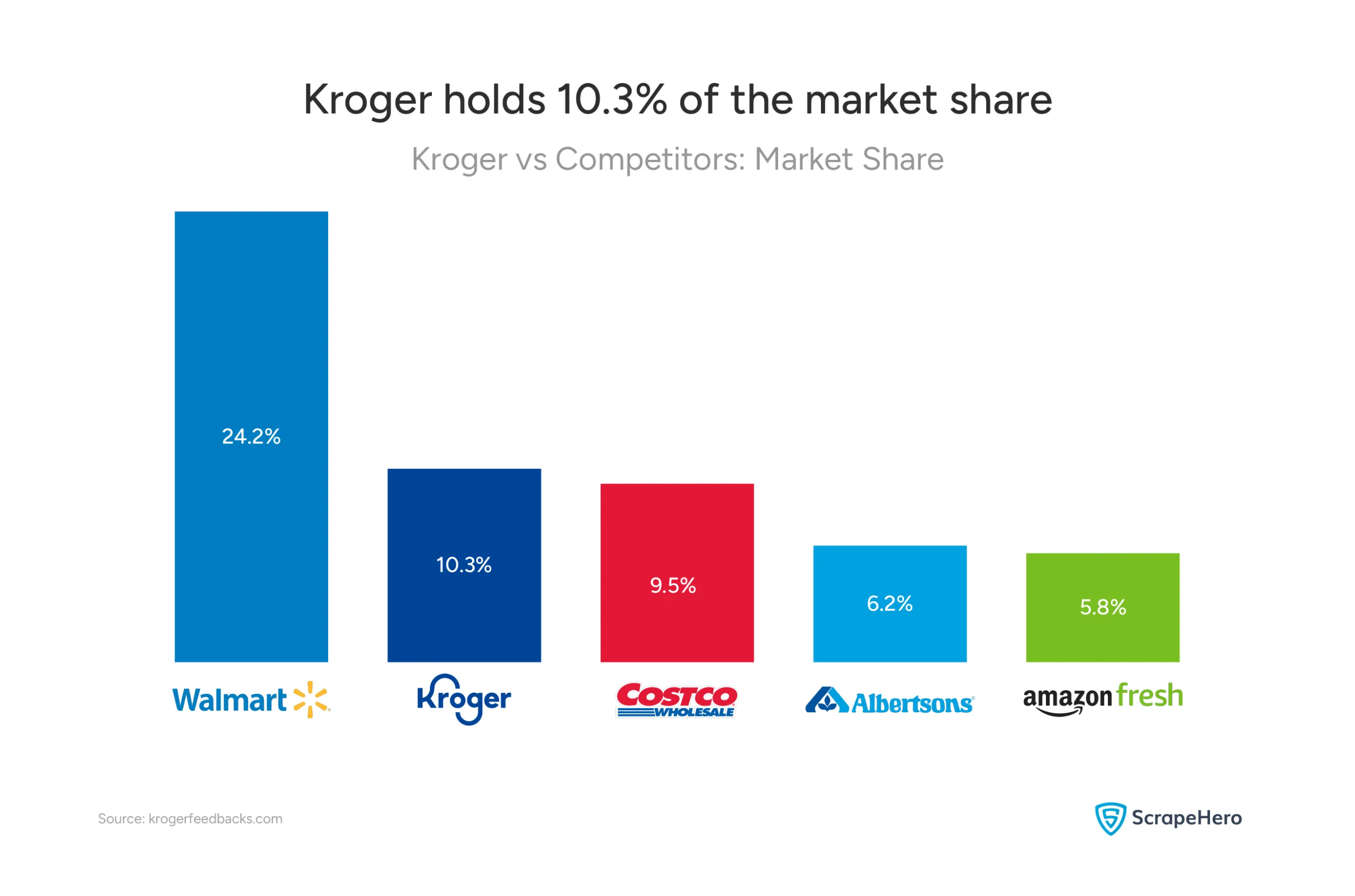
A few things stand out:
- Walmart dominates the grocery market with 24.2% share — more than double Kroger’s
- Kroger holds 10.3% — a strong second place, but the gap with Walmart is significant
- Costco (9.5%) is close behind Kroger — just 0.8 percentage points separating them
- Albertsons (6.2%) and Amazon Fresh (5.8%) round out the top five
For analysts, the Costco proximity is worth watching. Costco operates a fundamentally different model — membership-based, warehouse-format — yet it’s nearly matching Kroger’s grocery market share. That’s a meaningful competitive signal.
What This Kroger Store Location Analysis (US) Reveals?
Kroger’s US footprint is vast, but it’s the strategy behind it that makes it worth studying. Over 4,120 stores, 21 banners, and 36 states, all built through decades of deliberate acquisitions and regional brand preservation.
A few things this analysis makes clear:
- Scale doesn’t mean uniformity. Four of Kroger’s top 12 states by store count carry zero stores under the core Kroger banner
- City-level concentration matters. Houston, Cincinnati, and Louisville tell a very different story than state-level totals
- Foot traffic trends reveal what store count can’t. King Soopers and Smith’s are growing fast, while Ralphs and core Kroger lag behind
- The competitive gap is real. Kroger holds 10.3% market share, but Walmart’s 24.2% and Costco’s rising 9.5% signal that the pressure isn’t easing
For analysts and data teams, this is exactly the kind of intelligence that drives sharper market decisions, and it all starts with reliable, structured location data.
Need Custom Retail Data for Your Business?
This analysis was built using store location data scraped by ScrapeHero, a fully managed, enterprise-grade web scraping service trusted by Fortune 50 companies and 14,700+ businesses globally, and featured in Bloomberg, Forbes, and TechCrunch.
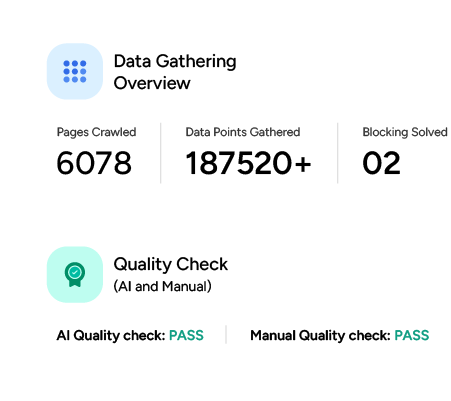
ScrapeHero doesn’t just scrape data; we deliver it clean, structured, and validated. Every dataset goes through both automated and manual QA, so what your team receives is ready to use from day one.
You tell us what data you need. Our experts, with decades of industry experience, handle everything else. And the first conversation? Completely free, no obligations.
Frequently Asked Questions About Kroger Store Locations
As of 2026, Kroger operates 4,120+ stores across 36 states and 1,247 cities in the US, under 21 different banners.
If you’re looking specifically for stores operating under the core Kroger banner, ScrapeHero’s Kroger location report tracks 1,251 Kroger-branded locations across the US.
Texas and Ohio are tied at the top with 408 stores each. Ohio is Kroger’s home state, while Texas is the largest single-banner Kroger market in the country.
14 US states have no Kroger presence at all. Additionally, 4 of the top 12 states by store count, California, North Carolina, Washington, and Virginia, have zero stores under the core Kroger banner, operating entirely through regional brands like Ralphs, Harris Teeter, Fred Meyer, and King Soopers.
The largest Kroger store in the US is the Kroger Marketplace in Centerville, Ohio, spanning 147,000 square feet. It’s part of Kroger’s Marketplace format, a hypermarket-style store offering groceries alongside general merchandise, pharmacy, and specialty departments. (Source: AndNowUKnow)
Kroger operates under 21 banners across the US, including Ralphs, Fred Meyer, King Soopers, Harris Teeter, Smith’s, QFC, Food 4 Less, Foods Co, Marianos, Ruler Foods, and the core Kroger banner among others.
Kroger operates exclusively in the United States, it has no international presence. All 4,120+ stores are located across 36 US states.