Trying to make sense of US hospital chains isn’t easy. There are hundreds of systems, conflicting rankings, and a lot of jargon standing between you and a clear picture.
This guide cuts through that. Using 2026 POI data from the ScrapeHero Data Store, and others from the American Hospital Association, and Hospitalogy, here’s exactly what you’ll find:
- The largest hospital chains ranked by locations, revenue, and geographic reach
- The difference between for-profit and nonprofit systems — and why it matters
- Where hospital coverage is strong, and where it’s notably thin
- How consolidation has shaped the map of American healthcare today
Understanding the Landscape: What These Numbers Actually Represent
Before diving into rankings, it helps to understand what you’re actually comparing. Not all hospital organizations are structured the same way — and the differences affect everything from how they’re funded to how they grow.
What is a hospital chain?
A hospital chain is a group of hospitals operating under shared ownership and centralized management. They share branding, administrative systems, and often clinical protocols across all locations.
Think of it like a retail franchise, but for healthcare.
How is a hospital chain different from a health system?
A health system is broader. It can include:
- Outpatient clinics and urgent care centers
- Physician practices and medical groups
- Insurance products and pharmacy networks
- Research and teaching facilities
Most of the organizations in this article are technically health systems. When you see location counts, they often reflect this full ecosystem, not just hospital buildings.
What is the difference between a for-profit and a nonprofit hospital chain?
This distinction matters more than most people realize. Here’s how they differ:
| For-Profit | Nonprofit | |
| Tax Status | Pays federal/state taxes | Tax-exempt |
| Profits | Distributed to shareholders | Reinvested into the organization |
| Obligation | Return on investment | Community benefit requirement |
| Examples | HCA Healthcare, Tenet Health | Ascension Health, Northwell |
Nonprofits aren’t charity operations; they generate significant revenue. But they’re required to reinvest it.
The Largest Hospital Chains in the US by Locations and Revenue
Size means different things depending on what you measure. A chain with thousands of locations isn’t necessarily the highest earner. And the highest earner isn’t always the most geographically widespread.
Here’s what the 2026 data actually shows.
Rank by Number of Locations
Ascension Health is the largest hospital chain in the US by total facilities, and it isn’t close.
A quick note on terminology: Most organizations on this list are technically health systems; they include outpatient clinics, physician groups, and affiliated facilities, as well as hospital buildings. Location counts reflect this full network. We use “hospital chains” and “health systems” interchangeably here because that’s how they’re commonly referenced, but the distinction is worth keeping in mind when comparing numbers.
| Provider | Locations | States | Cities |
| Ascension Health | 2,927 | 16 | 412 |
| Tenet Health | 634 | 35 | 373 |
| Indiana University Health | 545 | 1 | 43 |
| Cleveland Clinic | 309 | 4 | 106 |
| UNC Health | 241 | 2 | 32 |
| HCA Healthcare | 204 | 19 | 145 |
| Emory Healthcare | 177 | 1 | 38 |
| Northwell Health Hospitals | 154 | 3 | 154 |
| Butler Health Hospitals | 143 | 1 | 22 |
| Community Health Systems | 70 | 15 | 61 |
A few things worth noting:
- Tenet Health covers the most states (35) despite having far fewer locations than Ascension
- Butler Health System, Indiana University Health, and Emory Healthcare each operate in a single state only
- Ascension Health has nearly 5x more locations than the second-largest chain on this list
Want to look closely into the locations of Ascension Health in the US?
Rank by Revenue
Location count and revenue tell completely different stories about the hospital chains in the US.
| Hospital | Revenue ($B) | Category |
| HCA Healthcare | $70.6 | For-Profit |
| Ascension Health | $27 | Regional Non-Profit |
| Tenet Health | $20.7 | For-Profit |
| Northwell Health Hospitals | $18.6 | Regional Non-Profit |
| Cleveland Hospitals | $15.9 | Academic Medical Center |
| Community University Systems | $12.6 | For-Profit |
| Indiana University Health | $9.2 | Regional Non-Profit |
| Emory Healthcare | $7 | Academic Medical Center |
| Butler Health System | $0.5 | Regional Non-Profit |
| UNC Health | $0.3 | Academic Medical Center |
(Source: Hospitalogy)
Ascension Health has roughly 14x more locations than HCA Healthcare, yet generates less than half the revenue. You will need more data to explain why, but the pattern holds across organization types. For-profit systems consistently outperform nonprofits and academic centers on revenue, regardless of facility count.
How Hospital Chains Make Money, and Why the Revenue Gap Is So Wide
HCA Healthcare generates $70.6 billion in revenue from 204 locations. UNC Health generates $0.3 billion from 241. That’s not a small gap — it’s a notable one.
Here’s what the data shows.
The three types of hospital organizations and how they differ
The 10 systems in this dataset fall into three distinct categories. Each is structured differently, and each shows up differently in the revenue numbers.
- For-profit systems — like HCA Healthcare, Tenet Health, and Community Health Systems — are investor-owned and return profits to shareholders.
- Regional nonprofits — like Ascension Health and Northwell Health — are tax-exempt and required to reinvest earnings back into the organization.
- Academic medical centers — like Cleveland Clinic, Emory Healthcare, and UNC Health — balance patient care with teaching and research missions.
Here’s how those categories compare on revenue across this dataset:
| Category | Combined Revenue | Systems Listed |
| For-Profit | $103.9B | 3 |
| Regional Non-Profit | $55.3B | 4 |
| Academic Medical Center | $23.2B | 3 |
For-profit systems generate the highest combined revenue despite having the fewest systems listed. Whether organizational structure drives this difference, or whether other factors, geography, service mix, patient volume, payer ratios, are at play, falls outside what this dataset can tell us.
The gap between national systems and smaller regional providers
The revenue divide isn’t just between organization types. It’s also between national scale and regional scale.
- HCA Healthcare: $70.6B across 19 states
- Butler Health System: $0.5B across 1 state
- UNC Health: $0.3B across 2 states
The difference between the largest and smallest system on this list is $70.3 billion.
What’s clear from the data is that national systems and smaller regional or academic providers occupy completely different financial tiers. What explains that divide in full is a more complex question.
Where US Hospital Chains Are and Where They Aren’t
Revenue and organization type tell one part of the story. Geography tells another. Where these systems choose to operate, and where they don’t, is just as important as how much they earn.
States with the highest concentration of hospitals
Among the 10 systems analyzed, hospital presence is heavily concentrated in a handful of states. Michigan, Pennsylvania, California, and Tennessee stand out as major regional healthcare hubs — each hosting significant numbers of facilities from multiple large chains.
New York and New Jersey stand out as the most hospital-dense states in the dataset. Three chains drive that concentration:
- Ascension Health
- Tenet Health
- Northwell Health Hospitals
Northwell alone operates 152 locations in New York — one of the largest single-state footprints in the entire dataset.
States with high spending but limited major-chain presence
Three states show a pattern that stands out from the rest:
- Alaska — among the highest per-capita healthcare expenditure in the US, one major-chain hospital
- South Dakota — among the highest per-capita healthcare expenditure in the US, one major-chain hospital
- West Virginia — among the highest per-capita healthcare expenditure in the US, one major-chain hospital
These states spend more per person on healthcare than most of the country, yet have minimal presence from the major systems analyzed.
The data doesn’t explain why. But it’s a pattern worth flagging for anyone researching healthcare access or market gaps in the US.
How Hospital Consolidation Has Shaped the Current Map
The 10 systems in this dataset vary significantly in how they’re distributed across the country. Some cover a handful of states with thousands of locations. Others span dozens of states with a fraction of the facilities.
Two observable patterns in geographic reach
The data shows two distinct footprint profiles among the systems analyzed:
Wide state coverage, fewer locations:
- Tenet Health — 35 states, 634 locations, 373 cities
- HCA Healthcare — 19 states, 204 locations, 145 cities
- Community Health Systems — 15 states, 70 locations, 61 cities
Fewer states, higher location count:
- Ascension Health — 16 states, 2,927 locations, 412 cities
- Indiana University Health — 1 state, 545 locations, 43 cities
- Northwell Health Hospitals — 3 states, 154 locations, 154 cities
Some chains operate exclusively within a single state:
- Emory Healthcare — Georgia only
- Indiana University Health — Indiana only
- Butler Health System — Pennsylvania only
The data shows these patterns clearly. What drives them falls outside what this dataset can tell us.
How many hospital systems are in the US?
The 10 chains in this dataset represent the large-system tier of American healthcare. To put that in context:
- The American Hospital Association reports 5,112 community hospitals in the US
- 84% of all healthcare providers are community hospitals
- 11% are non-federal psychiatric facilities
- 3% are federal government facilities
- 2% fall into other categories
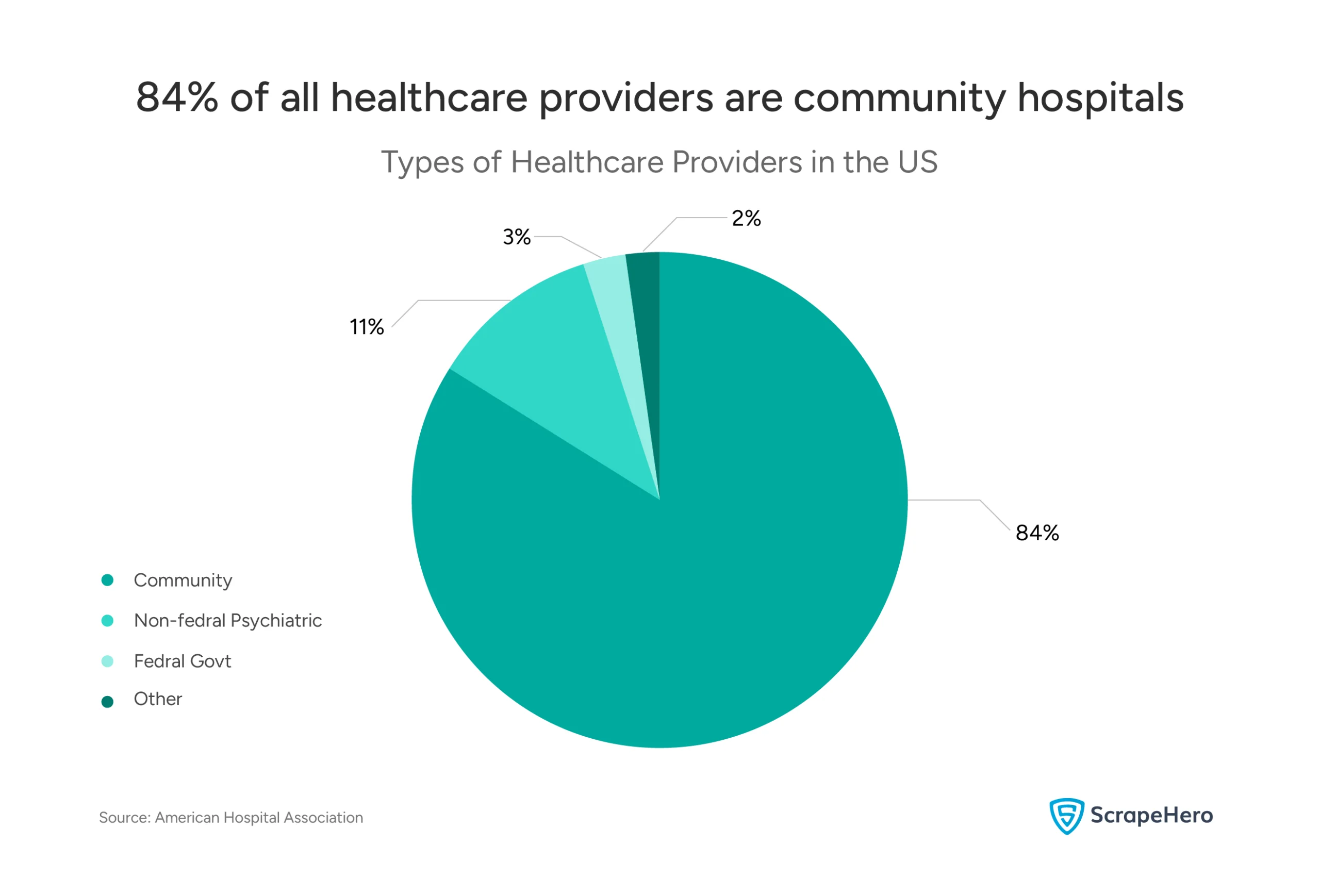
The 10 systems analyzed here are a small slice of the 5,112 community hospitals in the US by count, but they account for a significant share of the country’s total hospital revenue, as the figures in this dataset show.
Ownership Structure of US Community Hospitals
Beyond the 10 systems analyzed in this article, the broader US hospital landscape tells its own story.
Of the 5,112 community hospitals in the US, ownership is split three ways.
The majority are nonprofit, but not by revenue
The 10 systems in this dataset are large, well-known chains. But they exist within a much broader landscape of 5,112 community hospitals across the US.
Here’s how ownership breaks down across all US community hospitals:
- Non-govt not-for-profit: 2,978 hospitals — 58%
- Investor-owned for-profit: 1,214 hospitals — 24%
- State and local government-owned: 920 hospitals — 18%
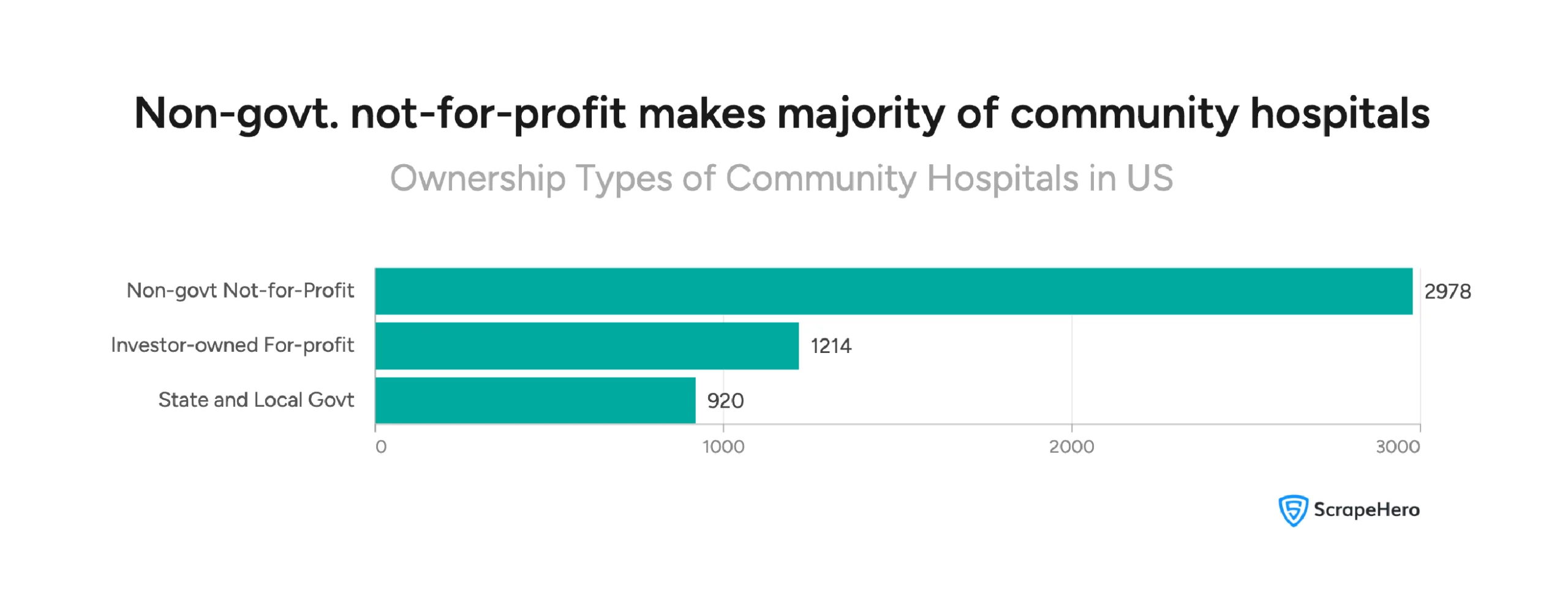
The majority of community hospitals in the US are nonprofit by ownership. For-profit systems account for roughly one in four.
Source: American Hospital Association
What This Data Shows — and What It Doesn’t
The US hospital landscape is large, complex, and difficult to summarize from any single dataset. Here’s what this analysis can tell you with confidence:
- Ascension Health is the largest hospital chain in the US by locations. HCA Healthcare leads by revenue.
- For-profit systems generate the highest combined revenue despite representing the fewest systems in this dataset.
- Hospital presence is concentrated in a handful of states — Michigan, Pennsylvania, California, Tennessee, New York, and New Jersey.
- 58% of US community hospitals are non-government not-for-profit. For-profit systems account for 24%.
What this dataset can’t tell you is why these patterns exist, what drives the revenue gap in full, or what the picture looks like beyond these 10 systems.
The US hospital landscape has thousands of systems. This article covers the largest. For research, market analysis, or business intelligence that requires the complete picture, the data in this article is a starting point — not the full story.
ScrapeHero is a web scraping service you can partner with to get all the data you want, without any of the technical hassle.
No infrastructure to build. No engineering team required. ScrapeHero handles the data collection so your team can focus on the analysis and decisions that matter.
Disclaimer: The data used in this report is sourced from publicly available information. This analysis has been produced independently by ScrapeHero and is not affiliated with, endorsed by, or produced in association with any of the hospital chains mentioned in this report. All brand names are the property of their respective owners.
Ready to Make Smarter Decisions in the US Market?
FAQ
By number of locations, Ascension Health is the largest hospital chain in the US with 2,927 facilities across 16 states. By revenue, HCA Healthcare leads at $70.6 billion.
Based on the latest data:
1. HCA Healthcare — $70.6B
2. Ascension Health — $27B
3. Tenet Health — $20.7B
4. Northwell Health Hospitals — $18.6B
5. Cleveland Clinic — $15.9B
A hospital chain refers to multiple hospitals under shared ownership. A health system is broader — it can include outpatient clinics, physician groups, insurance products, and research facilities alongside hospitals.
For-profit systems are investor-owned and distribute profits to shareholders. Nonprofits are tax-exempt and required to reinvest earnings back into the organization.
The American Hospital Association reports 5,112 community hospitals in the US. Of these, 84% are community hospitals, 11% are non-federal psychiatric facilities, 3% are federal government facilities, and 2% fall into other categories.
Among the systems analyzed, the largest regional nonprofits by revenue are Ascension Health ($27B), Northwell Health Hospitals ($18.6B), and Indiana University Health ($9.2B).