About the Report: This Costco US market analysis report analyzes Costco’s operational footprint and market performance across the US. The report evaluates data from 634 locations spanning 49 states and 540 cities, providing a detailed look at the retailer’s geographic concentration and expansion history.
The report further delves into a competitive benchmarking study against major retailers to compare store density, national reach, and revenue efficiency.
Source: The POI data downloaded from ScrapeHero Data Store, Companies Market Cap, Statista, Bullfincher
Costco Till Now
Costco Wholesale Corporation, also known as Costco, is an American multinational corporation that operates a chain of membership-only big-box warehouse club retail stores.
According to Statista, Costco is the third-largest retailer in the world, with just under a third of American consumers regularly shopping at Costco warehouses.
As of 2025, Costco is ranked 12th on the Fortune 500 rankings of the largest United States corporations by total revenue.
Costco originally began with a wholesale business model aimed at enrolling businesses as members, then also began to enroll individual consumers and sell products intended for them, including its own private label brand.
As of November 2025, Costco operates 923 warehouses worldwide, with 85% of them being in North America (the US, Canada, and Mexico).
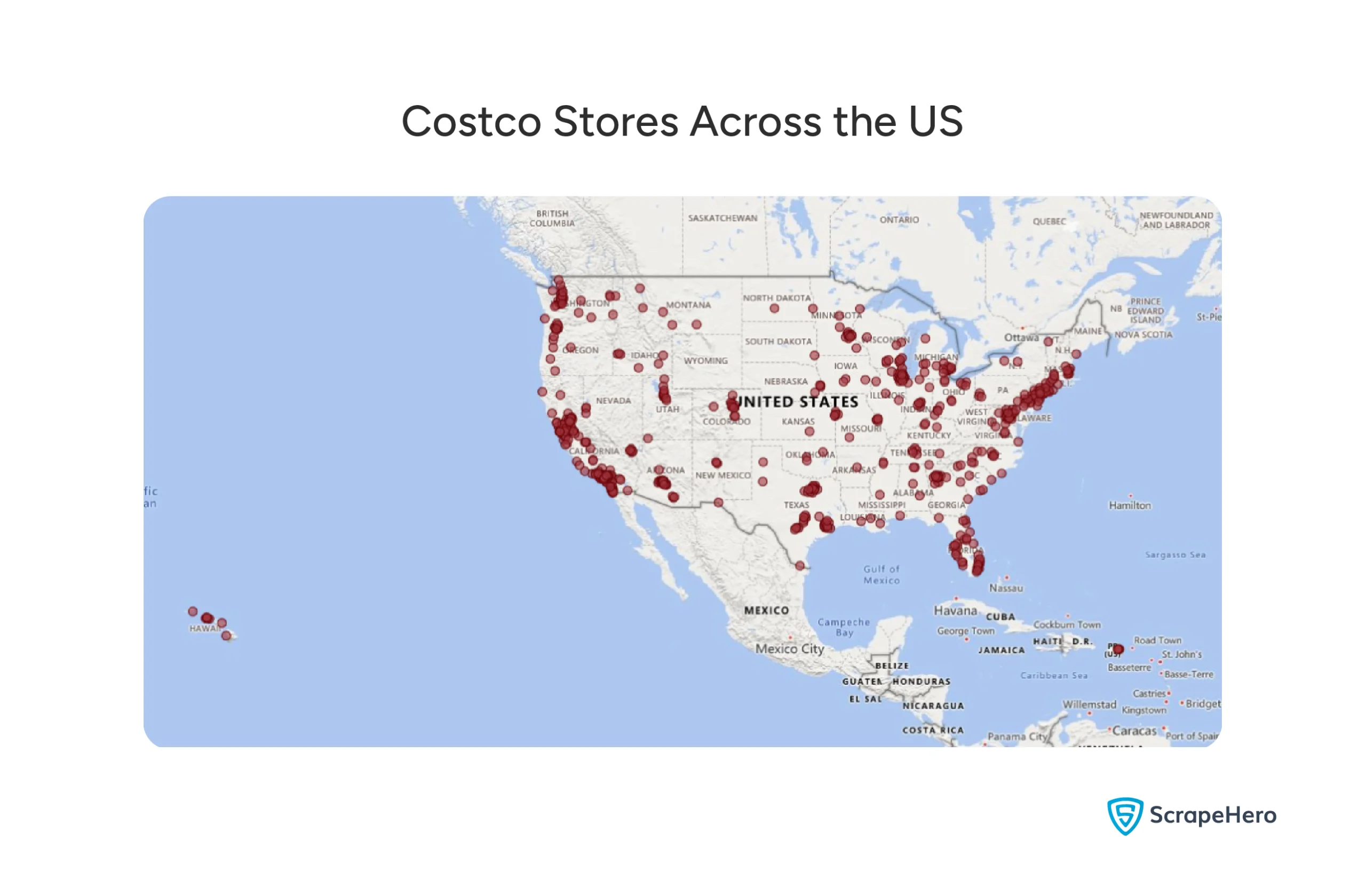
Distribution of Costco Stores in the US States
So, which US states have the most Costco stores?
California has the most Costco stores in the US.
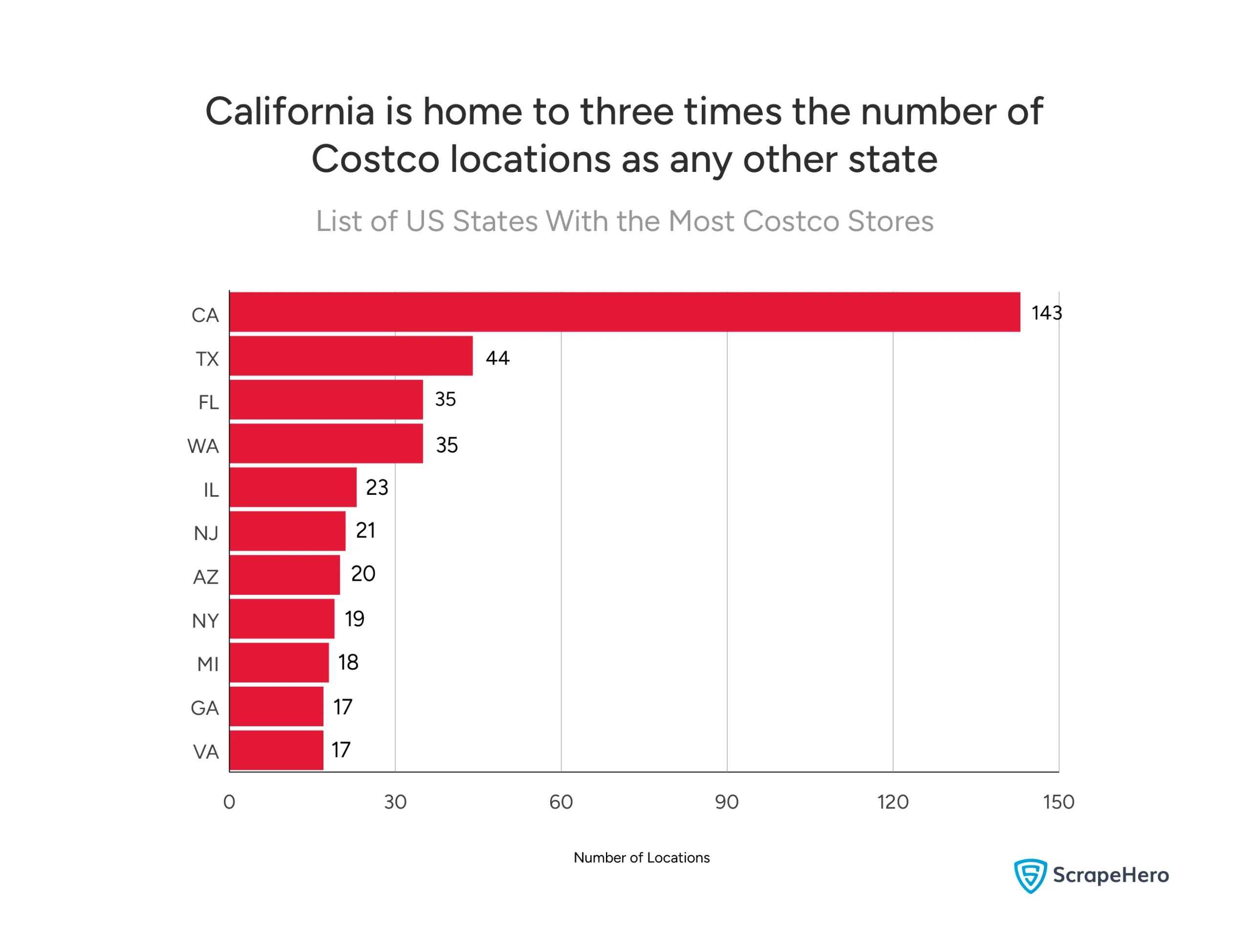
California is the undisputed heart of Costco’s operations. With 143 locations, it holds more warehouses than the next three highest states (Texas, Florida, and Washington) combined.
The list of the top 10 states with the highest number of Costco stores in the US includes:
- California- 143 locations
- Texas- 44 locations
- Florida- 35 locations
- Washington- 35 locations
- Illinois- 23 locations
- New Jersey- 21 locations
- Arizona- 20 locations
- New York- 19 locations
- Michigan- 18 locations
- Georgia- 17 locations
- Virginia- 17 locations
Understanding Costco’s Store Expansion Rate in the US
Key Phases of the Costco Scale-Up:
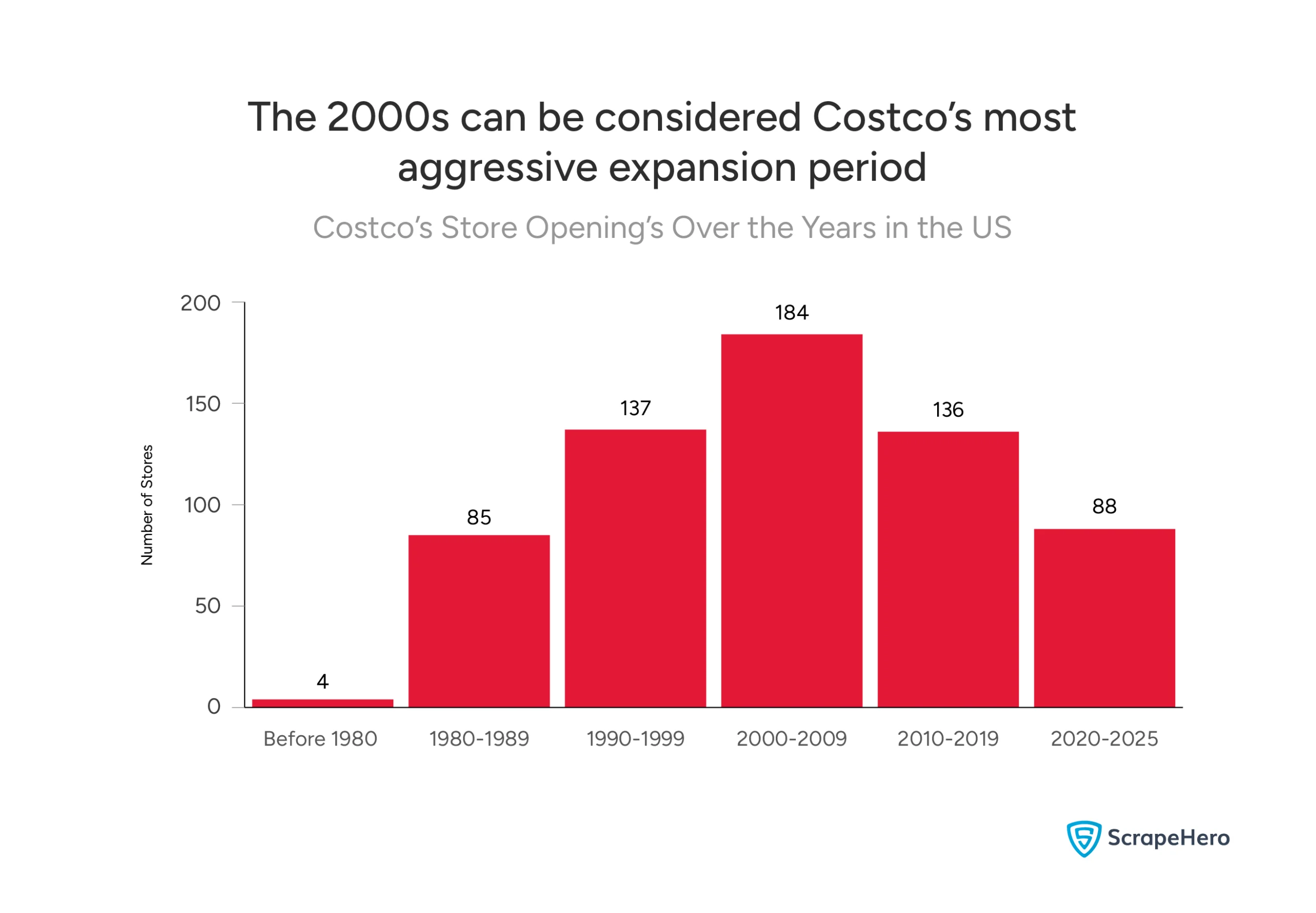
- The Early Foundations (Pre-1990): In its earliest years, Costco operated with a very lean footprint, with only 4 stores existing before 1980. The 1980s marked the first real sign of momentum, as the company added 85 locations to its network.
- The 90s Momentum: Expansion began to pick up speed through the 1990s, with 137 new warehouses opening across the country.
- The “Golden Era” of Growth (2000–2009): This decade represents Costco’s most aggressive expansion period, seeing the biggest jump in history with 184 new stores.
Sustained Modern Expansion (2010–2025): Growth remained consistently strong in the 2010s with 136 openings. Even into the 2020s, Costco has continued its upward trajectory, adding 88 more locations by 2025, proving that the warehouse model still has significant room to run in the modern retail landscape.
Other Services Available at Costco’s US Locations
Aside from bulk and brand-name products, the primary advantage of visiting a Costco warehouse is the access to a wide range of essential services they offer. These services make Costco a “one-stop shop” for household and professional needs.
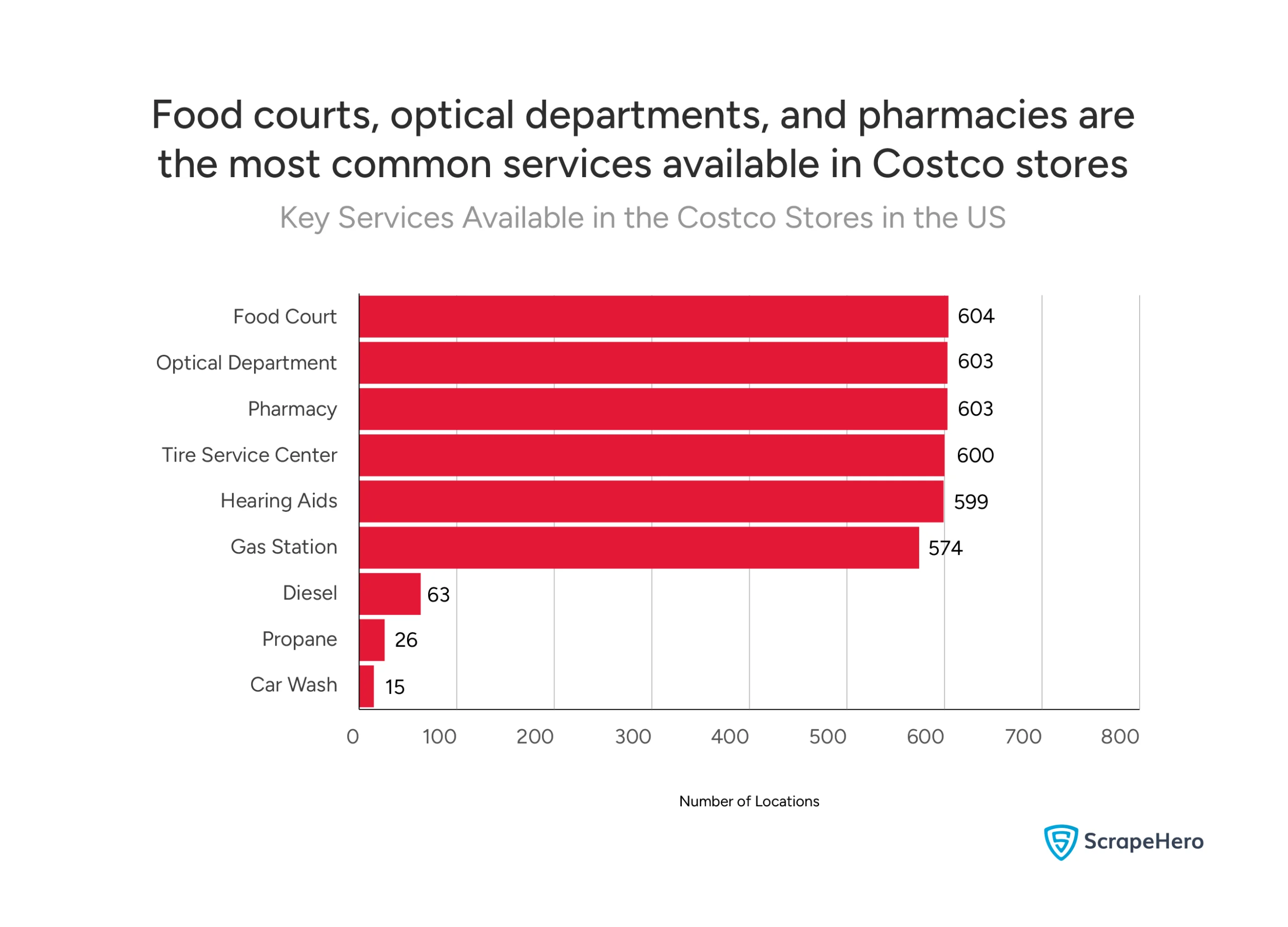
Most Costco locations in the US offer the following specialized departments:
- Food Court: Found in 604 locations.
- Optical Department: Available at 603 locations for eye exams and eyewear.
- Pharmacy: Present in 603 warehouses, providing prescription services and health essentials.
- Tire Service Center: Operating at 600 locations.
- Hearing Aid Center: Available at 599 warehouses for specialized auditory care.
- Gas Stations: Located at 574 warehouses.
A select number of warehouses offer extra specialized services:
- Diesel Pumps: Available at 63 locations.
- Propane Refills: Offered at 26 locations.
- Car Wash: Available at 15 locations.
How Does Costco Compare to Its Competitors?
Costco’s US Market vs Competitors: Based on Number of Locations:
When comparing store counts, Costco’s footprint appears modest next to retail giants like Target and Kroger.
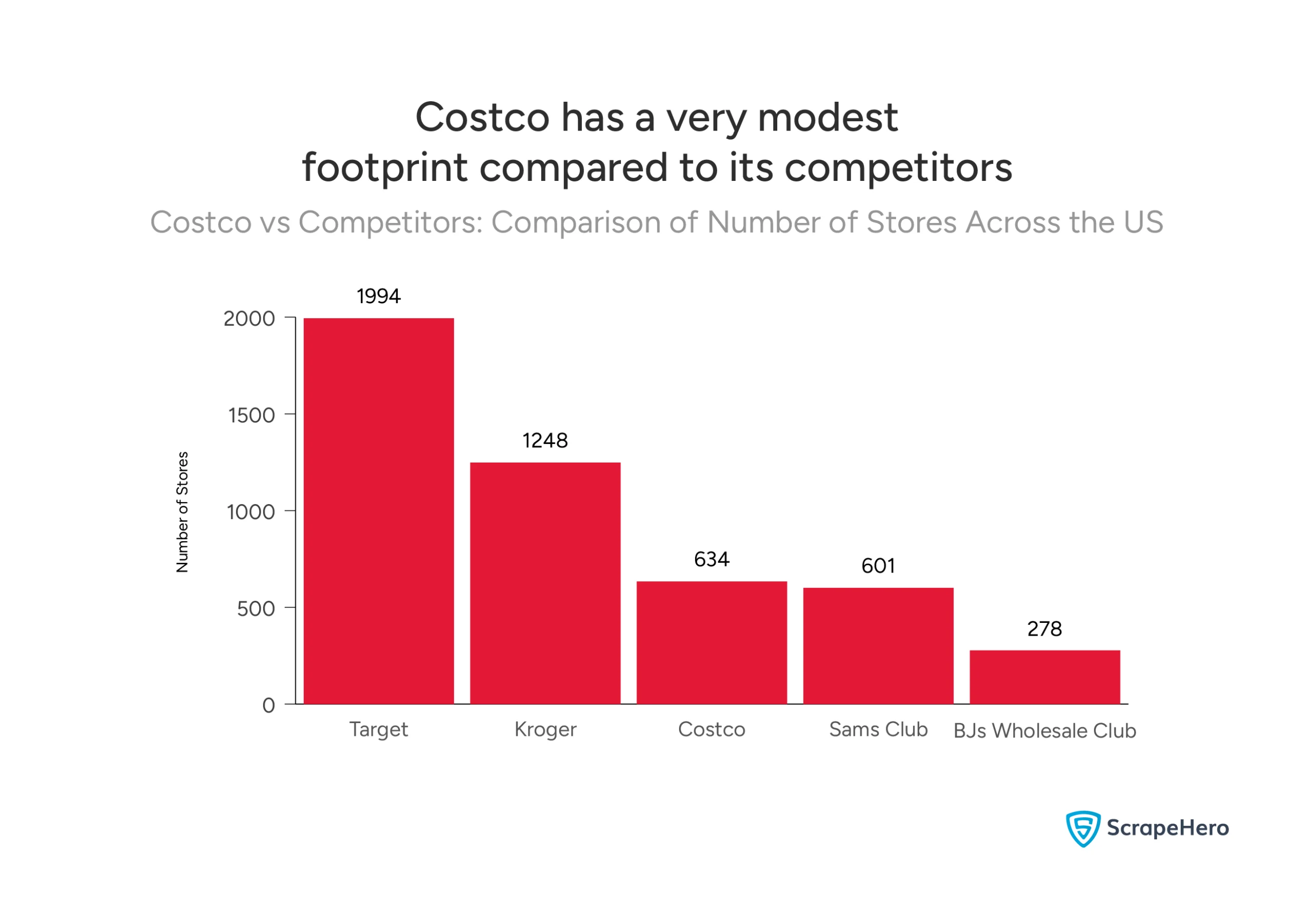
Costco operates 634 stores in the US. This is significantly fewer than Target, which leads with 1,994 stores, and Kroger, which runs 1,248 locations.
Fun fact. Unlike its competitors, which have a presence in more than half of the US states, Kroger has a presence in only 16 states. Read the location analysis of Kroger vs. competitors in the US here.
Costco’s US Market vs Competitors: Based on Total Revenue
While store counts and geographic reach provide a sense of scale, the true measure of Costco’s efficiency lies in its financial performance.
Our analysis reveals a “less is more” phenomenon: Costco produces industry-leading revenue with a fraction of the physical infrastructure used by its competitors.
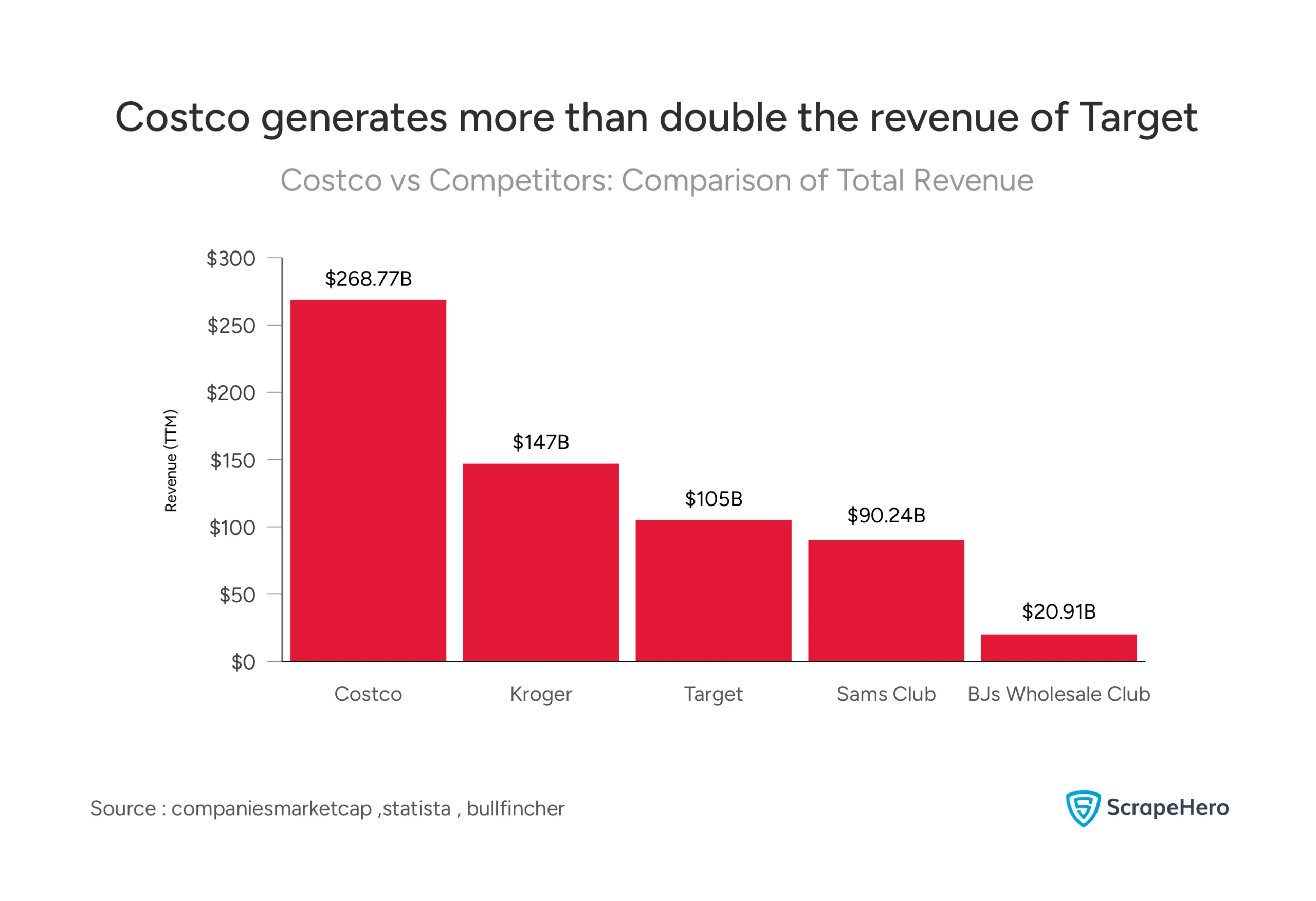
In a direct comparison of total revenue, Costco stands as the undisputed leader among the analyzed retail giants:
- Costco: $268.77B
- Kroger: $147B
- Target: $105.64B
- Sam’s Club: $90.24B
- BJ’s Wholesale Club: $20.91B
The disparity between store count and revenue highlights Costco’s superior operational efficiency. To put this in perspective:
- Target operates nearly 2,000 stores but generates only $105.64B.
- Costco generates $268.77B, more than double Target’s revenue, with only 634 locations.
- This means a single Costco warehouse generates significantly more value on average than a standard retail location from Target or Kroger.
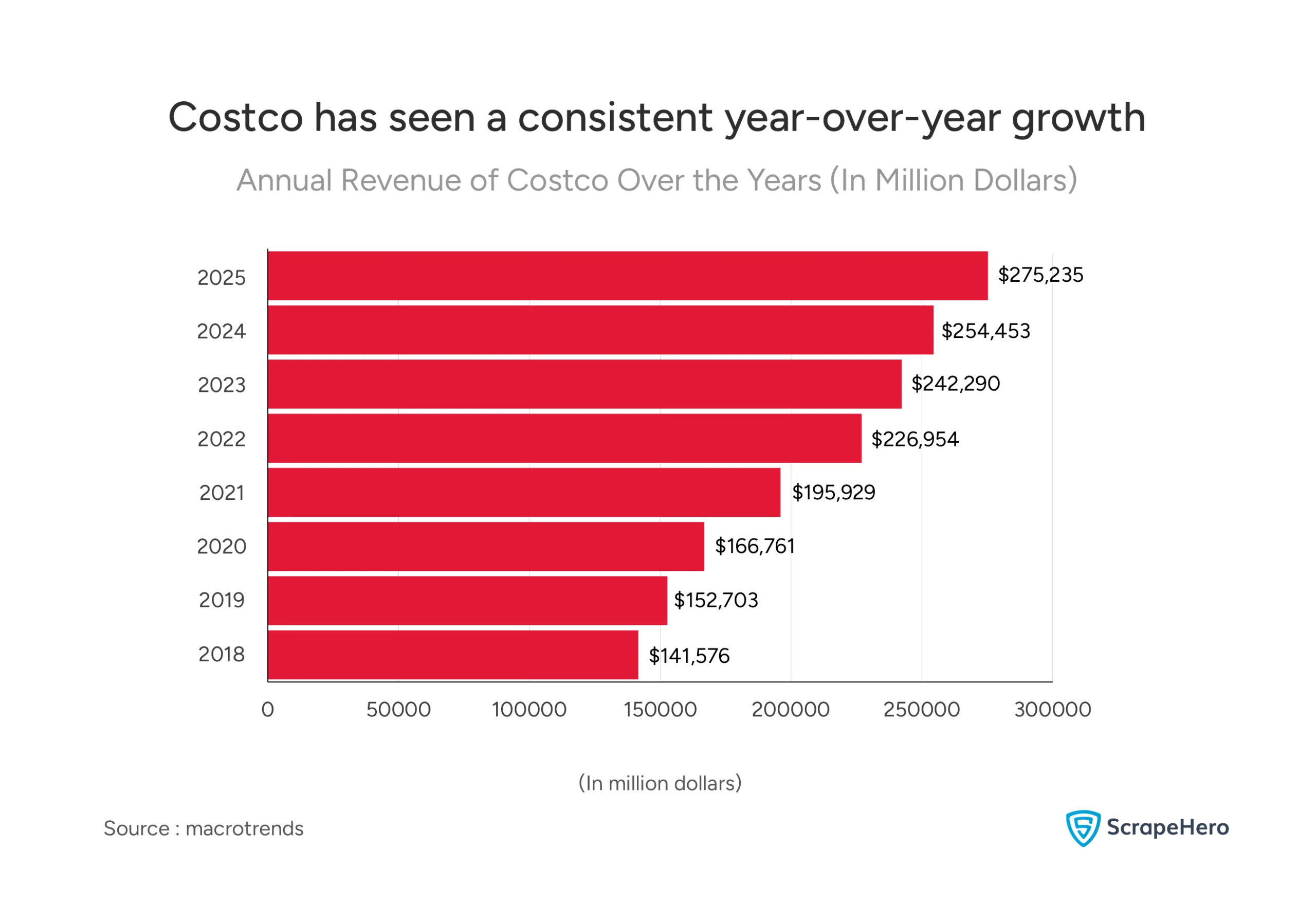
Revenue Growth of Costco Over the Years
This Costco US Market analysis highlights consistent year-over-year growth, showing how the company has nearly doubled its revenue in less than a decade:
- 2018–2020: Revenue grew from $141.6B to $166.8B.
- The 2021 Pivot: Revenue jumped significantly to $195.9B, marking the beginning of a period of rapid acceleration.
- Breaking the $200B Barrier: By 2022, revenue hit $226.9B, continuing its climb to $242.3B in 2023.
Current Performance (2024–2025): The momentum has not slowed, with revenue reaching $254.5B in 2024 and hitting a staggering $275.2B in 2025.
What Did This Costco US Market Analysis Reveal?
This comprehensive analysis reveals that Costco’s dominance in the US retail landscape is not built on having the most storefronts, but on extreme operational efficiency and strategic geographic concentration.
While competitors like Target and Kroger operate significantly more locations, Costco has managed to outperform them financially by focusing on high-performing warehouses in key markets.
Key Takeaways from the Analysis:
- Efficiency Over Volume: Despite operating only 634 stores—a fraction of Target’s nearly 2,000, Costco generates the highest revenue among its main competitors, reaching $268.77B. A single Costco warehouse generates substantially more value on average than a standard retail location from its rivals.
- Strategic Regional Dominance: Costco’s “quality over quantity” approach is most visible in California, which serves as its operational heart with 143 locations—more than the next three highest states combined.
- The “One-Stop Shop” Value Proposition: Almost every warehouse provides essential services beyond bulk groceries, including food courts (604 locations), optical departments (603), pharmacies (603), and gas stations (574). This integration makes Costco a convenient, high-utility destination for household needs.
- Consistent, High-Speed Growth: The analysis highlights a powerful financial trajectory, with revenue nearly doubling from $141.6B in 2018 to $275.2B in 2025.
In conclusion, the report confirms that Costco is a national retail powerhouse with a unique “less is more” strategy.
By leveraging a high-volume bulk-shopping model and a dedicated member base, Costco has solidified its position as one of the most efficient and profitable corporations in the United States.
Want to Do a Similar Analysis?
This Costco US market analysis has quantified its strategy across physical retail density, national reach, service availability, and long-term revenue efficiency.
Manually compiling this data, from tracking 634 warehouse locations across 540 cities to benchmarking financial performance against giants like Target and Kroger, is a monumental task that requires significant time and research.
The reality of modern market intelligence is that it requires data at scale. To truly understand competitor performance and your own market position, you need accurate, up-to-the-minute data on:
- Store Counts and Expansion Strategies: Identifying exactly where competitors are growing and where they are maintaining strong regional strongholds, such as Costco’s dominance in California.
- Service and Amenity Benchmarking: Tracking non-product offerings like pharmacies, gas stations, and optical centers that drive recurring foot traffic and member loyalty.
- National vs. Regional Reach: Analyzing store distribution across states to distinguish between true national retailers and those with more regional focuses.
- Revenue Efficiency Metrics: Understanding how total revenue relates to physical store footprints to uncover hidden operational efficiencies.
This is where a specialized data service becomes essential. Instead of manually tracking hundreds of data points from disparate sources like financial reports and store locators, you can access ready-to-analyze data that delivers clear, actionable insights.
For businesses that need similar competitive intelligence, specialized web scraping services like ScrapeHero handle the complexity of large-scale data collection.
We navigate thousands of web pages, extract accurate information, and deliver it in a structured format, saving you the time and resources required for in-house data gathering. The alternative- building and maintaining your own data collection infrastructure- means diverting focus from your core goal: strategic analysis and decision-making.
When you need data effortlessly, outsourcing to a specialized web scraping service is simply the smarter choice. You get the data without the infrastructure.
Report by ScrapeHero using publicly available data. This report is independent and not affiliated with Costco Wholesale Corporation.
Frequently Asked Questions
There are 634 Costco locations across 540 cities in the US.
California is the state with the most Costo locations with 143 warehouses
Rhode Island, West Virginia, and Wyoming currently have no Costco locations.
The data shows the biggest jump occurred in Costco expansion between 2000 and 2009, with 184 new stores opened.
This analysis reveals Target has significantly more at nearly 2,000 stores compared to Costco’s 634.
The report proves Costco earns the highest revenue among these competitors at $268.77B.
Yes, our analysis reveals that it operates in 49 states, making it a national presence.
The analysis provides specific numbers: 604 locations have food courts and 574 have gas stations in the US.
The data lists optical departments, pharmacies, tire centers, hearing aid services, and even car washes at select locations .
The analysis tracks revenue from $141.6B in 2018 to $275.2B in 2025.