We all know the big names in luxury, the brands we see in magazines and on celebrities.
But keeping track of US luxury brand performance isn’t that simple.
Is it about the most stores, the highest prices, or the best online reviews? To truly understand the US luxury goods market analysis, you have to look at the real numbers.
So we looked at the numbers behind five major players: Gucci, Hermès, Louis Vuitton, Prada, and Tiffany & Co.
We’re breaking down the latest luxury retail performance in the US across different areas to see who’s leading the pack. By looking at the key luxury market trends in the US, we can cut through the hype.
For instance, a big part of a brand’s strength is its physical presence. Did you know that Louis Vuitton has more stores in the US than any other brand, with 121 locations? That’s a powerful start.
Data sources:
- POI data from ScrapeHero Data Store
- Product details of the brand listings on Walmart from ScrapeHero Cloud Walmart Search Results Scraper
- Product details of the brand listings on Amazon from ScrapeHero Cloud Amazon Search Results Scraper
- Fashion Network
Let’s dig deeper and see which brand truly rules the market.
The Financial Benchmark: Top Brand by Value and Growth
When it comes to the US luxury brand performance, the first question is: which brand is the most valuable? Think of this as the brand’s financial report card.
Our analysis of the US luxury goods market for 2025 shows a clear winner and a surprising contender.
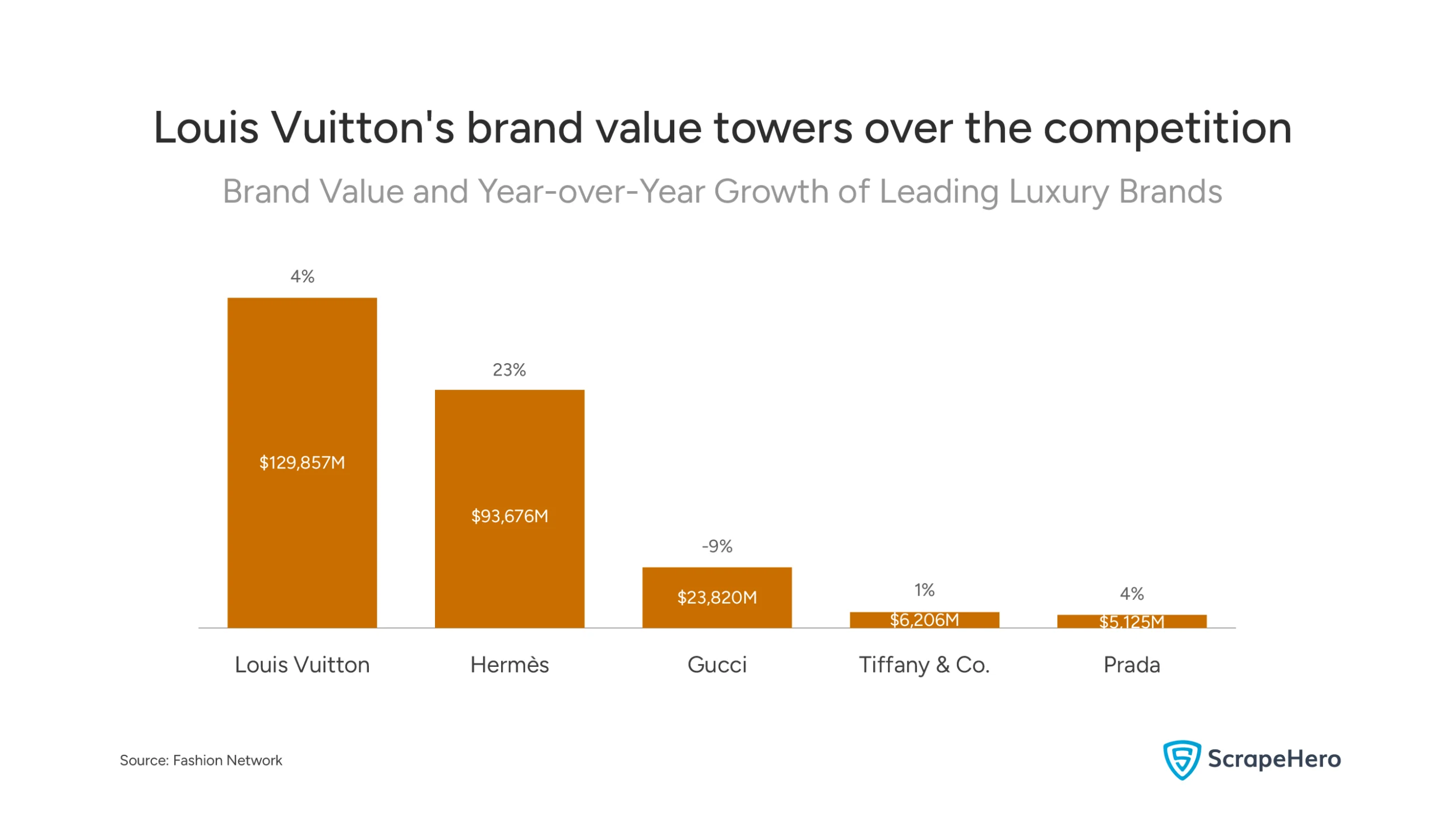
So, who’s the winner? When you look at pure brand value, the answer is simple: Louis Vuitton is number one. They’re the financial giant of the group.
But the most interesting part of the story isn’t just who has the biggest pile of cash, it’s who’s growing the fastest.
- That title goes to Hermès, which grew a huge 23% last year.
- They’re the brand with all the momentum right now.
On the flip side, not every brand is on the rise.
- Gucci was the only one in the group that lost value, with a 9% drop.
This just goes to show that in the luxury world, even the biggest names have to keep working to stay on top.
So, what’s the takeaway?
If “top” for you means the biggest and most valuable, it’s Louis Vuitton. But if you mean the most exciting and fastest-rising brand, then Hermès is the one to watch.
Retail Footprint: Top Brands for Physical Reach
A huge part of a brand’s power is its physical presence.
To understand US luxury brand performance, we need to see where the stores are.
A key part of our US luxury goods market analysis is looking at who has the best locations in the wealthiest and most visited parts of the country.
Let’s start with where the money is.
Store Count in the Wealthiest States
Where do you put a store to reach the richest customers? In the states with the highest GDP per capita.
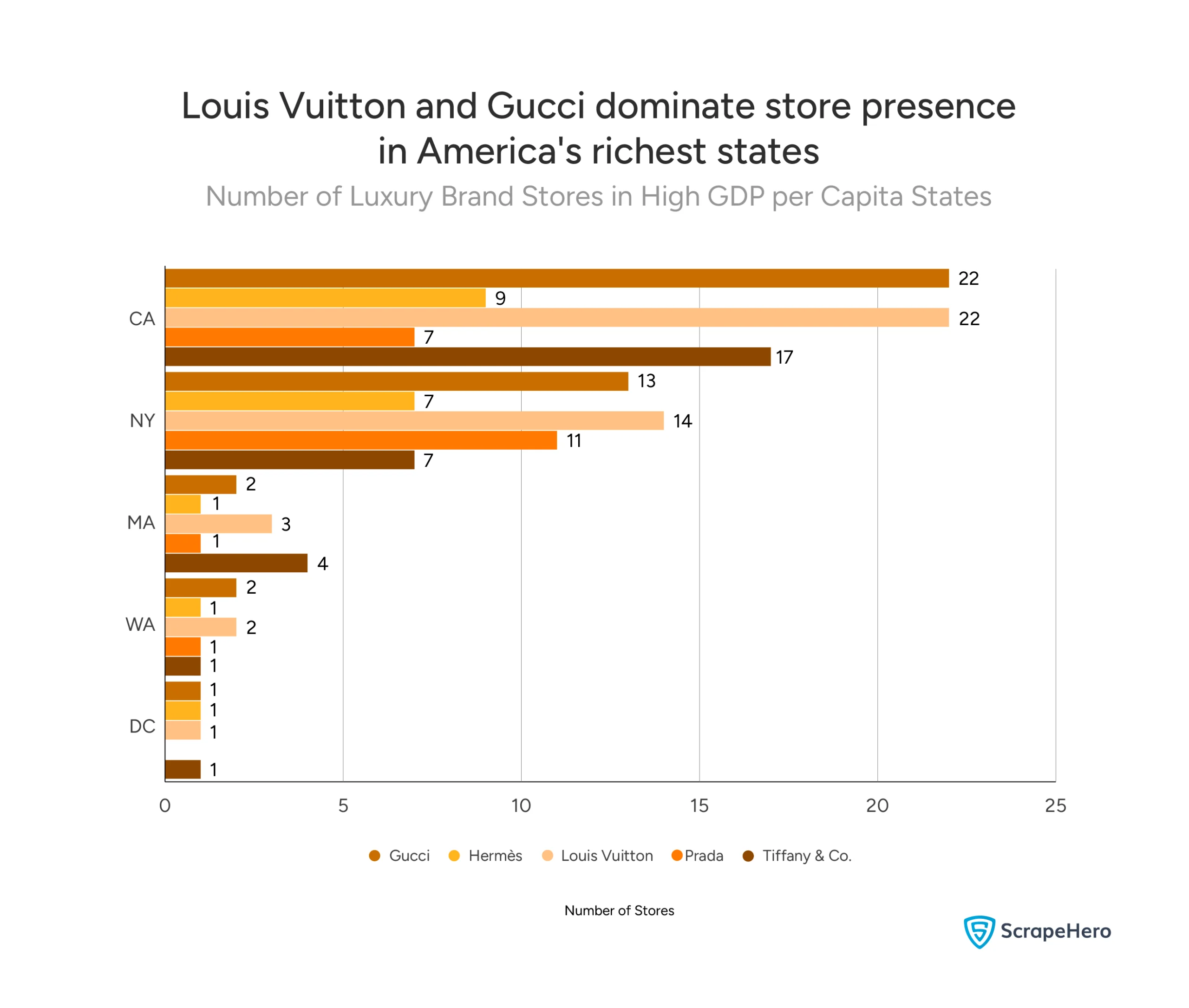
The data shows that Louis Vuitton and Gucci have cracked the code.
- Louis Vuitton and Gucci are the top brands here, tied for the lead.
- They have a massive 22 stores each in California alone, the state with the highest GDP.
- This heavy presence in wealthy areas is a major sign of strong luxury retail performance in the US.
But the map also shows some gaps:
- Prada is the only brand in this group that doesn’t have a store at all in Washington, D.C., another wealthy area.
- This suggests a more selective strategy compared to the widespread presence of Louis Vuitton and Gucci.
The bottom line? Based on their strategic placement in the wallets of America, Louis Vuitton and Gucci are the leaders. They understand that to win in luxury, you have to be where the money is.
Store Count in the Most Visited Cities
Luxury markets aren’t limited to where people live; they’re also extended to where they vacation. Tourists are often ready to spend, and a key luxury market trend in the US is having a strong presence in these busy cities.
Looking at the most visited cities in the US, a few things become clear:
- Las Vegas is the central hub for luxury shopping. The combined store count for these brands is higher here than anywhere else.
- In this, Louis Vuitton has taken the lead, with 8 stores.
- Gucci is also a major player in these tourist centers, showing up strongly in almost every major city on the list.
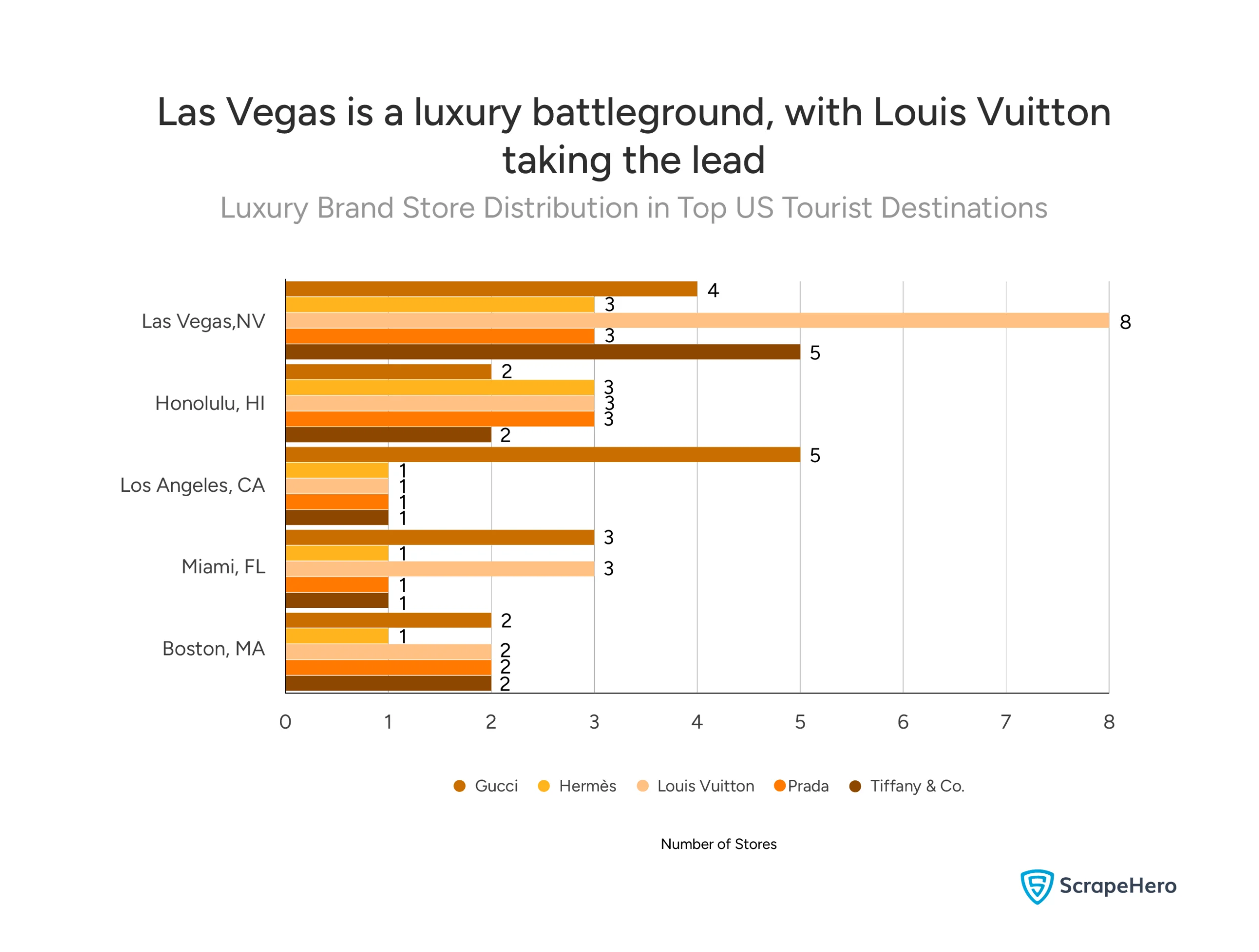
But there’s one city that stands out for its exclusivity:
- Only Louis Vuitton has a store in New York City according to this data, which is a huge statement in a city known for its shopping.
So, who wins in physical reach?
When you combine their dominance in wealthy states with their strong showing in tourist hubs, Louis Vuitton and Gucci are the top brands for overall physical presence.
They’ve built a network that catches customers whether they’re at home or on vacation, which is a massive part of their US luxury brand performance.
Want to compare the list of all Gucci store locations in the US with the store locations of Louis Vuitton for a better picture?
E-Commerce Landscape: Luxury Brand Presence in the Secondary Market
A large portion of the US luxury market is now fueled by the secondary or resale market, and this activity often takes place on major platforms.
Since these brands strictly control their distribution and do not sell directly on Amazon or Walmart, the data below reflects the market’s perception and reality of third-party and pre-owned listings on these platforms.
Amazon Marketplace: Third-Party Listing Performance
Shopping for luxury on Amazon is a different ball game, often navigating third-party listings and the secondary market. The data here reflects the performance of these listings, revealing a clear trade-off between price and customer satisfaction.
- Louis Vuitton listings show the top performance for pricing power, standing alone with the highest average price by a significant margin ($1 163.6).
- However, Louis Vuitton’s average rating on these third-party listings is a low 3.2. This is far below the other brands, which all maintain strong average ratings around 4.5.
A comparison of five luxury brands on Amazon shows that the Louis Vuitton secondary listings command the highest average price but suffer from a significantly lower customer rating below 4. The other four brands are clustered closely with high ratings and more affordable average prices.
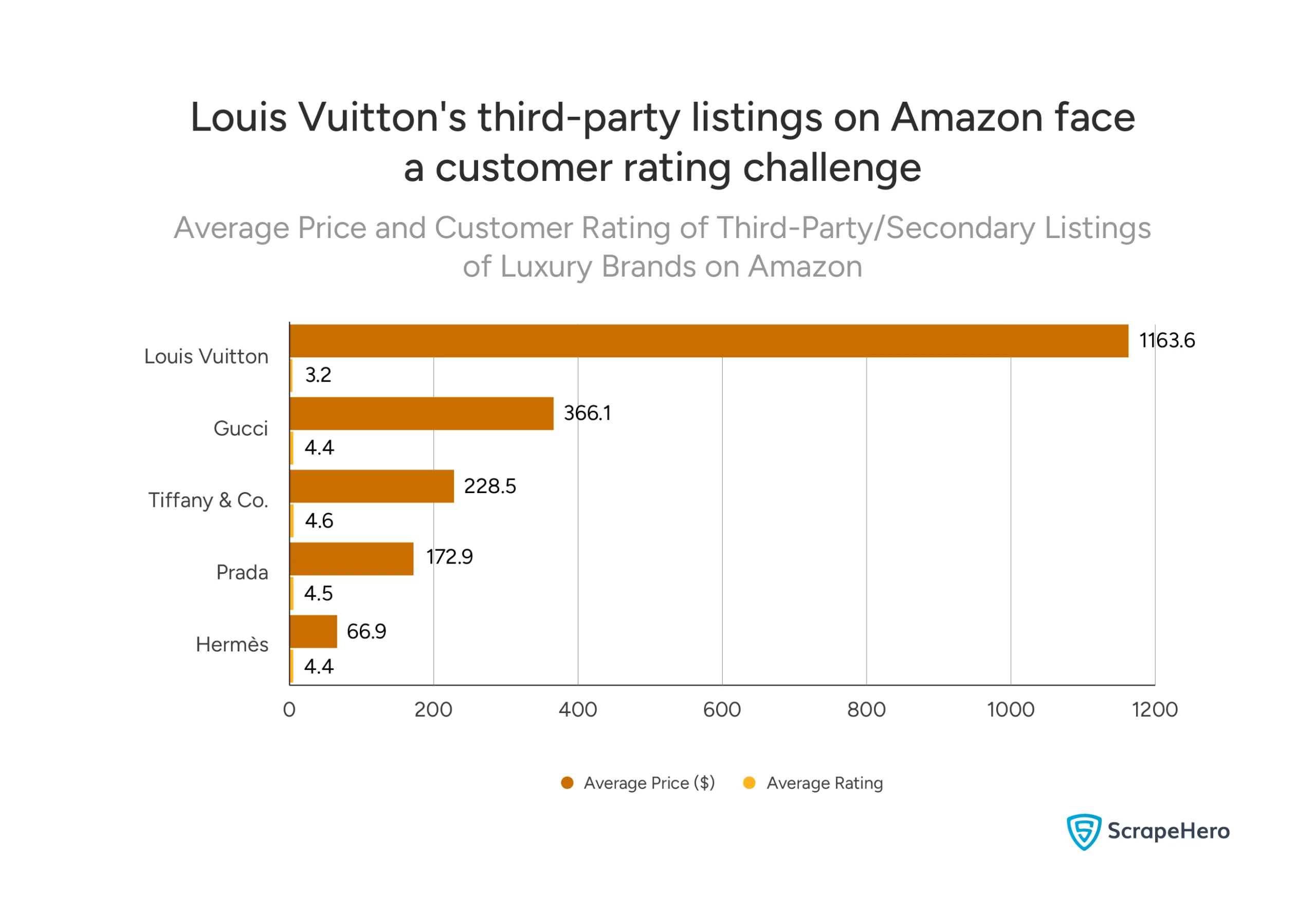
This suggests that while Louis Vuitton’s listings maintain its premium pricing status even in the third-party online marketplace, the actual customer experience of acquiring its products through these listings on Amazon might be lacking.
For shoppers looking for a better balance:
- Tiffany & Co. listings have the highest customer rating (4.6) on Amazon.
- Hermès third-party listings offer the most affordable average price among the group on this platform.
This split is a key insight for luxury retail performance, demonstrating that a high price tag from a third-party seller online doesn’t always translate to a happy customer experience.
Third-Party Listing Performance of Luxury Brands on Walmart
Okay, let’s talk about Walmart. While it might not be the primary destination for luxury retail, this platform offers an interesting view into the secondary market performance of these brands.
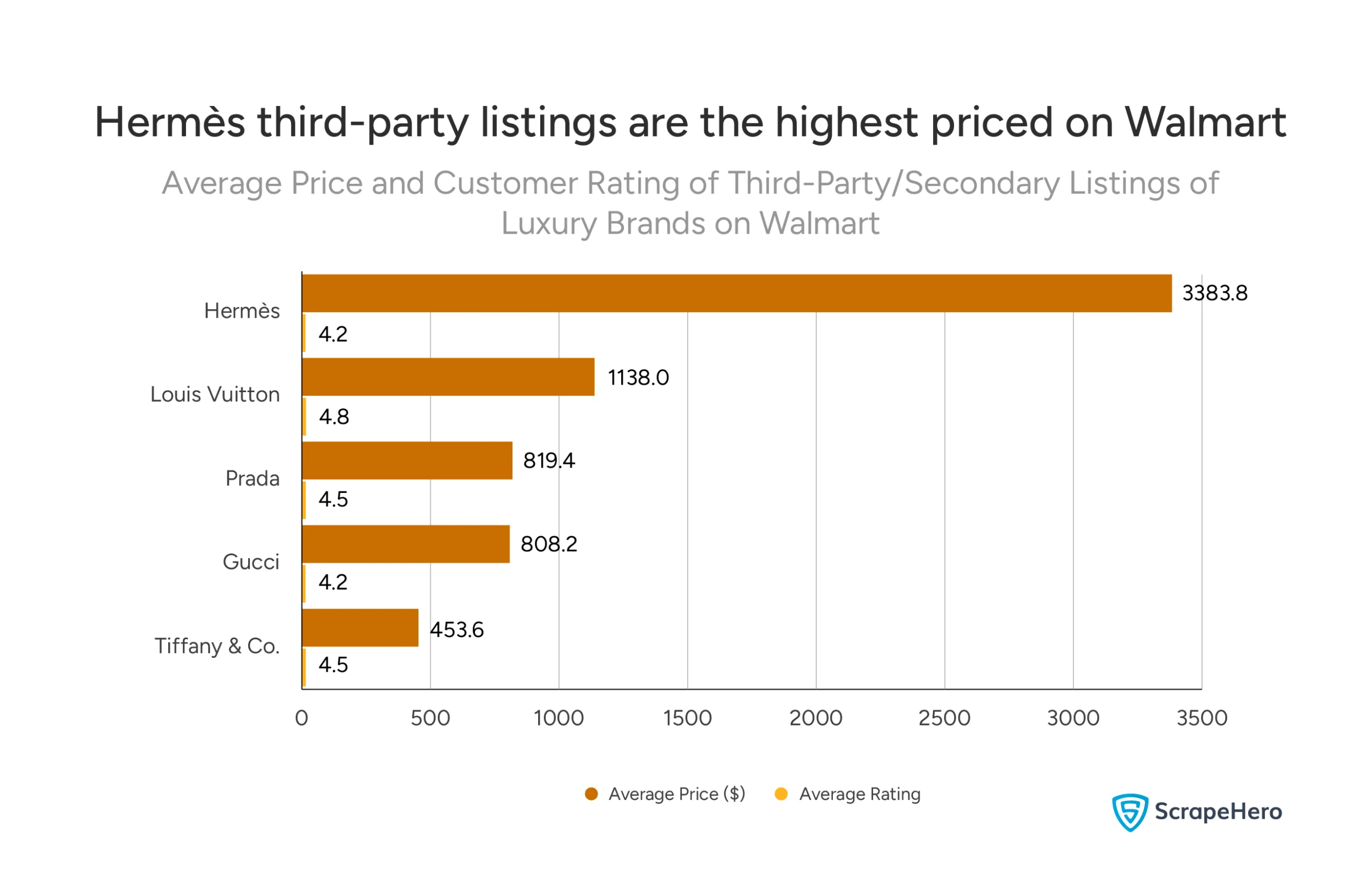
Here’s the simple breakdown of what we see among the third-party listings:
- Hermès listings are the most premium-priced among this group. Its average cost is significantly higher than that of the other brands’ secondary listings on Walmart.
- Customers generally seem satisfied with their secondary market purchases. All the listed brands have very strong ratings, but Louis Vuitton listings boast a near-perfect score (4.8) from its customers on this platform.
- Tiffany & Co. listings represent the most affordable option here.
Analysis of Luxury Product Categories in Amazon’s Third-Party Market
Now, let’s look at what types of third-party listings people are actually buying on Amazon. The competition in this secondary marketplace is concentrated around specific product types.
Here are the main categories we see being listed:
- Fragrance is the biggest category by far among the listings. Eau de Parfum has the most products listed across all the brands.
- Sunglasses are the second most popular category among the third-party offerings, but only the listings under the names of two brands—Louis Vuitton and Gucci—have significant numbers of them listed on Amazon.
Categories like Body Wash and Soap also appear in the third-party market.
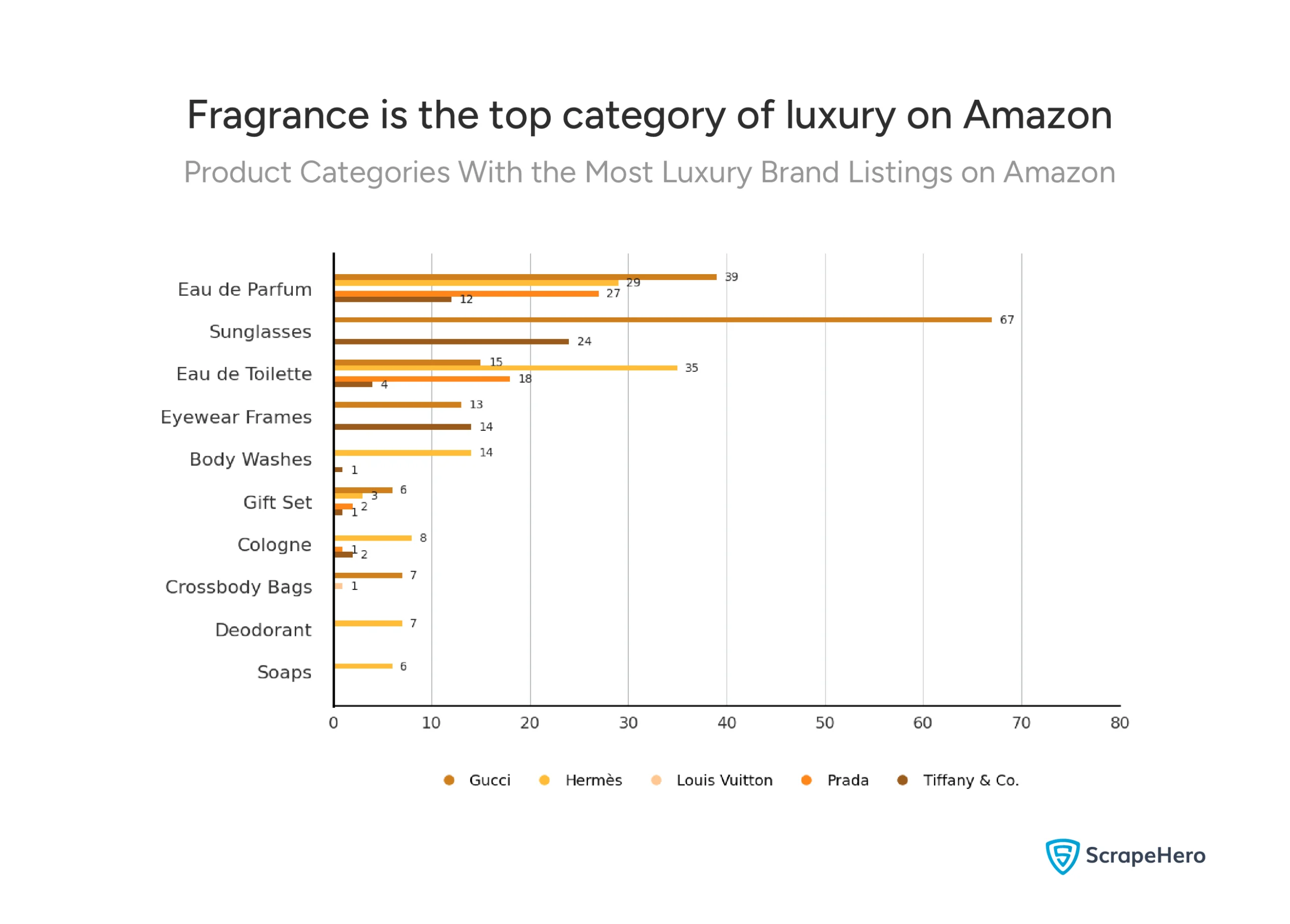
Eau de Parfum is the largest category of luxury goods offered by third-party sellers on Amazon, with the listings of multiple brands represented. Sunglasses are the second most popular category, but only the listings under two brands are available.
This shows that, for luxury secondary retail performance on Amazon in the US, fragrance is the main battleground.
Analysis of Luxury Product categories in Walmart’s Third-Party Market
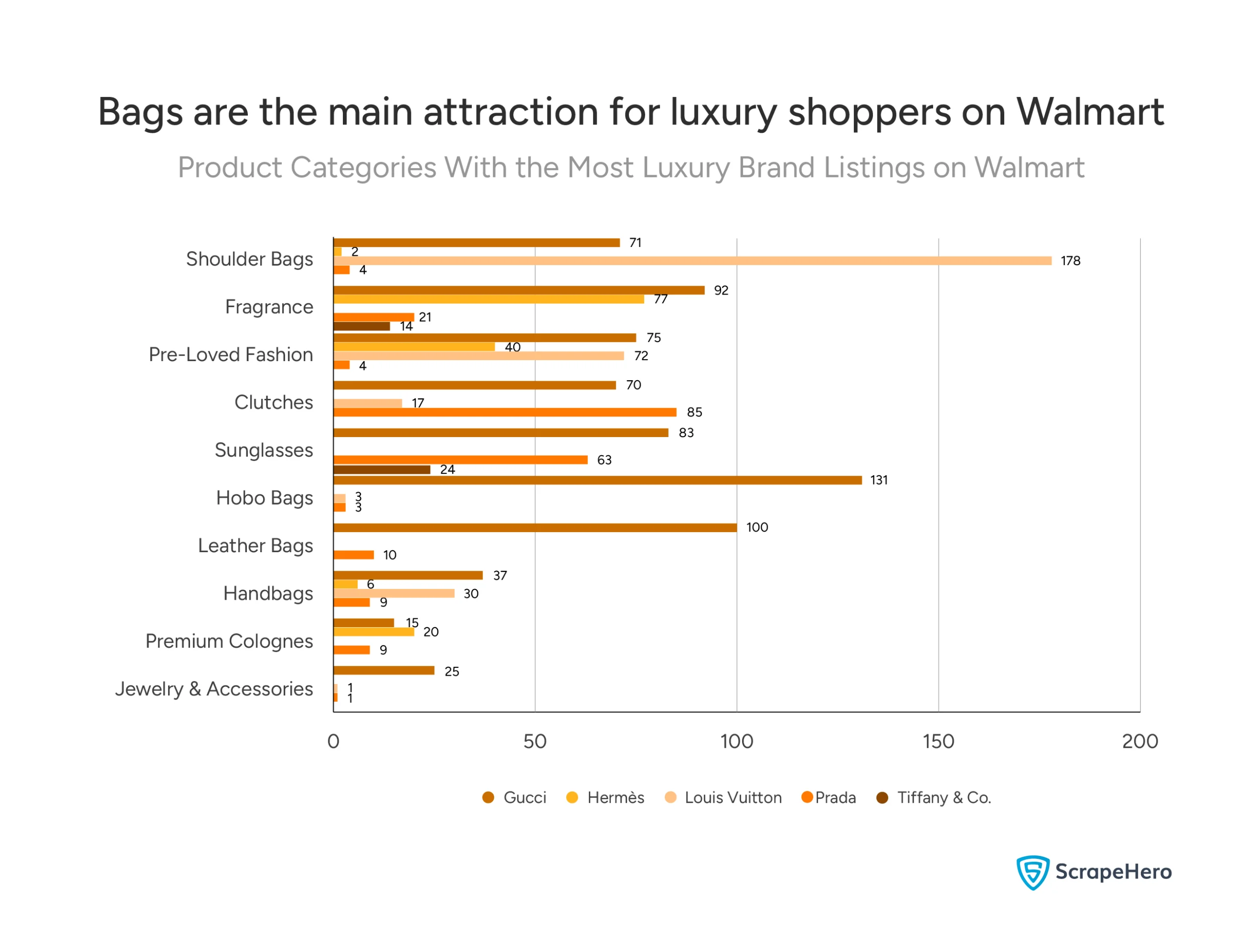
The product categories among the third-party listings on Walmart tell a different story than those on Amazon:
- Bags dominate the top categories available through independent sellers. Shoulder Bags, Hobo Bags, and Clutches are all at the top of the list of listed products.
- Louis Vuitton listings have the highest count of products in the Shoulder Bags category.
Gucci has listings across the widest range of bag categories, including Shoulder Bags, Clutches, Leather Bags, Handbags, and Hobo Bags.
Verdict: So, Who is the True Top Luxury Brand in the US?
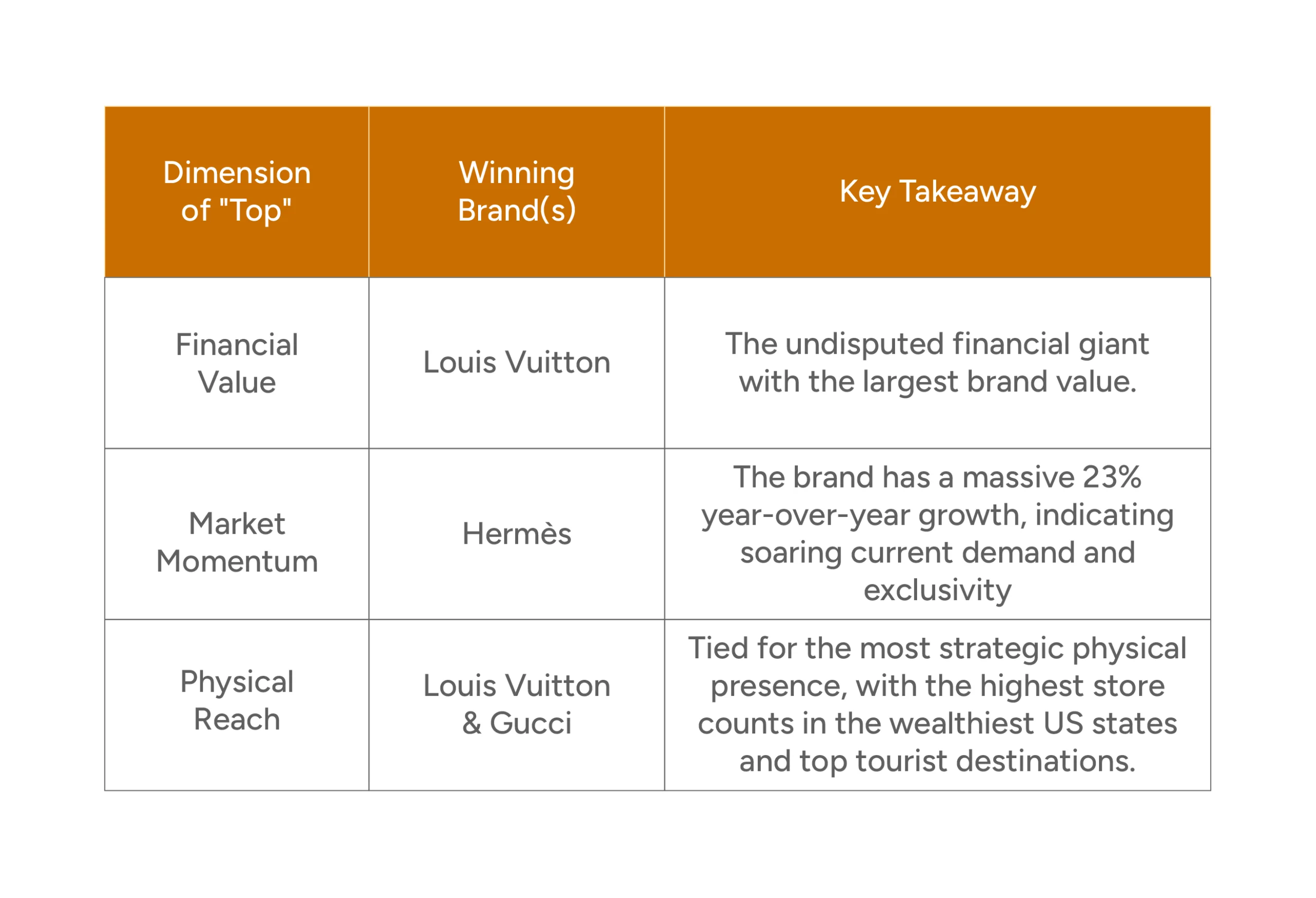
The simple answer is that there is no single “Top” luxury brand; there are three leaders, each dominating a different, critical dimension of the US luxury market: Value, Reach, and Momentum.
Final Verdict
Based on our criteria of Value, Price, and Reach:
The overall winner for Legacy and Scale is Louis Vuitton.
The winner for Growth and Ultimate Exclusivity is Hermès.
Ultimately, success in the US luxury market is no longer a single-lane race. The top brands are defined by their ability to dominate a unique axis of the market, whether it’s the financial report card, the brick-and-mortar footprint, or the emerging, complex world of the secondary online marketplace.
How Was this Analysis Possible? Getting Reliable Luxury Market Data
Throughout this analysis, we’ve examined store locations, pricing, customer ratings, product counts, and category distributions across five major luxury brands.
Compiling this data manually would take weeks—if not months—of work.
The reality is that comprehensive luxury market analysis requires data at scale. You need store counts in every state, pricing from multiple e-commerce platforms, product category breakdowns, and customer ratings—all current, accurate, and structured for analysis.
This is where a web scraping service becomes invaluable.
Instead of manually visiting hundreds of store locator pages or checking prices across platforms, the data arrives ready for analysis.
For businesses that need similar market intelligence, a web scraping service like ScrapeHero handles the heavy lifting: navigating complex websites, extracting data at scale, ensuring accuracy, maintaining updates, and delivering information in usable formats.
No software to install, no technical expertise required, no time spent on data collection.
The alternative, building an in-house scraping operation or manually gathering data, means diverting resources from what actually matters: analyzing the market and making strategic decisions.
When you need data effortlessly, outsourcing to a specialized web scraping service is simply the smarter choice. You get the insights without the infrastructure.
Frequently Asked Questions
Louis Vuitton leads with 121 locations across the US, giving it the widest physical retail footprint among the five brands analyzed.
Louis Vuitton holds the highest brand value among the five brands studied, making it the financial leader in the group.
Hermès showed the strongest growth momentum with a 23% year-over-year increase in brand value, significantly outpacing competitors.
Luxury brands focus heavily on wealthy states and tourist destinations. California hosts the most stores, with Louis Vuitton and Gucci each operating 22 locations there. Las Vegas is the top tourist city for luxury retail, with Louis Vuitton leading with 8 stores.
Fragrance dominates on Amazon, with Eau de Parfum being the largest category. Sunglasses come in second, though only Gucci and Tiffany & Co. sell them on this platform.
Bags are the main attraction on Walmart, with Shoulder Bags, Hobo Bags, and Clutches leading the category rankings.
This varies by platform. On Amazon, Tiffany & Co. has the highest customer rating at 4.6. On Walmart, Louis Vuitton leads with a 4.8 rating.
Hermès offers the most affordable average price on Amazon among the five brands. On Walmart, Tiffany & Co. is the most budget-friendly option.
Report by ScrapeHero using publicly available data. This report is independent and not affiliated with Gucci, Hermès, Louis Vuitton, Prada, or Tiffany & Co.